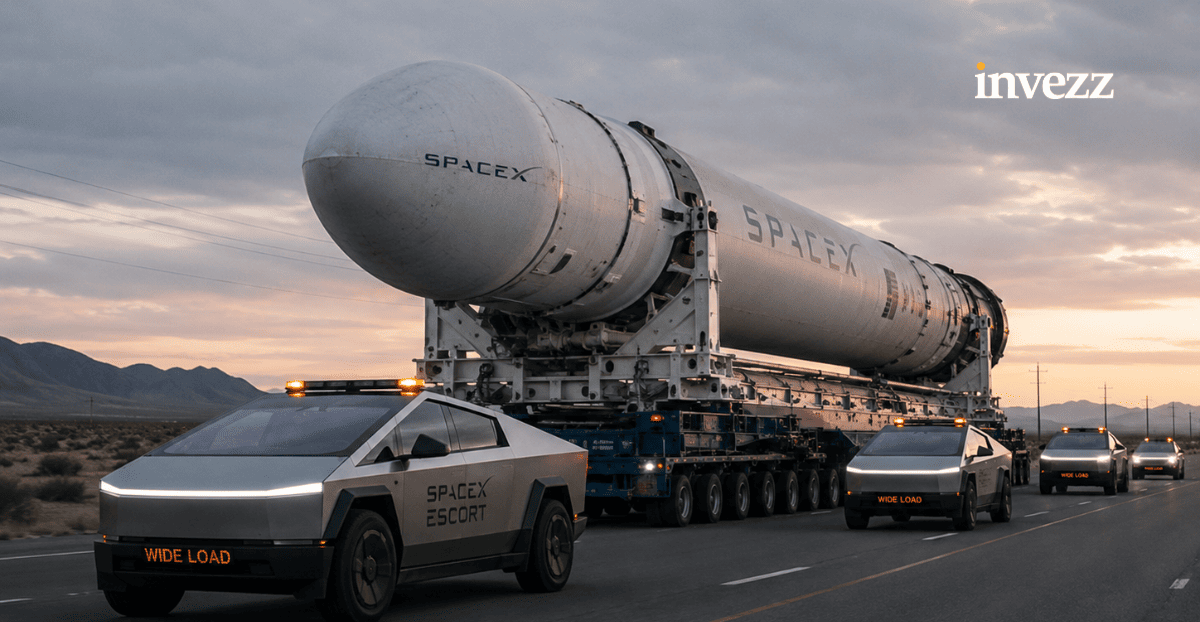
SpaceX is planning a major expansion of its computing infrastructure with a proposed $24 billion gas-fired power plant and artificial intelligence data centre at its Starbase facility in Texas, according to a Bloomberg report citing a local public hearing notice. The project would be built in phases, with room for further expansion, and represents one of the company's largest capital commitments outside its core launch business.
Starbase serves as SpaceX's primary manufacturing and launch site for its Starship rocket system. The company currently operates two data centres near the Tennessee-Mississippi border and closed the third quarter with 1.7 gigawatts of AI computing capacity. Management has outlined plans to scale that to roughly 3 gigawatts by the end of 2026 and as much as 10 gigawatts by the end of 2027.
Political shift in Texas raises approval risk
The timing of the proposal coincides with a change in Texas leadership. Incoming Governor Gina Hinojosa has advocated a moratorium on new hyperscale data centres and has proposed measures aimed at protecting residential electricity rates. While SpaceX intends to generate its own power through the planned gas-fired facility, the project would still require environmental and power-related approvals from state agencies, including the Texas Commission on Environmental Quality, the Public Utility Commission of Texas and the Electric Reliability Council of Texas.
Those approvals introduce a layer of regulatory uncertainty that could delay construction or force design changes. The outcome will depend on how the incoming administration balances industrial investment against its stated commitments on grid costs and residential ratepayers.
Starship recovery attempt could cut launch costs
Separately, SpaceX is preparing for its 15th Starship test flight, potentially as early as November 13. The mission is scheduled to launch from Starbase during a 75-minute window beginning at 5:45 p.m. Eastern Time. The flight will attempt to return both the Super Heavy booster and the Starship upper stage to the launch site, where mechanical arms on the launch towers would catch the vehicles. It would be the first planned recovery attempt involving a Super Heavy V3 booster.
SpaceX has previously caught three earlier-generation boosters during flight tests, with two of those subsequently flying again. The upcoming mission is expected to last more than 22 hours, with Starship reaching an altitude of approximately 275 kilometres and completing around 14 orbits before attempting its return. The spacecraft is also scheduled to deploy 26 next-generation Starlink V3 satellites, each designed to provide one terabit of network capacity. The combined capacity is expected to match roughly 10 launches of smaller Starlink V2 Mini satellites aboard Falcon 9 rockets.
A successful recovery could help SpaceX reduce launch costs and turnaround times. It also carries implications for NASA's lunar ambitions, which depend partly on a modified version of Starship, and for the company's longer-term Mars plans.
Morgan Stanley stays overweight
Morgan Stanley reiterated its overweight rating on SpaceX, pointing to opportunities beyond the current AI computing expansion. The investment bank said SpaceX is moving past the peak of the neocloud investment cycle, arguing that efficiency in intelligence per watt, dollar and second will distinguish the eventual winners in AI infrastructure. Looking toward 2027, Morgan Stanley expects the company to undergo a significant shift toward robotics, mesh networks and space-based infrastructure.
SpaceX stock SPCX was up 0.32% at the time of writing. The shares have not traded above their November 3 levels since the election results.
This article is for informational purposes only and does not constitute financial advice.