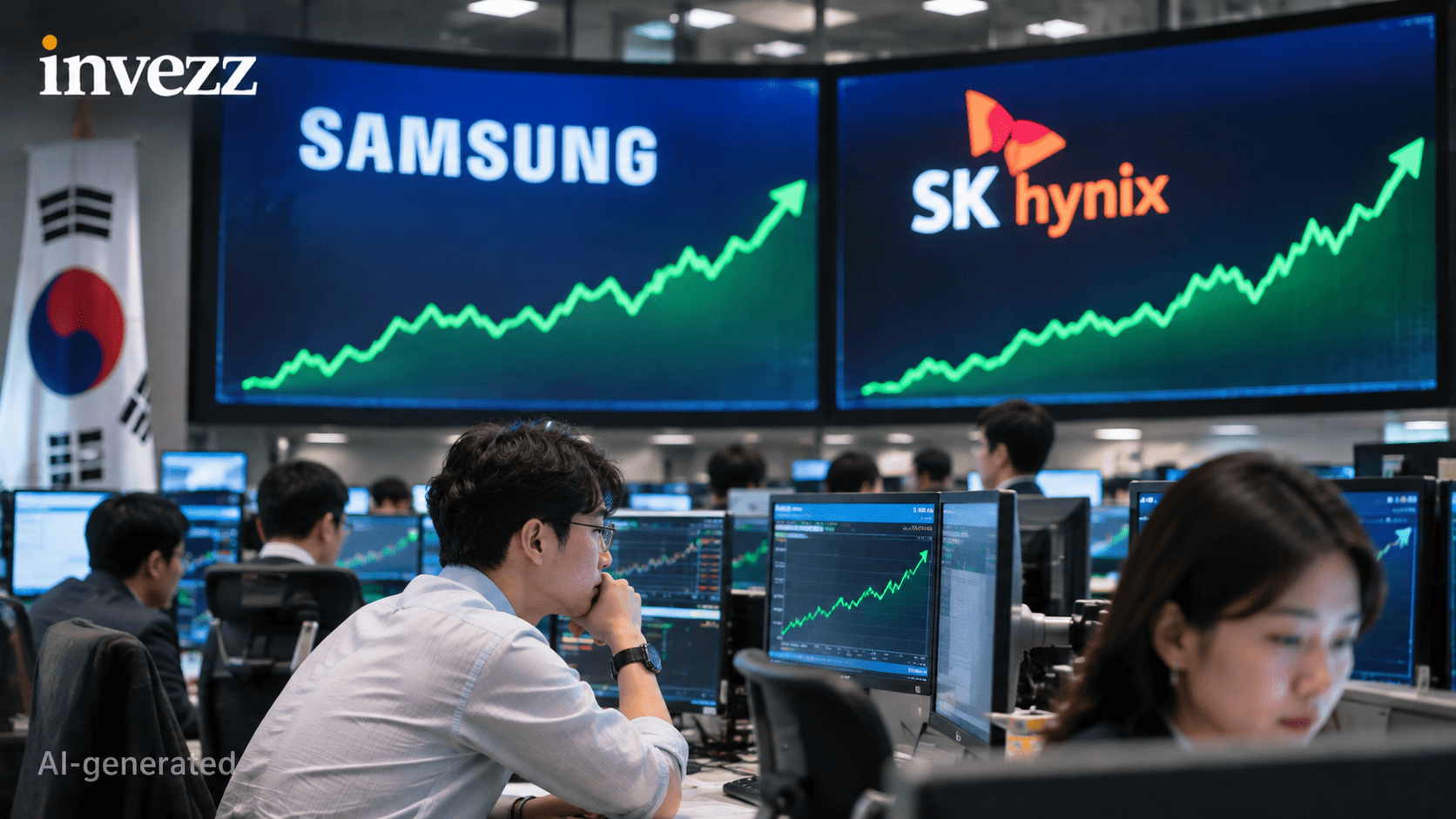
South Korea's leading chipmakers staged a sharp recovery on Monday, with Samsung Electronics and SK Hynix leading a rebound in the KOSPI after last week's steep selloff. By late morning in Seoul, Samsung had advanced 3.29% to 194,800 won, while SK Hynix climbed 4.51% to 1,182,000 won. The benchmark KOSPI rose 1.61% to 5,145.81, recovering from Friday's 6.02% plunge, which had briefly sent the index down more than 8% and triggered a 20-minute trading halt.
The bounce followed a recovery on Wall Street, where semiconductor shares rallied on Friday. Nvidia gained 2.78%, AMD jumped 11.04%, and Micron rose 5.12%, lifting the Philadelphia Semiconductor Index by 4.2% after Thursday's 12.25% collapse. For South Korea's largest memory producers, the US chip rebound is significant because demand for high-bandwidth memory and conventional server chips is closely tied to technology companies' AI infrastructure spending.

Despite the rebound, investor caution remains. The previous week saw the KOSPI lose nearly 12%, its weakest close in seven months, as fears of tighter US data-centre regulation battered technology shares. Samsung fell 6.35% and SK Hynix plunged 10.44% on Friday alone. Analysts suggest the selloff may have been overdone. "Delays in new data center permits do not mean reduced demand for memory chips in existing servers," said Seo Sang-young, a strategist at Mirae Asset Securities, noting that recent chip shortages and higher prices still support the near-term outlook.
Foreign selling remains a persistent concern. During the previous week, foreign funds sold roughly 10.44 trillion won of KOSPI shares, including about 5.42 trillion won in SK Hynix and 2.19 trillion won in Samsung. That trend continued on Monday, with foreigners selling a net 469.3 billion won by late morning, while domestic institutions purchased 297.3 billion won and individuals bought 68.7 billion won. The contrasting flows explain the volatility, as local buyers see cheaper shares, but overseas investors are still reducing their exposure to Korea's concentrated semiconductor sector.
Regulators have stepped in to curb forced selling. Starting Monday, brokerage firms are temporarily exempt from a rule requiring them to maintain a 140% collateral ratio on margin loans. The three-month measure is intended to limit forced sales when falling share prices weaken borrowers' collateral. Yuanta Securities Korea analyst Lee Je-won said the decline reflected fears of future investment cuts and selling imbalances rather than confirmed damage to chipmakers' businesses.
Despite reclaiming 5,100, the KOSPI had dipped below 5,000 earlier Monday, demonstrating how fragile confidence remains. Kiwoom Securities expects the benchmark to trade between 4,800 and 5,350 this week. Its forward price-to-book ratio has fallen to around 0.95, according to Kiwoom, making valuations look less demanding. However, low multiples alone cannot guarantee a durable recovery while earnings forecasts remain uncertain. Kiwoom analyst Han Ji-young said another succession of steep declines appeared less likely unless fresh shocks emerged.
The rebound in Samsung and SK Hynix underscores the market's sensitivity to AI-related news. While the immediate recovery is welcome, the sustainability of the rally depends on whether foreign selling subsides and whether AI spending concerns ease. For now, investors are treading carefully, balancing bargain-hunting opportunities against lingering regulatory and demand uncertainties.
This article is for informational purposes only and does not constitute financial advice.