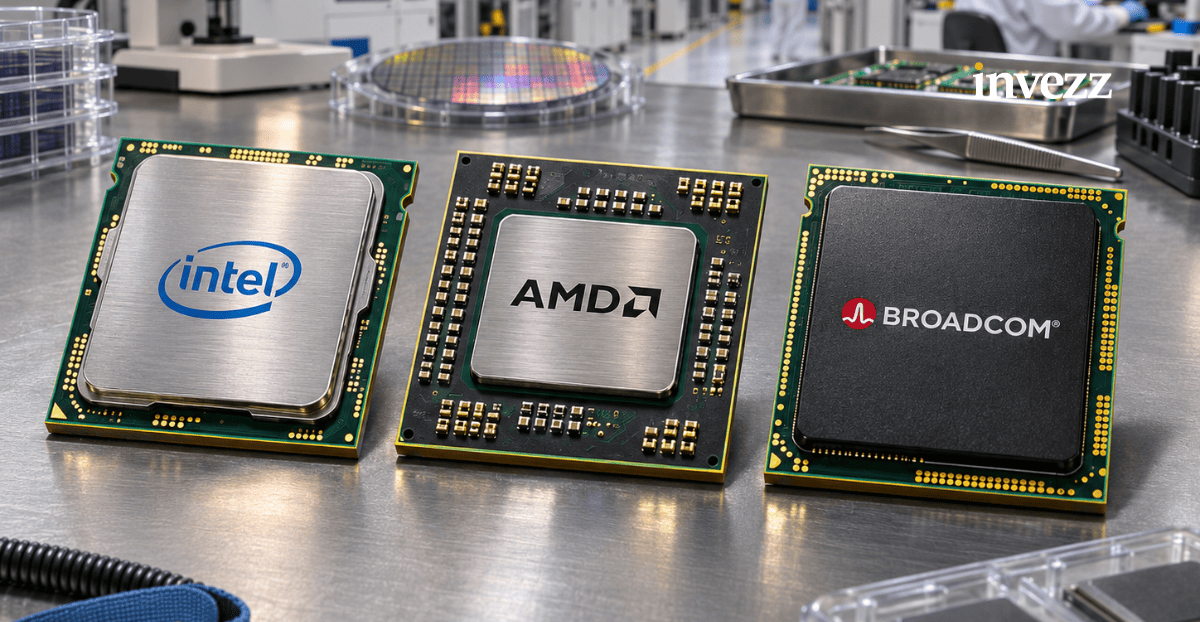
Semiconductor shares moved sharply higher on Wednesday, led by Intel, Advanced Micro Devices and Broadcom, after CoreWeave delivered quarterly results that reassured investors about the staying power of the artificial intelligence infrastructure buildout.
Intel climbed 7.4%, AMD added 5.65% and Broadcom gained more than 5.39% in intraday trading. The advance came alongside a broadly positive session on Wall Street, with all three major US benchmarks opening higher and the Nasdaq Composite up about 1.5%. CoreWeave itself surged 21%.

CoreWeave's results reset the AI narrative
The Nvidia-backed cloud provider reported third-quarter revenue of $3.66 billion, a 168% increase from the same period a year earlier. Management also lifted its 2026 sales guidance to a range of $13 billion to $13.3 billion. Contracted revenue backlog rose to $132.5 billion from roughly $104 billion at the end of June, while adjusted operating income reached $379 million.
Those figures matter well beyond CoreWeave. The company buys large volumes of advanced computing hardware and rents capacity to AI developers, so its order book functions as a read-through on capital spending across the data-center supply chain. A stronger demand picture supports the case that operators will keep funding purchases of processors, networking gear and memory.
Why the three chipmakers are moving
AMD has direct exposure to demand for AI accelerators and server processors. Intel participates through server chips and other computing hardware. Broadcom supplies optical communication components, Ethernet switching platforms and custom backend ASICs used in high-density AI clusters, making it a key beneficiary when hyperscalers expand capacity.
The rally also reflects a sentiment shift. CoreWeave's steep share-price decline in recent months had amplified worries about whether the AI trade could hold up, particularly given the heavy borrowing by companies building data-center infrastructure. Wednesday's report eased some of that anxiety and drew investors back toward AI-linked names.
JPMorgan stays bullish on Broadcom
JPMorgan reiterated its Overweight rating on Broadcom. Analyst Harlan Sur said Google's latest TPU design fits the 3-nanometer roadmap the firm outlined in its autumn research, and he expects the TPU 8i Max to begin ramping in the second half of 2027. He added that Google's next-generation 2-nanometer TPU, referred to as v9.5 or v10, remains on schedule for production in mid-2028.
The bank believes Broadcom continues to supply Google's highest-performance and highest-priority TPU programs, which it says provides uninterrupted revenue visibility through 2031. Separately, DA Davidson analyst Gil Luria raised his Broadcom price target to $400 from $350 following Anthropic's IPO filing, writing that the filing suggests the offering will proceed and that OpenAI will raise additional capital in its own IPO next year, allowing Broadcom to meet expectations over the next couple of years.
AMD's server launch adds to the momentum
AMD announced availability of its sixth-generation EPYC server SP7 processors on Tuesday. Major cloud providers including Microsoft Azure and Oracle Cloud Infrastructure are preparing to deploy them. AMD said the chips extend its leadership in server processors and are built to run AI agents, accelerated infrastructure and critical enterprise applications, helping customers scale the computing capacity their businesses require.
The launch followed an upgrade from analyst Rick Schafer, who moved AMD to Outperform from Perform on Monday with a $600 price target. He pointed to multigenerational customer wins, Helios rack-scale data-center solutions and a strategic ramp with Anthropic in early 2027.
This article is for informational purposes only and does not constitute financial advice.