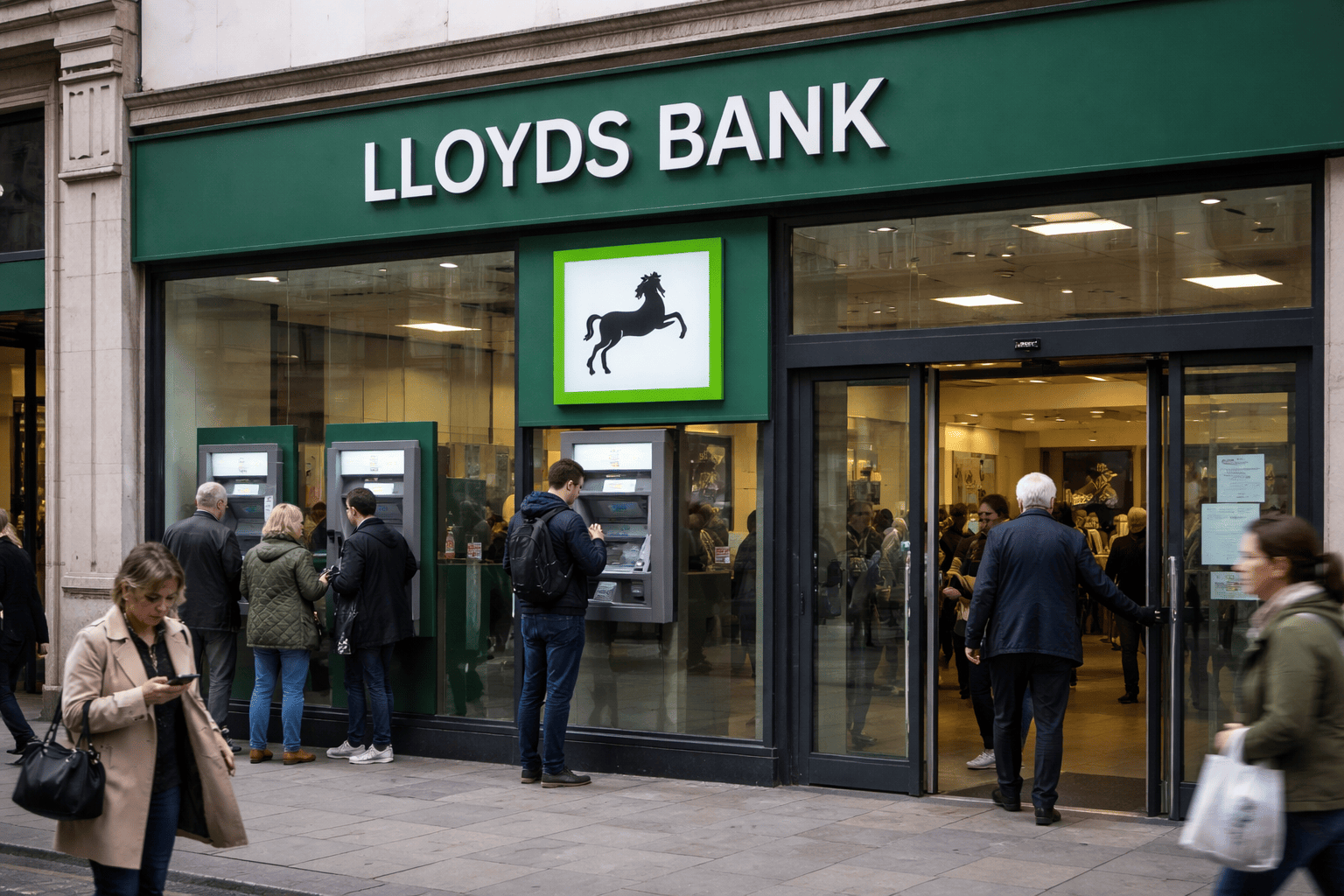
Lloyds Banking Group shares have staged a modest recovery over the past few sessions, climbing from a September 1 low of 108.25p to around 112.75p. The stock remains just below its year-to-date peak of 117p, having gained roughly 33% from its lowest point this year. Over a five-year horizon, the shares have surged about 218%, lifting the bank's market capitalization to over £65 billion.
What's driving Lloyds' performance
The rally in Lloyds shares is part of a broader re-rating of European banks. The iShares STOXX Europe 600 Banks ETF (EXV1) has climbed 303% in five years and 51% in the last twelve months. Peers such as Barclays, HSBC, and NatWest have also posted strong gains over the same periods.

Beyond the sector-wide momentum, Lloyds benefits from expectations that interest rates will stay elevated for longer. The Bank of England has held rates steady in recent months, and prediction markets currently assign a 55% probability of a hike later this year. Higher rates typically support bank profitability through improved net interest margins.
The company has also enhanced shareholder returns. Management announced a £1 billion share buyback program in the last quarter and raised the dividend by 30%, bringing the forward yield to approximately 3.55%.
Growth strategy and potential pitfalls
Lloyds is now executing its 'Accelerate 2030' strategy, targeting £2 billion in gross cost savings between 2027 and 2030, partly through investments in artificial intelligence. CEO Charlie Nunn aims to lift return on tangible equity (RoTE) from around 13% to 20% by 2030, with expansion plans in the United States and Europe.
However, this international push carries risks. Past attempts by European banks to enter the US market have often stumbled—Deutsche Bank and Barclays have both had to scale back their American operations. Investors may also note that the CFO recently sold £10 million worth of shares, a move that could signal insider caution.
Technical outlook: head-and-shoulders pattern
On the four-hour chart, Lloyds shares have formed a head-and-shoulders pattern, a classic bearish reversal signal. The pattern is currently completing its right shoulder. If the neckline support near 108p gives way, the stock could retreat to that level. Conversely, a decisive break above the year-to-date high of 116.70p would open the door to further upside, potentially toward 120p.
Traders may also be watching related setups in other UK equities. For instance, Lloyds shares have shown bearish signals after hitting their 2024 high, while Rolls-Royce stock eyes 2,000p but faces valuation and wedge pattern risks. Meanwhile, the broader FTSE 100 has outperformed as miners rally on gold and silver surges, as seen in this analysis.
Investors should weigh the positive fundamentals against the technical warning signs and insider selling. The coming sessions will be crucial in determining whether the pattern resolves to the downside or if the bulls can push the stock to new highs.
This article is for informational purposes only and does not constitute financial advice.