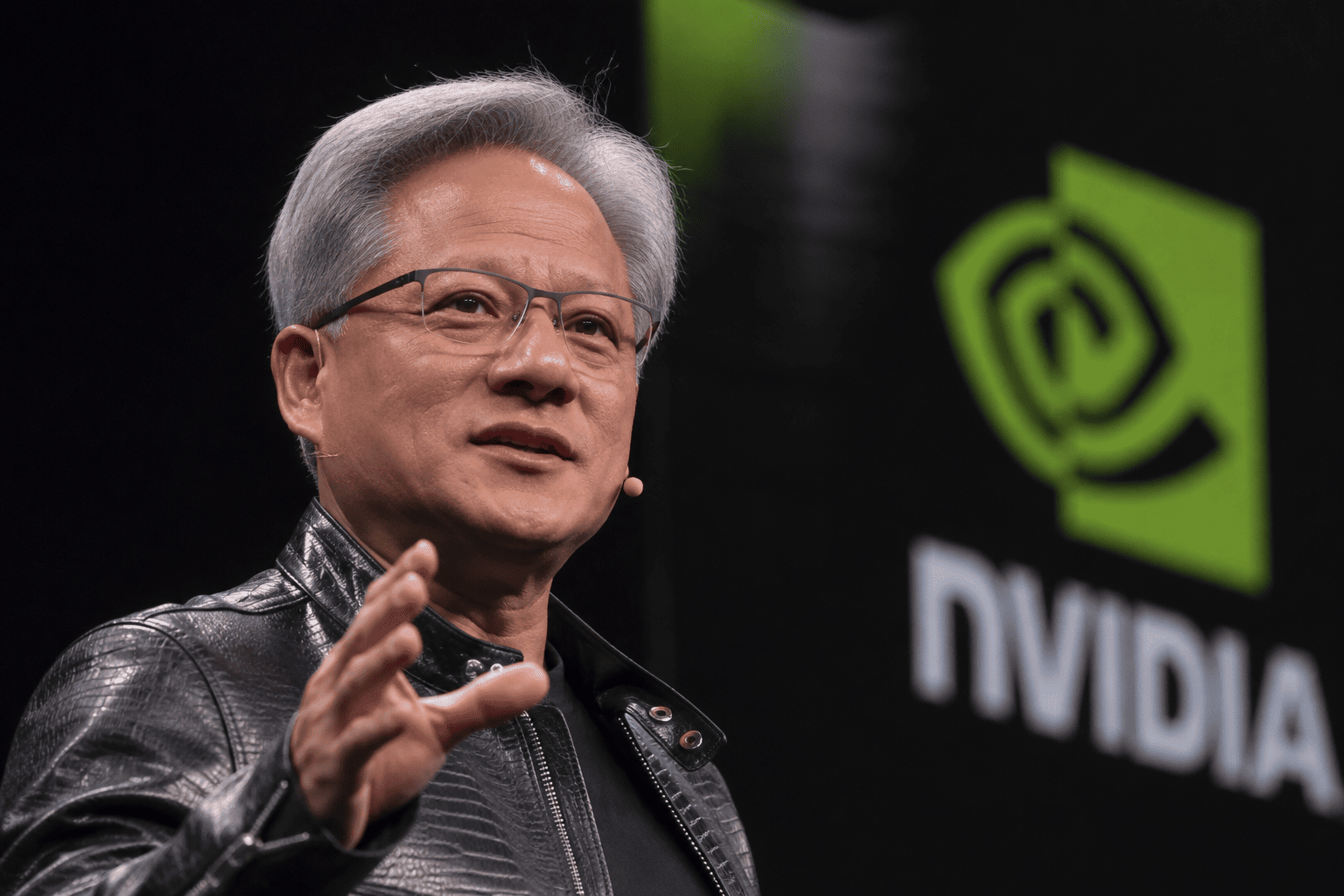
Nvidia CEO Jensen Huang has described OpenAI's Astra as the arrival of artificial general intelligence, but for investors, the more actionable signal lies in the hardware required to build and run such systems. Astra was trained on more than 100,000 Nvidia Grace Blackwell systems, with an additional 400,000 GPUs expected to come online, according to Huang.
Whether Astra truly meets AGI benchmarks remains a matter of debate. Researcher Gary Marcus has argued that Astra falls short of conventional definitions. Regardless of the classification, the investment implications are clear: if frontier AI models can perform economically valuable work, the infrastructure needed to train and deploy them will likely keep expanding.
Nvidia: the clearest compute winner
Nvidia remains the most direct beneficiary of this trend. Astra demonstrates how heavily frontier AI still depends on Nvidia's hardware. The company reported fiscal second-quarter revenue of $96.2 billion, up 106% year over year, with Data Center revenue reaching $89 billion, a 117% increase. Nvidia guided for $108 billion in revenue for the current quarter.
TD Cowen analyst Joshua Buchalter described the shares as “materially undervalued” after the results, according to MarketWatch. He argued that customer demand could support revenue approaching twice current levels if supply constraints were removed. Astra's scale adds to that narrative, showing that OpenAI's training needs already require a six-figure Nvidia deployment, and Huang's comments suggest further expansion is planned. Nvidia's Vera Rubin generation is moving into production, extending the hardware roadmap beyond Blackwell.
Broadcom: the custom-silicon angle
The next AI buildout will not rely solely on Nvidia GPUs. Hyperscalers and AI labs are developing custom accelerators to reduce inference costs and optimize specific workloads. Broadcom has become a key beneficiary of this shift. Its third-quarter AI semiconductor revenue jumped 221% to $16.7 billion, with management expecting $21.7 billion in the fourth quarter.
Broadcom is also working with OpenAI on Jalapeño, its first custom intelligence processor, with future generations in development. Macquarie analyst Arthur Lai upgraded Broadcom to Outperform and raised his price target to $490, citing the company's dominance in the rapid-growth AI ASIC market. OpenAI is expected to become Broadcom's second-largest XPU customer by fiscal 2028, when management sees more than five gigawatts of OpenAI accelerators being deployed. This makes Broadcom another way to play Astra: smarter models can increase demand for specialized compute and the networking that connects AI clusters.
Oracle: the capacity behind the models
Oracle takes the thesis beyond chips and into data-center capacity. The company is a major cloud partner to OpenAI, and its shares rose following Astra's release ahead of September 10 earnings. Bank of America analyst Tal Liani maintained a Buy rating and a $240 price target. TipRanks noted that BofA expects Oracle's infrastructure-as-a-service revenue to jump 116% year over year as one gigawatt of new data-center capacity comes online.
Oracle's $638 billion backlog provides strong visibility, but the opportunity is capital-intensive. BofA expects around $92.5 billion of fiscal-year capital expenditure, which could pressure free cash flow. That makes Oracle the riskiest of the three. AI demand can produce extraordinary cloud growth, but Oracle must finance the physical infrastructure before much of that revenue arrives.
For investors, the takeaway is that Astra's launch underscores the scale of AI infrastructure spending. Nvidia, Broadcom, and Oracle each offer exposure to different parts of that ecosystem, from compute to custom silicon to cloud capacity. As AI tokens surge and software stocks rebound, these hardware and infrastructure names remain central to the AI trade.
This article is for informational purposes only and does not constitute financial advice.