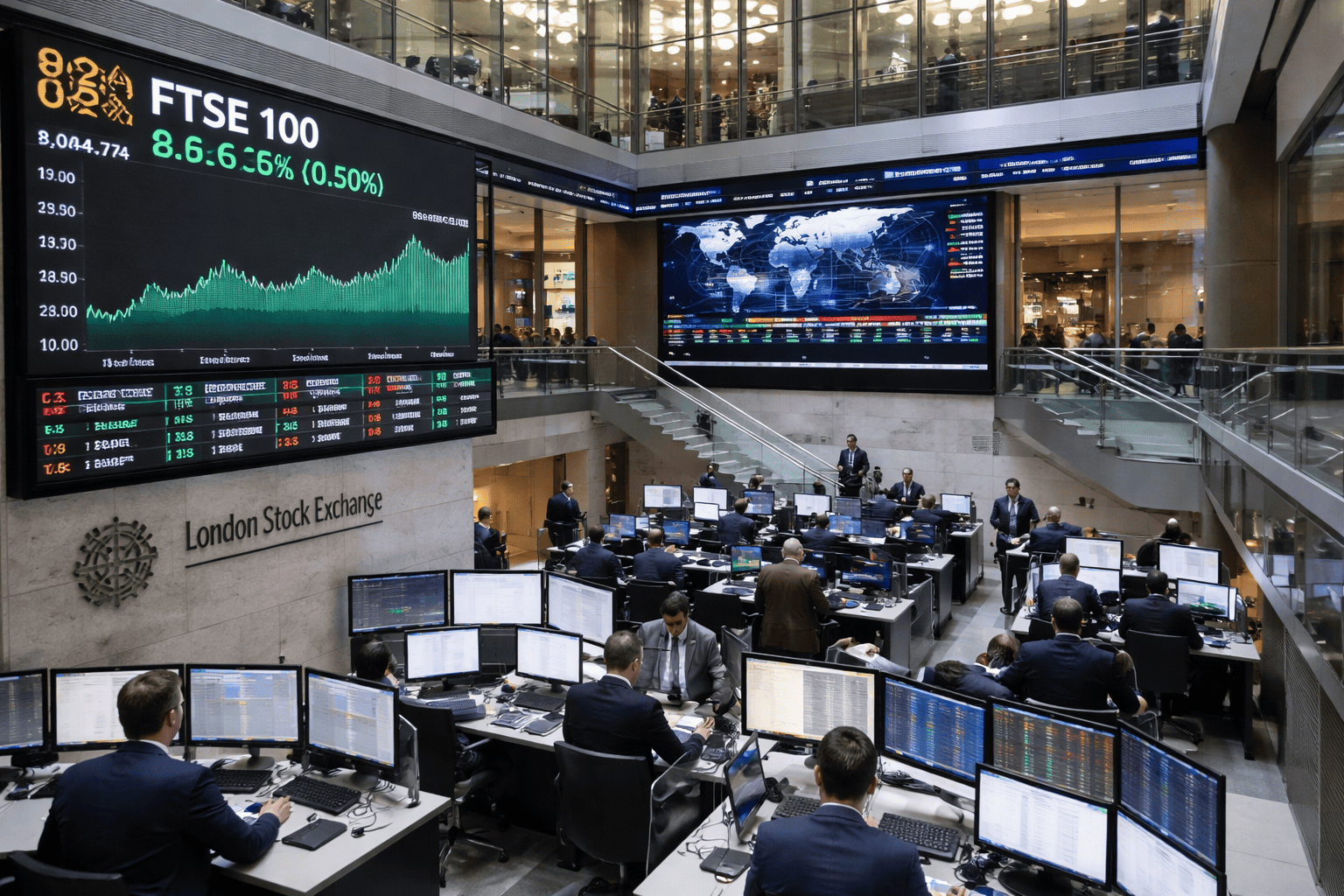
The FTSE 100 edged higher on Friday, outperforming a largely subdued European market as a rally in London-listed miners offset concerns over rising government bond yields and expensive oil.
Britain's blue-chip benchmark was up 0.22% in morning trading, while the FTSE 250 also advanced modestly. In contrast, Germany's DAX and France's CAC 40 were around 0.1% higher, while the broader Stoxx Europe 600 struggled for direction and remained on course for a second consecutive weekly decline.

The divergence highlights the FTSE 100's heavy commodity exposure, which is proving advantageous at a time when many European markets are wrestling with the implications of higher borrowing costs and renewed inflation pressure.
Miners give the FTSE 100 an edge
Mining stocks provided most of London's support as precious metals climbed on a weaker dollar and growing anxiety over US fiscal policy. Antofagasta gained more than 4%, Fresnillo rose close to 4%, and Anglo American added almost 3%, putting miners firmly among the FTSE 100's best performers.
Gold was trading above $4,550 an ounce and remained on course for a third straight weekly advance. Jefferies analysts see investors as still underestimating the consequences of widening fiscal deficits, elevated government debt, and potential currency debasement. Those concerns have supported demand for gold and silver, creating a direct tailwind for London's sizeable mining sector.
Bond-market stress caps European upside
The bigger obstacle for equities remains the global bond market. US 30-year Treasury yields climbed back towards 5.25%, while the 10-year approached 4.7%, reversing much of Wednesday's decline after Washington expanded its programme for repurchasing longer-dated government securities.
The Treasury plans to at least double the size of liquidity-support buybacks for long-dated debt, but investors remain focused on underlying fiscal pressures. US federal debt has crossed $40 trillion, and the budget deficit remains above 6% of GDP. As per market data, investors remain unconvinced the buyback programme is large enough to change those fundamentals, leaving long-term borrowing costs vulnerable to renewed selling.
Higher yields matter for European equities because they increase corporate financing costs and reduce the relative attraction of future earnings, particularly for richly valued technology and growth shares. This dynamic has been a key theme in recent market action, as seen in the Dow's recent slide on yield pressures.
Oil and Iran keep inflation in the trade
Energy prices are adding another complication. Brent crude traded around $93.50 a barrel after reaching a one-month high of $94.71, while WTI remained above $86. The move followed tougher US rhetoric towards Iran and continuing uncertainty over shipping through the Strait of Hormuz.
Treasury Secretary Scott Bessent has signalled that Washington plans to intensify economic pressure on Tehran, reducing expectations of a quick diplomatic breakthrough. For the FTSE 100, higher commodity prices are a mixed blessing. They support miners and energy companies, but prolonged oil strength could keep UK and global inflation elevated and slow the path towards lower interest rates.
Investors are also keeping an eye on the broader commodity complex, with crypto markets reacting to Treasury buybacks and other macro forces. Meanwhile, the resilience of the FTSE 100 contrasts with the struggles of other indices, as tech stocks face headwinds from higher yields.
As the session progresses, traders will watch for further moves in bond yields and oil prices, which remain the key drivers of market sentiment across Europe.
This article is for informational purposes only and does not constitute financial advice.