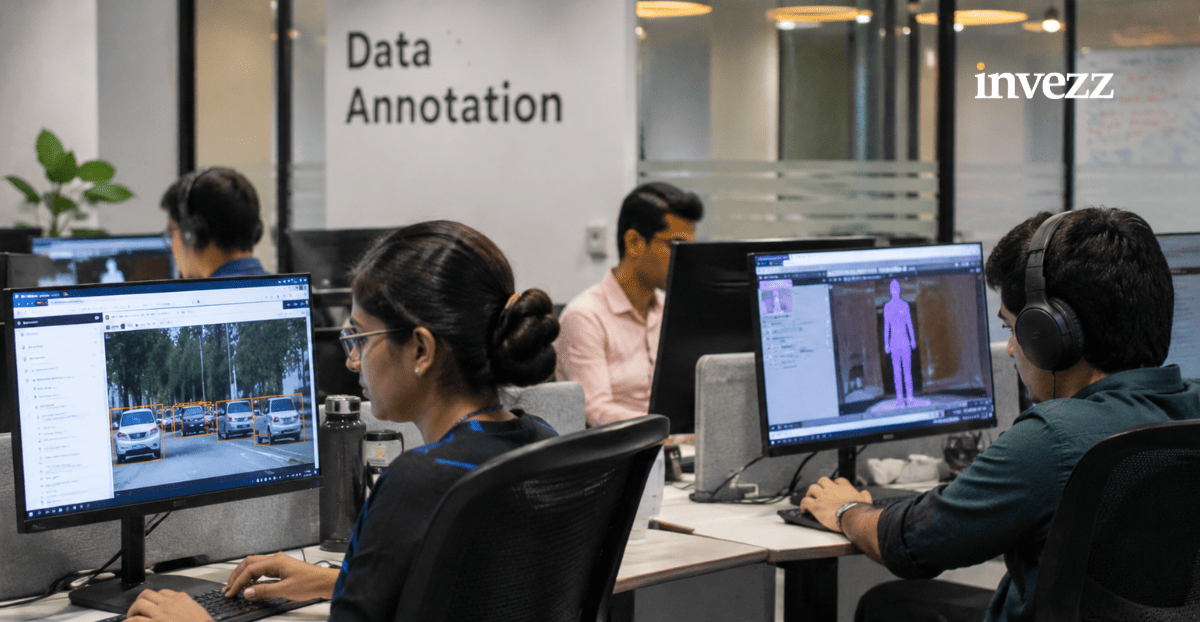
Data annotation has become a critical source of employment in India's tier 2 and tier 3 cities, where workers feed data into AI models to help them understand the world. However, as AI models become more sophisticated, the nature of these jobs is evolving rather than disappearing, according to Radha Ramaswami Basu, Executive Vice President and Head of iMerit, an EXL Company.
India's data annotation tools market, valued at $138 million in 2026, is projected to reach $648 million by 2031, according to Ken Research. This growth reflects the increasing demand for human expertise in the AI lifecycle, even as automation takes over routine tasks.

From labeling to judgment
Basu acknowledges that routine data labeling, such as drawing boxes around cars, is being automated. However, she emphasizes that AI remains heavily dependent on human input, expertise, and oversight. The work is becoming more advanced and nuanced, requiring judgment and context.
Instead of simply identifying objects in images, workers now assess complex scenarios, such as predicting a car's actions in an emergency. This shift demands descriptive and subjective analysis, making the evaluation of AI outputs more challenging. As models become more capable, the cost of their mistakes rises, increasing the need for rigorous human checks.
Demand is moving toward specialized expertise. Clients now request physicians to review clinical reasoning, lawyers to test contract interpretations, and mathematicians to identify flaws in proofs. Coders are shifting from writing basic functions to reviewing and correcting AI-generated behaviors.
This evolution is creating a labor market centered on expert judgment, where speed, accuracy, and cognitive load are valued. Workers who gain early experience and grow with the technology become highly valuable.
Productivity and robotics
On productivity concerns, Basu points out that when a task becomes cheaper, it gets used more. Companies apply AI to more problems, languages, and countries, each launch bringing new evaluation needs. Roles are changing faster than they are disappearing, and the focus is on helping people adapt.
In robotics, Basu notes that robots already handle repetitive tasks in controlled environments like assembly plants and warehouses. The next frontier is unpredictable settings such as farms, mines, and construction sites. iMerit worked with an agricultural robotics company to annotate nearly a million images, improving detection accuracy and reducing completion time for complex scenes by 61 percent.
Human judgment remains crucial in distinguishing between data that looks correct on a screen and data that works in the field. Progress will come workflow by workflow, with narrow, repetitive tasks moving first, while improvisational work will take longer.
Career paths in smaller cities
Smaller cities are where much of India's new work is happening. As routine labeling gets automated, entry-level annotators need to transition to expert evaluator roles. iMerit is helping workers make this move by providing training and opportunities to develop specialized skills.
The career path from basic labeling to expert evaluation involves learning to assess complex AI outputs, ensuring accuracy, and providing oversight. This transition is essential for workers to remain relevant in an AI-driven economy.
This article is for informational purposes only and does not constitute financial advice.