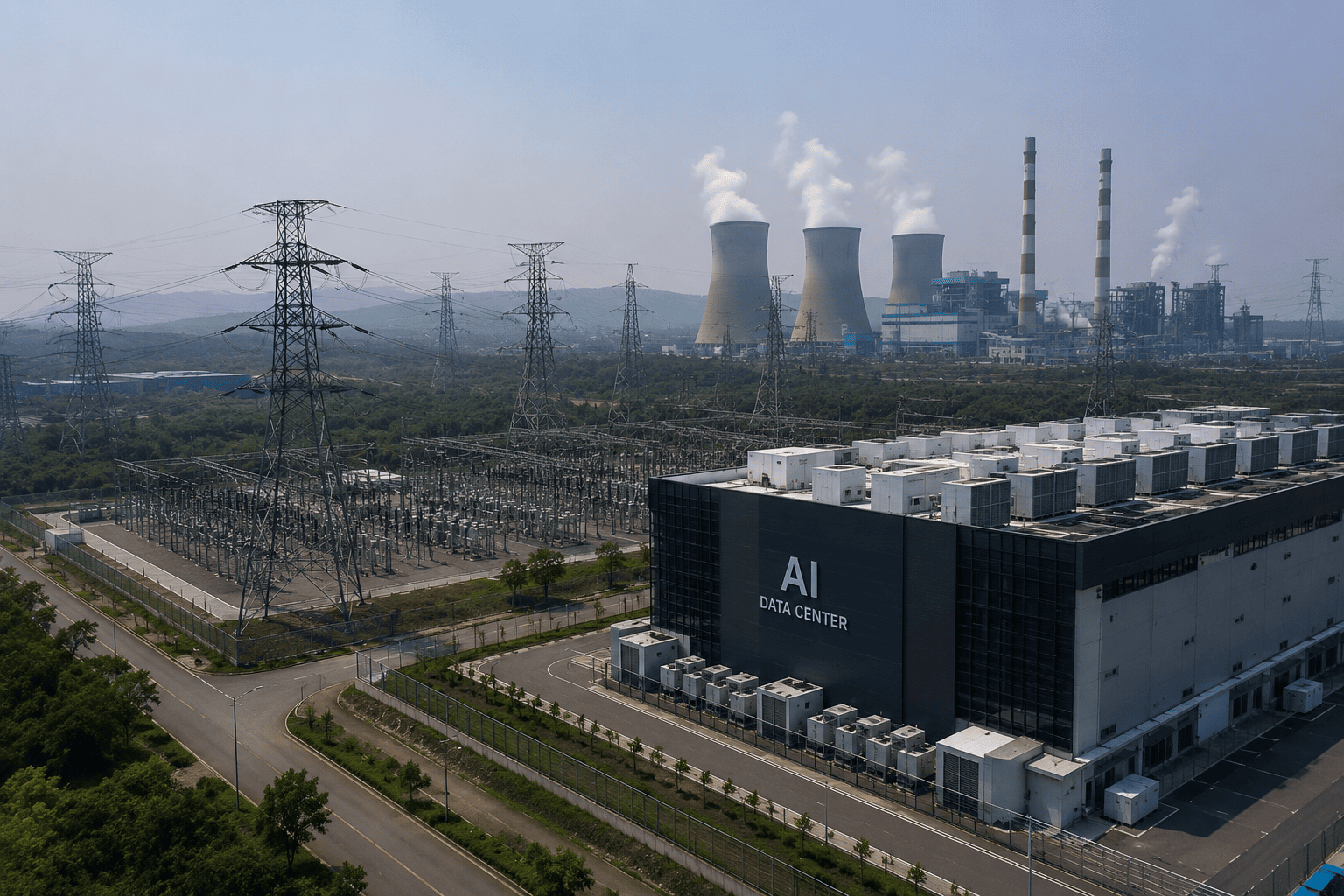
India's energy sector is experiencing a surge in investor interest, driven by the dual catalysts of rising temperatures and the rapid expansion of AI data centers. The Nifty Energy index has climbed 11% year-to-date, significantly outperforming the broader Nifty 50, which has fallen 8.3% over the same period. However, analysts remain divided on whether the rally is sustainable or if valuations have become stretched.
Power demand hits record highs
Electricity consumption in India rose to 164.98 billion units in May and 166.46 billion units in June, both up 11% from the previous year, according to the Central Electricity Authority. Heatwaves and a delayed monsoon have added to the strain on the grid, while the country's growing data center industry is emerging as a structural demand driver.
Global tech giants are pouring capital into India's digital infrastructure. Amazon recently committed an additional $13 billion to expand its AI and cloud operations, bringing its planned investments in the country to $48 billion between 2026 and 2030. Microsoft has earmarked $17.5 billion, while Google plans to invest $15 billion over five years to expand data center capacity in southern India. These investments are expected to significantly boost electricity demand.
According to S&P Global Commodity Insights, Indian data centers consumed about 13 terawatt-hours (TWh) of electricity at the end of 2024, roughly 0.8% of the country's total power demand. That figure is projected to rise nearly fivefold to 57 TWh by 2030, representing about 2.6% of total electricity consumption. India is expected to become the second-largest market for data center electricity demand in Asia-Pacific within two years, overtaking Japan and Australia.
Analysts split on valuations
While the long-term demand outlook appears robust, near-term earnings for power generators may not yet justify the current stock prices. Jahol Prajapati, equity research analyst at SAMCO Securities, told Invezz: "AI-driven data centers are undoubtedly a long-term demand catalyst for India's power sector, but the market appears to be pricing in this opportunity much faster than earnings are likely to materialize." He noted that many power stocks have re-rated on expectations rather than current cash flows.
Prajapati believes the strongest pricing power lies with grid equipment manufacturers, particularly those producing high-voltage transformers and switchgear. Global supply shortages, lead times exceeding 24 months, and premium pricing support margins for these companies. He added that AI data centers require steady 24x7 baseload power, which will necessitate round-the-clock renewable energy backed by storage, stronger transmission infrastructure, and flexible thermal generation.
In contrast, Siddarth Bhamre, head of institutional research at Asit C Mehta, argues that strong past performance does not preclude future growth. "Investors often look beyond FY28 to FY29 and FY30 to see how value can be captured or discounted today," he told Invezz. "Sometimes market participants discount long-term earnings today if the probability of earnings visibility is high." Bhamre prefers transmission companies within the power segment, followed by equipment manufacturers and power generators.
Grid expansion and capex cycle
India's power infrastructure is expanding to meet rising demand. The Central Electricity Authority estimates that the country will attract ₹7.9 trillion in transmission investments through 2035-36. According to Ankit Jain, vice president and co-group head for corporate ratings at ICRA, electricity demand rose 7.1% year-on-year during the first two months of FY2027, with peak demand reaching around 271 GW in May 2026, up from 245 GW in FY2026.
India added approximately 62 GW of generation capacity in FY2026 and is expected to add another 50 GW this fiscal year, largely from renewable sources. Average thermal plant load factors stood at 65.2% in FY2026, indicating headroom for ramp-up. Battery storage is also gaining traction, with more than 22 GWh of standalone battery energy storage tenders awarded in FY2026. These projects could be installed within 12 to 18 months and help support peak demand.
Jain expects transmission companies to enter a capital expenditure cycle as renewable capacity expands. However, he cautioned that the timeline for realizing returns on these investments remains uncertain.
For investors tracking the broader market, recent moves in U.S. equities and Alphabet's capex surge highlight the global appetite for AI infrastructure. Meanwhile, nuclear power initiatives in the U.S. underscore the energy demands of AI, a theme that is also playing out in India.
This article is for informational purposes only and does not constitute financial advice.