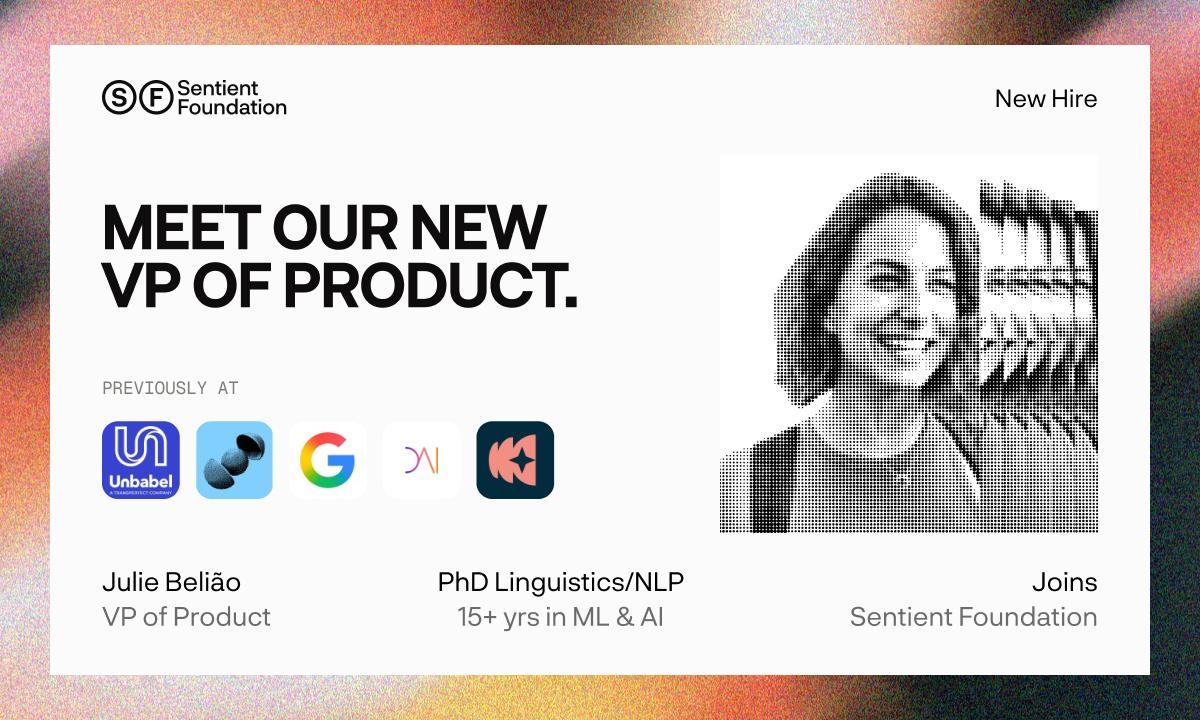
The Sentient Foundation, a nonprofit research group focused on keeping advanced artificial intelligence open-source, has appointed Julie Belião as its vice president of product. Belião previously served as VP of product at Mozilla.ai and spent roughly a decade at Google, giving her a rare mix of big-tech, startup, and academic experience.
In her new role, Belião will oversee product development across Sentient's frontier research programs. Her mandate centers on two areas: recursive self-improvement, in which AI systems iteratively enhance their own capabilities, and model provenance, the effort to verify where a model came from and how it was built.

Translating research into tools
The foundation's stated goal is to convert its open-source research into usable products for developers and enterprises. That includes systems that can improve themselves while also making AI models more transparent and trustworthy. Sentient argues that no single company can credibly act as both builder and auditor of advanced AI, positioning itself as a neutral party at the intersection of open-source development and trust infrastructure.
Sentient's projects have drawn a following among developers. Its repositories have collected more than 12,500 GitHub stars, spanning agentic AI, open search, and model verification. Flagship initiatives include ROMA, a recursive open meta-agent framework; OpenDeepSearch; OML model fingerprinting; and EvoSkill. The foundation says its work has been cited by researchers at Google, Microsoft, Meta, and major universities.
Why the timing matters
The hire lands as recursive self-improvement attracts growing attention from both industry and investors. Google DeepMind is already exploring the approach in production settings, and the field has pulled in more than $2 billion in venture funding over the past year, according to the foundation. Model provenance, by contrast, remains an emerging discipline without a widely accepted verification standard, which Sentient cites as evidence of the need for independent approaches to AI transparency.
Belião's track record includes leading open-source ecosystem strategy and community growth at Mozilla.ai across a portfolio of 61 repositories, work that helped establish Mozilla as a recognized contributor to the agentic AI developer ecosystem. She also spent a decade on multilingual AI, covering speech synthesis, linguistic resources, and natural language processing data that supported Google Assistant, Google Translate, and YouTube.
She holds a PhD in computer science from Université Paris Nanterre, where her research examined the relationship between sentence structure and speech patterns in spontaneous conversation. Her academic work includes co-authoring "Rhapsodie: a Prosodic-Syntactic Treebank for Spoken French" in 2014 and "Towards Best Practices for Open Datasets for LLM Training" in 2025, a Mozilla–EleutherAI collaboration offering recommendations on sourcing, documenting, and sharing open training data.
"The AI industry has become very good at building impressive technology. The harder question is how we turn that technology into something genuinely useful, trustworthy, and accessible," Belião said. "What excites me about Sentient is the opportunity to tackle fundamental challenges like recursive self-improvement and turn frontier research into practical tools that developers and organizations can actually build on."
Sachi Kamiya, director of growth and venture at Sentient Foundation, said Belião brings a combination of experience across academia, major technology companies, and startups, along with a proven ability to build products from the ground up. Kamiya added that her expertise will be invaluable as the foundation focuses on translating frontier research into practical products.
The appointment reflects a broader push within the open-source AI community to close the gap between closed frontier labs and the wider ecosystem of developers and enterprises. Whether Sentient's tools gain commercial traction will depend on adoption by developers and on progress toward a workable standard for model verification.
This article is for informational purposes only and does not constitute financial advice.