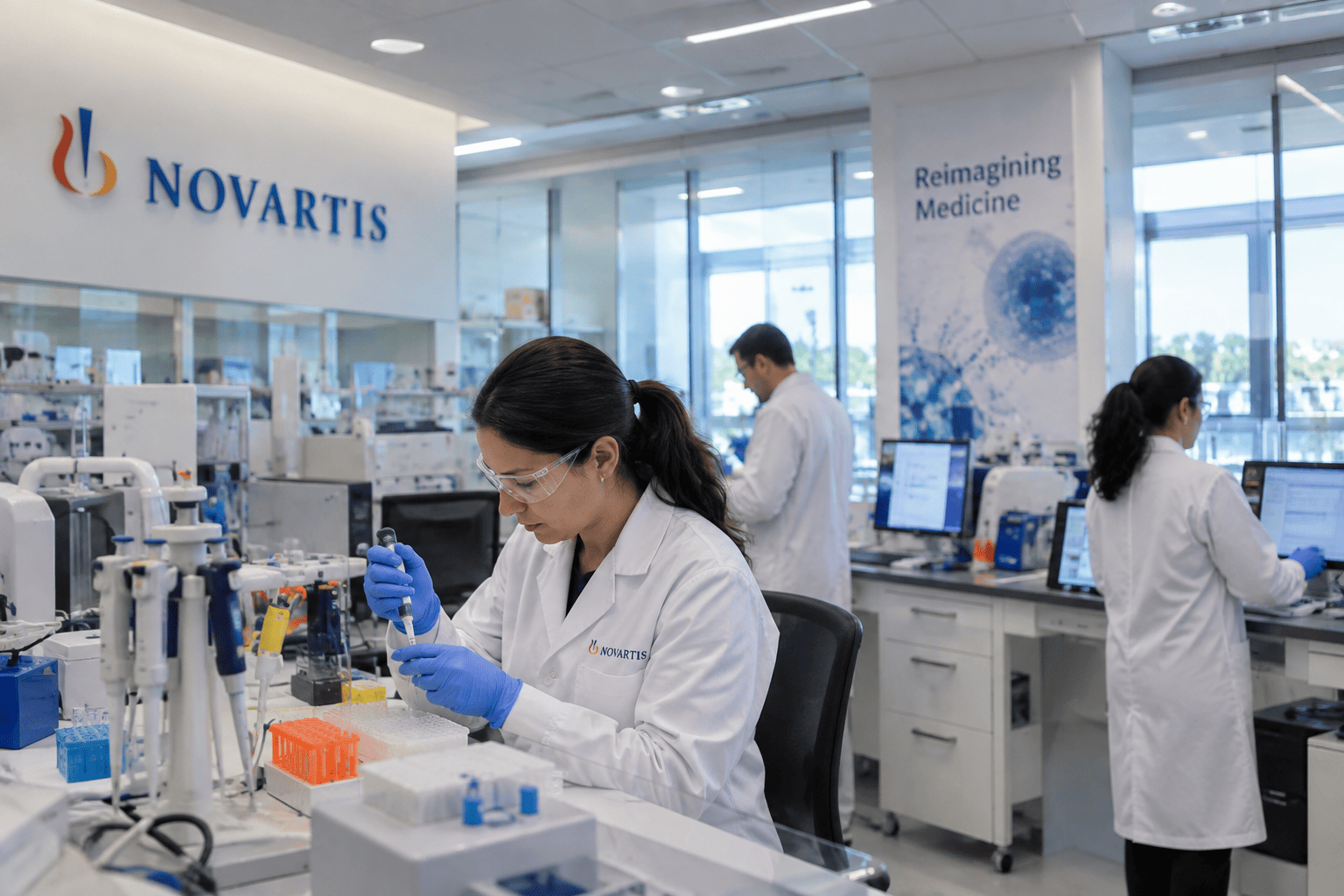
Novartis shares tumbled approximately 10% on Tuesday after the Swiss pharmaceutical giant announced that its experimental treatment for myotonic dystrophy type 1 (DM1) failed to meet the primary endpoint in a Phase III clinical trial. This marks the second major pipeline disappointment within a week, intensifying investor concerns about the company's growth prospects.
The stock has now lost more than 14% over the past five trading sessions, reflecting mounting pressure on the company's research and development pipeline. The failed therapy, del-desiran, was acquired through Novartis's $12 billion purchase of Avidity Biosciences and was considered a key growth driver.
Del-desiran misses primary endpoint
Novartis reported that the Phase III HARBOR study of del-desiran did not achieve a statistically significant improvement over placebo on the primary endpoint of video hand-opening time, a measure of hand myotonia (muscle stiffness). Patients with DM1 often experience difficulty relaxing muscles after contraction, and the trial assessed how quickly they could open their hands after clenching.
"Despite decades of research, there are still no approved treatment options for DM1, and patients and caregivers continue to face a significant daily burden," said Shreeram Aradhye, President of Development and Chief Medical Officer at Novartis. The company said it will analyze the full dataset before deciding on next steps for the program.
Pipeline setbacks raise concerns
The failure of del-desiran follows Monday's announcement that pelacarsen, another experimental drug, did not reduce cardiovascular events in a late-stage trial. These two misses, combined with the recent pause of eight trials of an experimental cell therapy after three patient deaths, have cast doubt on Novartis's ability to offset upcoming patent expiries and declining sales of its heart-failure drug Entresto.
Investors had been counting on del-desiran, pelacarsen, and the anti-inflammatory drug remibrutinib to support growth. Vontobel had previously estimated that del-desiran could generate peak annual sales of $3 billion, with a 50% probability of success. Following the trial failure, the brokerage removed those sales projections from its model and cut its price target for Novartis to 125 Swiss francs from 128 francs. Shares were trading at 112.56 Swiss francs on Tuesday.
Long-term guidance maintained
Despite the setbacks, Novartis reiterated its guidance for sales to grow at a compound annual rate of 5% to 6% between 2025 and 2030. However, the recent failures make that target more challenging to achieve, and investors are now looking for evidence that the company can replenish its pipeline quickly enough to offset upcoming patent pressures.
The string of disappointments has also drawn comparisons to other companies facing pipeline challenges. For instance, Tesla's recent regulatory hurdles have similarly weighed on its stock, while AMD's AI-driven momentum shows how pipeline strength can support valuations. In the biotech sector, the market's reaction underscores the high stakes of late-stage trial outcomes.
Analysts note that Novartis's remaining pipeline candidates, including remibrutinib, will now face closer scrutiny. The company's ability to deliver on its growth guidance will depend on successful execution of these programs and potential new acquisitions.
This article is for informational purposes only and does not constitute financial advice.