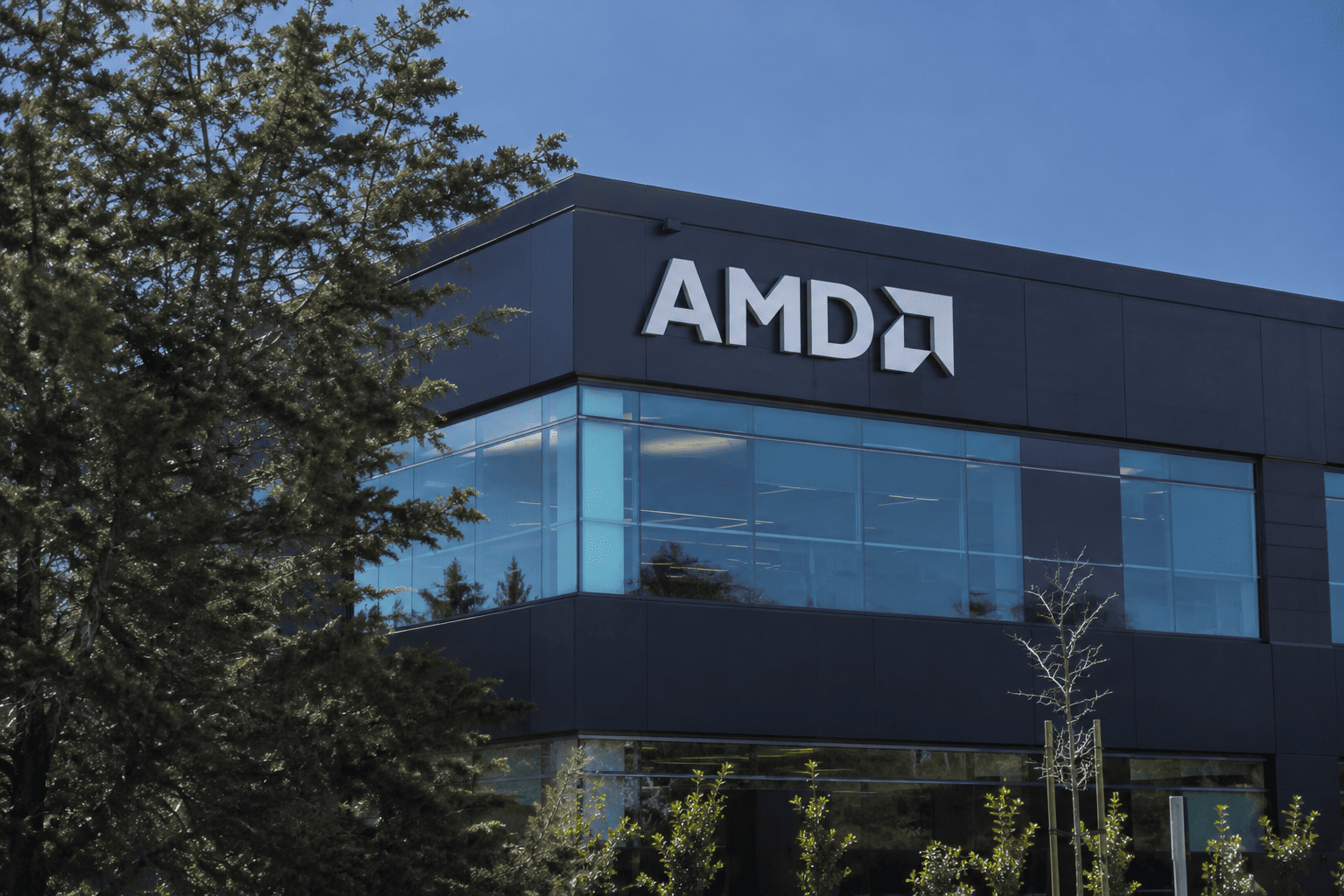
Advanced Micro Devices (AMD) shares have experienced a notable pullback over the past few months, retreating from a June high of $584.90 to around $456. Despite this correction, technical analysis suggests the stock may be positioning for a breakout, with a bullish flag pattern emerging on the daily chart. This pattern, often seen as a continuation signal, hints at potential upside in the coming months, aligning with the generally optimistic outlook from Wall Street analysts.
Technical indicators point to potential gains
The daily chart reveals that AMD has been trading within a descending channel, dropping below the 23.6% Fibonacci retracement level and the 50-day exponential moving average (EMA). The percentage price oscillator (PPO) has remained below the zero line since late June, which in isolation might suggest further downside. However, the context is crucial: this pullback follows a strong rally, and the formation of a bullish flag pattern typically indicates that the uptrend may resume.

If the pattern plays out, the next key target is the previous high of $584.90. A decisive move above that level could open the door to further gains, potentially reaching $600 or beyond. Investors will be watching this level closely as a breakout trigger.
AI demand provides fundamental tailwinds
Beyond the technicals, AMD has several fundamental catalysts that could drive its performance. The artificial intelligence (AI) industry continues to show robust growth, with no signs of slowing. Recent earnings from major tech companies underscore this trend. Dell Technologies reported a 58% surge in quarterly revenue to $47 billion, while HP Enterprise saw revenue jump to $12.2 billion from $9.1 billion a year earlier. These results highlight sustained demand for AI infrastructure, which directly benefits AMD's data center and GPU businesses.
AMD's largest customers in the AI space—including Meta Platforms, OpenAI, Microsoft, Oracle, and Anthropic—have all signaled continued capital expenditure. This commitment is critical for AMD's growth trajectory, as it competes with Nvidia in the GPU market. Notably, AMD has been gaining market share in both GPUs and CPUs, with its processors increasingly favored in AI agent applications.
Strong financial results and optimistic forecasts
AMD's recent quarterly results were impressive. Revenue jumped 50% year-over-year to $11.5 billion, while gross margin expanded to 54% from 40% in the same period last year. This margin improvement was driven by strong pricing power in the data center segment, where revenue surged 107% to $6.7 billion. The embedded segment also grew nearly 20%, while client and gaming revenue rose 6% to $3.8 billion.
Looking ahead, analysts project AMD's revenue to reach $50 billion this year and $87.39 billion next year, reflecting continued momentum. This optimism is reflected in recent analyst actions. Raymond James' Simon Leopold raised his price target from $565 to $641 with a Strong Buy rating. BMO Capital Markets' Harsh Kumar initiated coverage with an Outperform rating and a $550 target. Other bullish calls come from Rosenblatt Securities, DA Davidson, TD Cowen, and Wells Fargo.
Valuation concerns remain
Despite the positive outlook, AMD's valuation is a point of caution. The stock trades at a forward price-to-earnings ratio of approximately 60, significantly higher than many peers. This premium valuation suggests that much of the expected growth is already priced in, leaving little room for error. Investors should weigh the potential upside against the risk of a valuation reset if growth disappoints.
In the broader context, AMD's position as a key player in the AI chip market is solid. The company's ability to capitalize on the AI boom, coupled with strong execution, makes it a stock to watch. However, as with any investment, it's essential to consider both the opportunities and the risks.
This article is for informational purposes only and does not constitute financial advice.