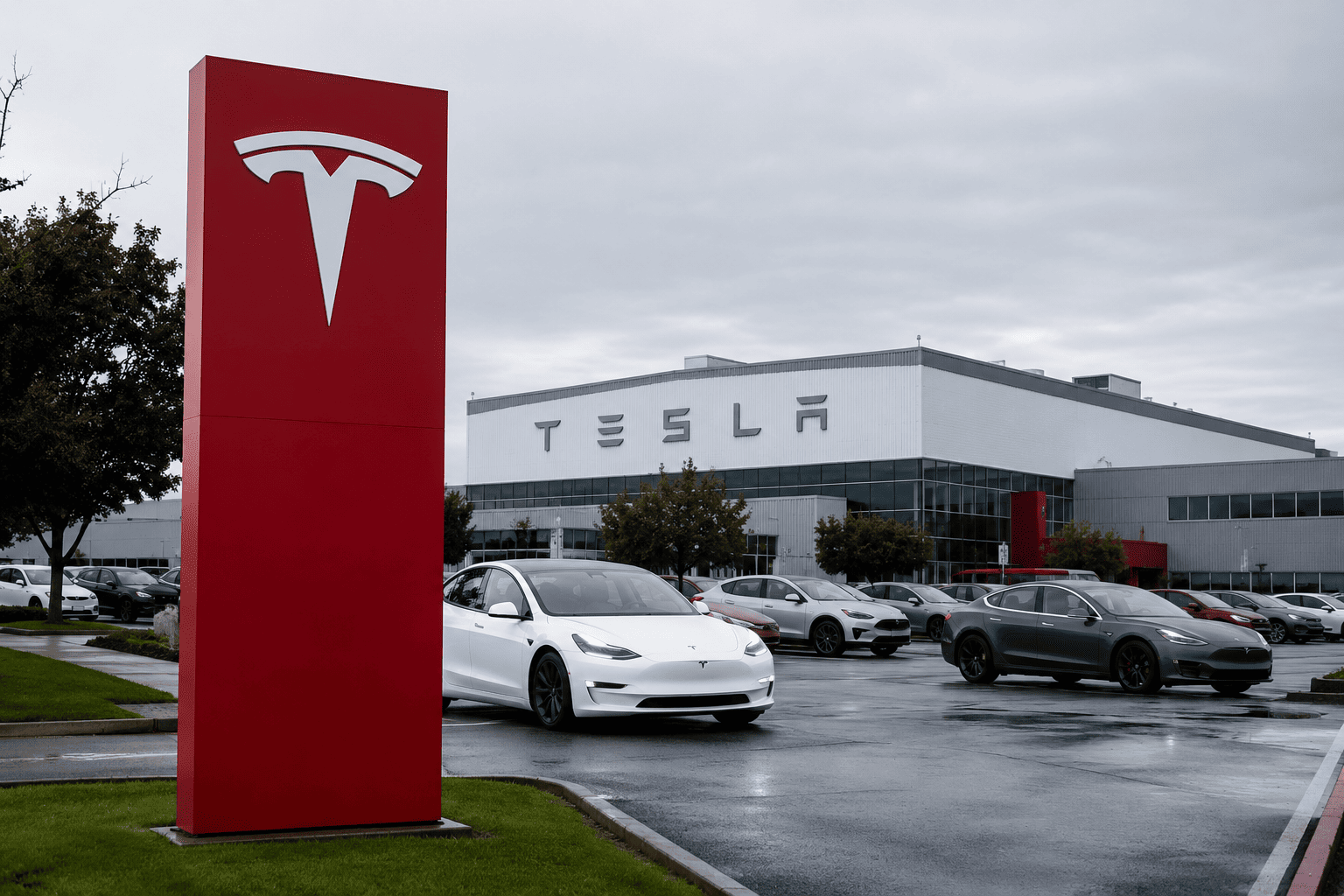
Tesla's stock tumbled roughly 6.4% on Friday, a day after the electric vehicle maker officially launched its Cybercab robotaxi in Austin, Texas. The decline came as analysts expressed skepticism about the event and federal regulators opened a new safety inquiry into the vehicle's certification.
Cybercab launch draws mixed reactions
Tesla added its two-seat Cybercab to its Robotaxi network in Austin, marking the commercial debut of its purpose-built autonomous vehicle. The gold-colored car has no steering wheel or pedals, designed to operate without a driver. Public rides were scheduled to begin Friday at 5 p.m. CT in limited areas of the city.
However, the rollout has been met with caution from Wall Street. Wells Fargo maintained its Underweight rating and $130 price target on Tesla, implying roughly 63% downside from current levels. The bank said the Cybercab launch likely fell short of investor expectations due to limited updates and a lack of surprises. GLJ Research also reiterated a Sell rating, describing the event as a "sell-the-news" moment, according to TipRanks.
Tesla has not disclosed how many Cybercabs will initially be available, but Wells Fargo noted that about 45 vehicles were registered in Texas around the launch. The company faces competition from Alphabet's Waymo, which has established a larger U.S. autonomous-vehicle operation.
NHTSA opens inquiry into Cybercab certification
The National Highway Traffic Safety Administration (NHTSA) said Friday it had opened an Audit Query covering about 1,000 Cybercab vehicles. The agency is examining how Tesla determined that the vehicle complies with federal safety regulations, particularly given the lack of conventional manual controls.
Michael Brooks, executive director of the Center for Auto Safety, told Reuters, "I don't think there is a reasonable interpretation that can be made to suggest that the Cybercab can comply with the Federal Motor Vehicle Safety Standards." Carnegie Mellon professor Philip Koopman noted that Tesla has historically "tested limits and pushed boundaries on regulations," and he expects the company to do the same with the Cybercab.
For vehicles that do not meet federal standards, NHTSA offers an exemption process that limits deployment to 2,500 vehicles annually. Tesla's engineering chief Lars Moravy has said Cybercab would not be subject to that cap, but he did not provide details. Amazon-backed Zoox previously attempted to self-certify a similar driverless vehicle but withdrew its certification after an NHTSA investigation, later receiving a federal exemption for limited commercial deployment.
Valuation and broader concerns
The regulatory questions add another challenge as Tesla seeks to expand its robotaxi operations. The company currently operates a limited paid robotaxi service in Texas and Florida using Model Y vehicles, which retain manual controls and have human backup drivers in some cases.
Bryant Walker Smith, a University of South Carolina law professor specializing in autonomous-driving regulation, questioned whether Tesla's technology is ready for broad deployment. He said public information does not indicate that Tesla is "anywhere close" to safely and reliably deploying an automated driving system across the conditions required for a vehicle without conventional controls.
Investor concerns extend beyond the Cybercab itself. Gary Black cautioned Tesla shareholders against conflating enthusiasm for the company with enthusiasm for its stock, saying, "Loving the company doesn't mean you should love the stock." He urged investors to conduct their own research rather than rely on management's promises.
Despite the drop, Tesla's stock remained on track for its fourth weekly gain in five weeks. The company's CEO Elon Musk has positioned autonomous driving and robotics as increasingly important to Tesla's future, with Cybercab production having started in April and Musk previously saying output would grow "exponentially" later this year or next.
For more on Tesla's recent stock movement, see the earlier rally ahead of the unveiling. Investors are also watching broader tech trends, such as AMD's AI-driven momentum and Oracle's AI spending debate.
This article is for informational purposes only and does not constitute financial advice.