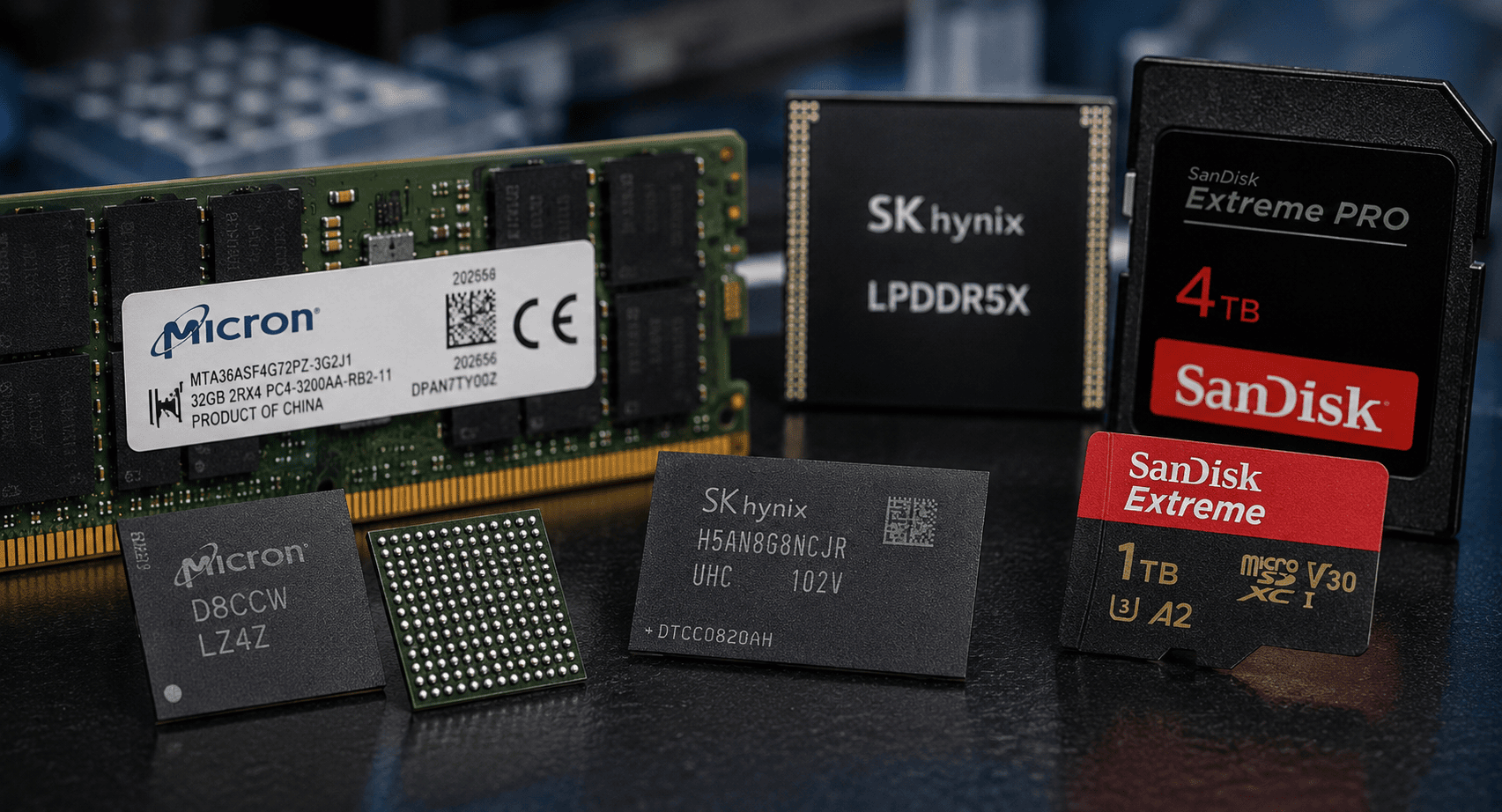
Shares of Micron Technology, SanDisk and SK Hynix extended their declines on Thursday, pressured by mounting worries over Chinese memory-chip competition and a wider sell-off in artificial intelligence-linked equities. The pullback has erased a substantial portion of the sector's recent gains and raised questions about whether the group can engineer a comeback.
Micron fell as much as 4.4% to $873.66 in early trading before paring most of the drop, and was last down about 0.6%. SanDisk lost 3.5%, while SK Hynix's US-listed shares shed 3% after its South Korean stock tumbled 11%. Samsung Electronics also slid 9.5%.

The selling began earlier in the week after reports that China's ChangXin Memory Technologies (CXMT) is developing a new memory chip. Concerns about stretched AI valuations, elevated interest rates and the durability of technology companies' capital spending have compounded the pressure.
Analysts push back on CXMT threat
UBS analyst Nicolas Gaudois argued that fears over CXMT's new technology may be overdone. The company's 4F-square design, known as 4F2, is likely to remain a sample product this year, with additional development needed to improve efficiency and performance.
Jefferies analyst Edison Lee also urged caution about the potential impact on global memory markets, pointing to uncertainty around CXMT's production yields and capacity, as well as equipment constraints. Even if advanced Chinese memory chips become available, that would not automatically translate into immediate competition for US manufacturers. American companies may face restrictions on buying CXMT-produced memory, while the Chinese firm prioritises domestic customers.
Still, the longer-term risk is that rising Chinese supply could erode the elevated memory prices that currently benefit Micron and its peers.
AI sell-off complicates any rebound
The broader AI correction is adding to the strain. JP Morgan's global strategy team does not expect the current downturn to recover as quickly as the July pullback, when AI stocks bounced back relatively swiftly. Strategist Nikolaos Panigirtzoglou cited several factors that could make a recovery harder, including weaker dip-buying activity, reduced corporate buybacks, limited short interest and increased exposure through leveraged exchange-traded funds. The Philadelphia Semiconductor Index ETF has fallen around 12% over seven sessions.
Buybacks emerge as potential catalyst
Shareholder returns have surfaced as a possible catalyst for memory stocks. Gaudois noted that memory shares had fallen 19% from their September peak, bringing them close to their July lows, and argued that the decline should encourage companies to increase shareholder returns.
JP Morgan analysts said a survey of more than 100 investors in Asia found broad support for immediate corporate action by large-cap Asian memory manufacturers to prevent further declines in their valuation multiples.
Micron's ability to respond is currently constrained by conditions attached to funding it received under the US CHIPS Act in 2024. Those restrictions are expected to be lifted on December 9. The company has also recently increased its total share-repurchase authorisation to more than $35 billion.
UBS analyst Timothy Arcuri has suggested that Micron could initially repurchase around $20 billion worth of shares per quarter, potentially increasing the amount to approximately $50 billion quarterly towards the end of fiscal 2027 in September next year. The scale and timing of any buybacks remain uncertain, but shareholder returns could offer investors another reason to reconsider the stocks after their recent declines.
AI spending concerns could delay a broader rebound
The outlook for a sustained recovery remains uncertain because the factors driving the sell-off extend beyond Chinese competition. Investors are reassessing the growth prospects of AI infrastructure companies amid higher interest rates and concerns about the ability of companies such as Anthropic and OpenAI to achieve profitability.
JP Morgan also noted that leveraged memory ETFs have increased their assets under management relative to the market capitalisation of the underlying stocks, which can amplify price movements when markets decline.
Meanwhile, SK Hynix is seeking US approval to export additional chipmaking equipment to China, Reuters reported, citing people familiar with the matter. Its US unit, Solidigm, wants to install equipment for NAND flash memory production at an existing facility in Dalian, China. The company is making plans for a new US NAND factory contingent on securing the export licence, according to the report. Expanded production in China would help Solidigm finance the US facility.
This article is for informational purposes only and does not constitute financial advice.