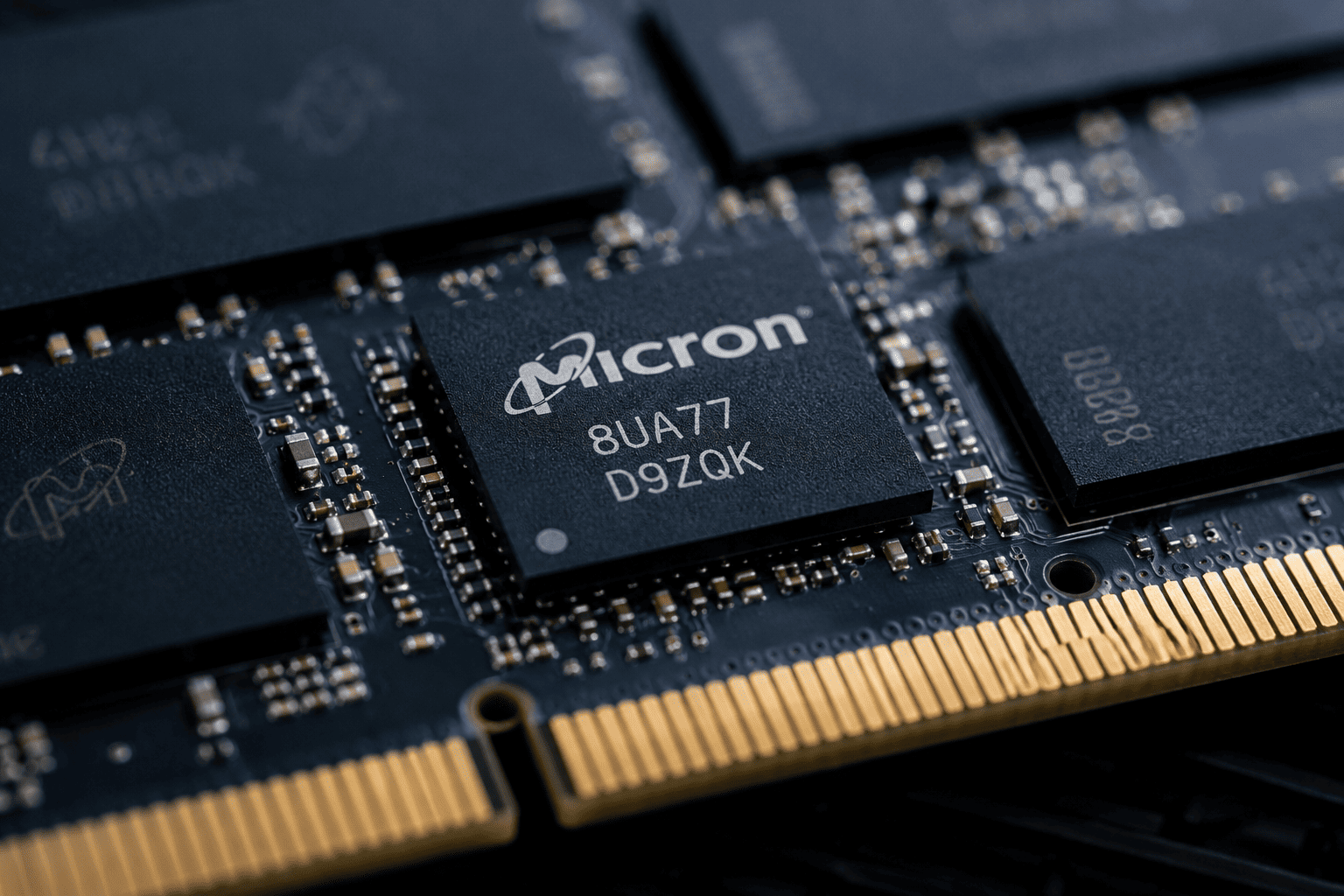
Micron Technology (NASDAQ: MU) closed Friday at $1,029, having spent most of the past month oscillating between roughly $1,000 and $1,100. That sideways action stands in sharp contrast to the Street-high price target of $3,000 set by D.A. Davidson analyst Gil Luria, and to a memory market where AI-driven demand remains exceptionally robust.
The most aggressive bull case hinges on earnings durability. Nicholas Mugalli, CEO of World Trade Securities, told Benzinga that Micron could reach $3,000 within two years if fiscal 2028 earnings approach $200 per share and the stock trades at about 15 times earnings. "I need $200 in FY28 at 15 times earnings," Mugalli said. While the math is aggressive, the operating backdrop provides some support: Micron has already committed more than 75% of its fiscal 2027 output through customer allocations and contracts, and has signed 26 strategic agreements covering over 35% of estimated revenue through 2030.

High-bandwidth memory (HBM) is central to the thesis because it consumes more wafer capacity than conventional DRAM, keeping supply tighter elsewhere. Luria, who set the $3,000 target, said "investors are early in their journey of understanding MU's value."
Yet the stock's inability to break above $1,100 reflects a market that is not rejecting Micron's growth story but is refusing to price the most optimistic version of it. After a 260% rally this year, each new forecast faces a higher bar, and any hint of a slowdown in AI spending triggers profit-taking. The latest pullback followed fresh questions about OpenAI's revenue trajectory, which dragged down AI-linked stocks broadly.
Since mid-September, MU has remained confined to the $1,000-$1,100 range. That range suggests investors are waiting for more concrete evidence of sustained earnings power. Juxtaposed Ideas, quoted by TipRanks, noted that MU "may suffer intermediate-term stock price underperformance" but argued the weakness creates an opportunity for patient investors, estimating fair value near $1,500 and a longer-term target of $2,000.
The clearest near-term catalyst may not be another earnings report but Micron's own share repurchase program. On October 8, the board increased the authorized buyback to $35.16 billion. Purchases under the expanded authorization can begin from December 9, subject to conditions tied to Micron's CHIPS Act funding agreements. UBS analyst Timothy Arcuri expects buybacks to become an important source of support once those restrictions ease. Barron's reported that Arcuri sees repurchases potentially starting around $20 billion per quarter and rising further as cash generation expands. UBS maintains a Buy rating and a $1,625 target.
A larger buyback would not guarantee a breakout, but it could reduce the share count, lift earnings per share, and introduce a marginal buyer into a stock that has struggled to clear $1,100. For now, the market's skepticism line remains firmly drawn at that level, and only time—or a decisive earnings beat—will tell whether the $3,000 bull case can finally push MU through.
This article is for informational purposes only and does not constitute financial advice.

