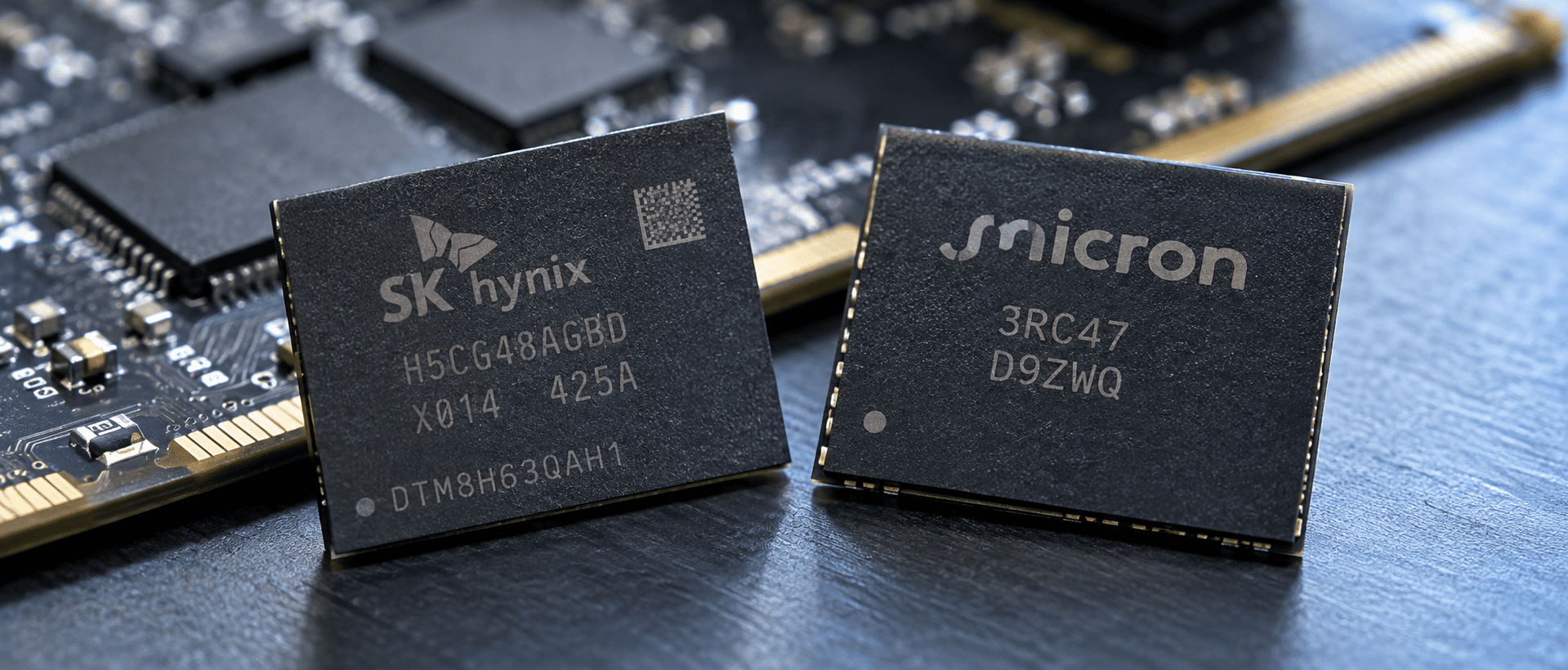
Shares of Micron Technology and SK Hynix moved lower on Monday as investors weighed a fresh competitive development from China's ChangXin Memory Technologies, or CXMT, alongside a broader retreat in technology equities.
Micron fell close to 5%, while SK Hynix lost 4%. SanDisk declined 7%, extending weakness across memory and storage names. The selling pressure coincided with a jump in crude prices, with Brent futures trading above $106 a barrel after deadly strikes on Riyadh's international airport over the weekend, a move that revived inflation concerns and hit rate-sensitive growth stocks.

What CXMT announced
CXMT said it achieved "key progress" on a new memory-cell architecture intended to raise storage density. Company president Cao Kanyu, speaking at an industry event in Shanghai over the weekend, said CXMT aims to launch a server-memory product built on the technology by the end of 2026, according to a company statement.
The design at the center of the announcement is the "4F square" cell, which shrinks the footprint of each memory cell to four square F, where F denotes the minimum line width in semiconductor manufacturing. Mainstream commercial DRAM currently relies on a 6F square structure, so a shift to 4F square could allow manufacturers to pack more cells onto a single die and improve manufacturing efficiency. CXMT said the core of its approach is a proprietary Vertical Surrounding Gate transistor, a vertical gate architecture meant to curb current leakage while reducing cell area.
CXMT also expects to release a new generation of DDR5 registered dual in-line memory modules for enterprise servers by the end of the year, though it has not disclosed detailed specifications or an exact launch date. The 4F square concept is not exclusive to CXMT: SK Hynix outlined its own development plan in 2025, and South Korean outlet The Elec reported in April that Samsung intends to mass-produce sub-10-nanometer DRAM based on the design by 2028.
Market-share shifts sharpen the focus
Investors have tracked CXMT's rise in the memory market for some time. The company's shares surged 466% on their trading debut in July, giving it a market capitalization just under $500 billion. A Counterpoint Research report published last month showed CXMT captured 10% of the global DRAM market in the second quarter of 2026, up from 4% a year earlier and 8% in the prior quarter, a pace of growth that outpaced many analyst forecasts.
The same data highlighted changes among the three established DRAM producers. SK Hynix saw the steepest decline, with its share falling to 25% in the second quarter from 39% a year earlier. Samsung held the largest position at 38%, up from 33%, while Micron's share rose more modestly to 24% from 22%.
CXMT is also pushing beyond conventional memory. The Information reported last month that the company had begun producing advanced high-bandwidth memory in small quantities, with plans to expand that output in 2027. Alibaba's T-Head semiconductor unit and Chinese AI chip designer Cambricon are already testing CXMT's HBM products with their processors.
Analysts see near-term limits
Despite the progress, analysts argue that constraints could blunt CXMT's immediate impact on incumbent suppliers. KC Rajkumar of Lynx Equity Research said supply limitations and customer qualification requirements make the threat less urgent than recent headlines imply, noting that CXMT supply is unlikely to dent the DRAM shortage Apple faces or improve Apple's negotiating position with traditional suppliers such as Micron.
Ellie Wang, an analyst at TrendForce, told CNBC last month that CXMT continues to strengthen its domestic position but remains relatively limited in high-capacity server memory and advanced products designed for AI servers. Counterpoint Research Vice President Neil Shah, however, flagged the company's capacity expansion plans as a key variable, saying how CXMT leverages its recent IPO to boost capacity for HBM and LPDDR6 will be important to watch in the second half of 2026.
For investors, the debate centers on whether CXMT can convert technological progress into qualified, high-volume supply for major customers. That outcome will depend on production capacity, product performance and customer adoption, leaving the timing of any meaningful share shift an open question.
This article is for informational purposes only and does not constitute financial advice.

