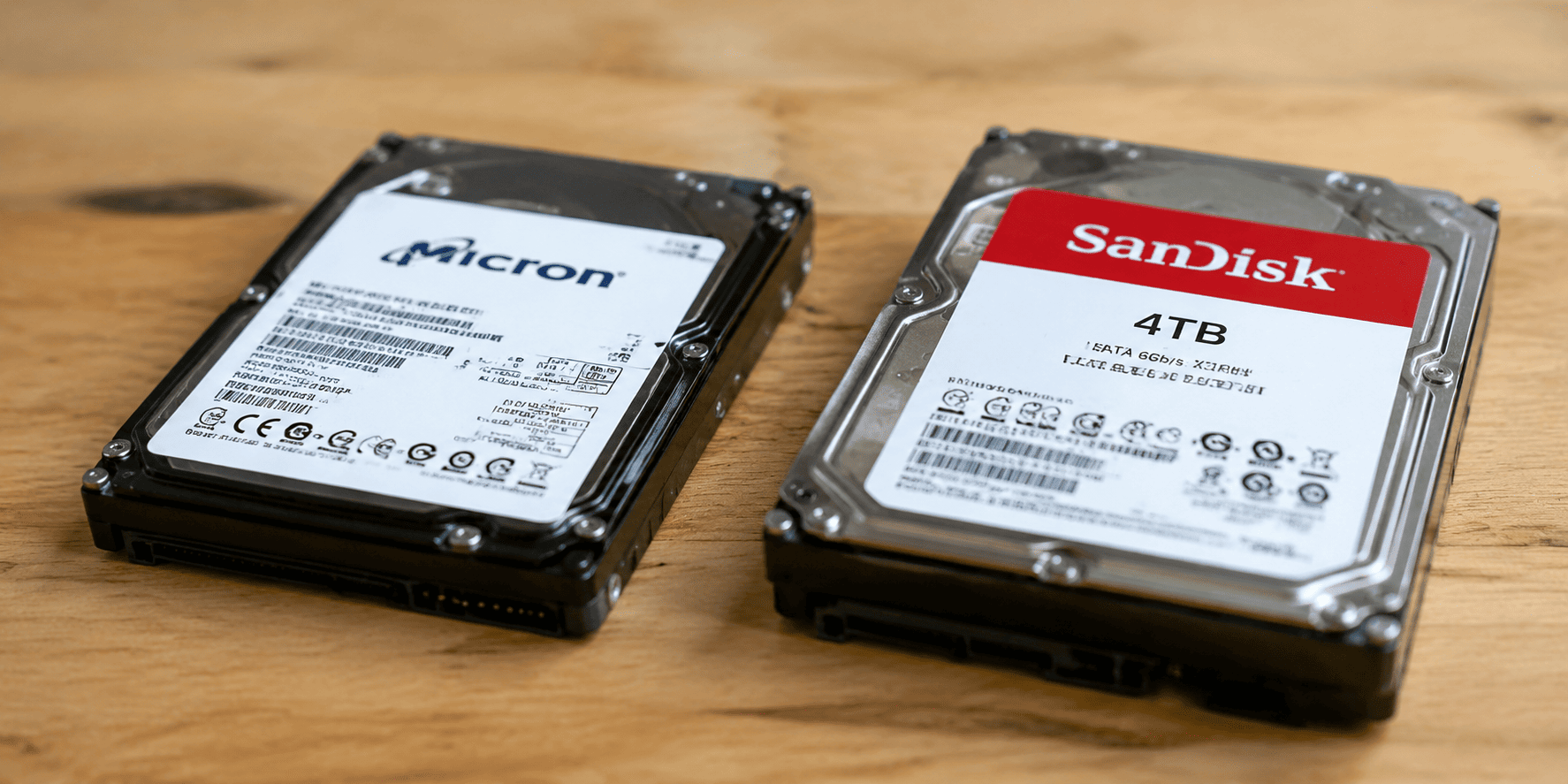
Micron and SanDisk shares continued their decline in Wednesday's premarket trading, as investors further reduced positions in two of the market's most heavily traded memory names. Micron slipped roughly 2% before the bell, while SanDisk fell about 3%, following Tuesday's drops of 4.5% and 4.3%, respectively.
The sell-off does not indicate a collapse in artificial intelligence demand, but rather reflects growing uncertainty about whether the extraordinary memory shortages, pricing power, and margins can persist once new supply enters the market. Tuesday's decline marked Micron's fourth consecutive loss and pushed the Philadelphia Semiconductor Index to a fifth straight retreat.

Profit-taking accelerates amid China memory fears
Investors are locking in gains from stocks that had become some of the market's most crowded AI winners. "When you back off and realize there might be competition coming, all the sheep run to the door at the same time," Robert Pavlik, senior portfolio manager at Dakota Wealth, told Reuters. He described the move as a rush to protect profits, given that Micron and SanDisk entered the week with unusually large gains.
The immediate catalyst was China's ChangXin Memory Technologies (CXMT), but positioning supplied the fuel. Once investors questioned the scarcity narrative, trimming exposure became an easy decision.
CXMT threatens scarcity premium more than near-term earnings
CXMT says it plans to introduce server DDR5 memory using a denser 4F-squared cell architecture by year-end. If successful, that could eventually add meaningful Chinese supply to a market currently dominated by Samsung, SK Hynix, and Micron. Jefferies analysts noted that rapid technology transitions and capacity expansion could keep sentiment toward DRAM weak, but they also cautioned that commercial viability remains uncertain, as Samsung and SK Hynix have pursued similar architectures.
Micron is directly exposed because DRAM represents most of its revenue. SanDisk primarily sells NAND flash, so its similar decline suggests investors are treating memory as one crowded trade rather than separating each company's exposure. Markets are pricing a future threat before CXMT has proven it can manufacture the technology economically at scale.
Strong AI demand argues against calling the cycle broken
The strongest counterargument came from Mizuho TMT specialist Jordan Klein. "I would not be selling or in a panic if I owned MU, SNDK, SKHY or Samsung," Klein wrote in commentary reported by Investing.com. He said CXMT's announcement changed "nothing near term," arguing that a product roadmap does not establish manufacturing maturity, yields, or cost competitiveness.
Wednesday delivered another useful reality check. ASML said AI-driven demand for its chipmaking equipment will exceed planned capacity through 2028, with customers already discussing orders extending into 2029 and 2030. The Dutch group also raised its full-year sales forecast after strong third-quarter results.
That does not guarantee Micron or SanDisk can preserve today's margins, as more manufacturing capacity eventually means more supply, precisely what investors are beginning to discount. But ASML's outlook makes one conclusion difficult to defend: AI infrastructure demand is not suddenly disappearing.
The debate has shifted from whether AI needs enormous amounts of memory to who captures the profits as more capacity enters the market.
This article is for informational purposes only and does not constitute financial advice.