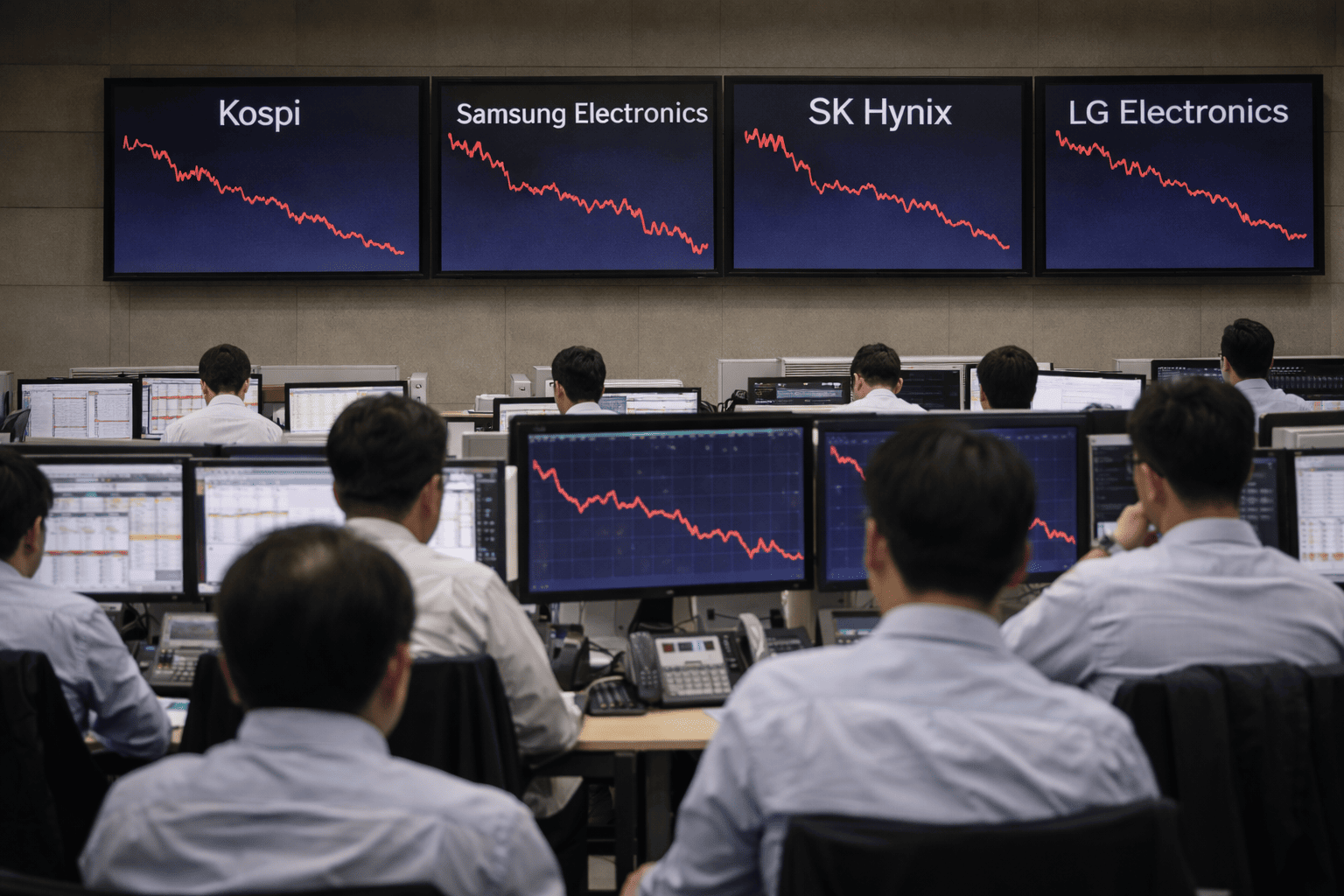
South Korea's benchmark Kospi index suffered its sharpest decline in months on Thursday, plunging more than 5% as a broad selloff in semiconductor and defense stocks rattled investor confidence. The index briefly dipped below 5,350 after opening at 5,580, triggering a temporary halt in program trading on the main exchange. The tech-heavy Kosdaq also activated a sell-side sidecar around noon as it fell below the 700 mark.
Foreign investors were the primary sellers, dumping nearly 2 trillion won ($1.4 billion) worth of shares on the main board. The selling pressure was concentrated in chipmakers, equipment suppliers, and power infrastructure companies, reflecting growing unease about the sustainability of AI-driven demand.

Semiconductor stocks lead the decline
Samsung Electronics fell approximately 8%, while SK Hynix dropped more than 10%, leading the rout. Semiconductor equipment and component makers also suffered, with Hanmi Semiconductor and Samsung Electro-Mechanics posting significant losses. The weakness followed a 3% drop in the Philadelphia Semiconductor Index overnight, even as broader US markets closed higher.
Investors are increasingly worried that Democratic victories in the US midterm elections could lead to tighter restrictions on artificial intelligence infrastructure and data-center development. Proposals for stricter oversight of electricity and water consumption, environmental impact assessments, and permitting requirements could delay new data-center construction, hitting demand for memory chips and equipment.
South Korea is particularly vulnerable to these concerns because memory chips and semiconductor equipment account for a substantial share of its exports and stock market capitalization.
Qualcomm and Arm results add pressure
Mixed earnings from US semiconductor companies compounded the negative sentiment. Qualcomm shares fell after reporting a 26% decline in handset chip revenue to $5.14 billion, missing Wall Street expectations. Rising memory prices have increased smartphone manufacturing costs, raising concerns about device demand and weighing on Qualcomm's core business.
Arm Holdings also struggled despite record quarterly revenue of $1.44 billion, up 27% year over year. The results offered little relief amid broader weakness in semiconductor stocks and concerns about AI-related valuations.
Defense stocks tumble
Defense companies faced heavy selling as investors anticipated that Democratic lawmakers might seek to restrain military spending and pressure the administration to reduce involvement in the Iran conflict. LIG Defense & Aerospace fell 16%, Hanwha Systems declined 11.45%, and Hanwha Aerospace lost over 8%.
However, the selloff was not uniform across the market. "Still, more than 400 stocks are advancing even after the sell-side sidecar was triggered, which shows sector rotation is taking place," Kang Jin-hyuk, an analyst at Shinhan Securities, told the Seoul Economic Daily.
The Korean won weakened slightly against the US dollar. Elsewhere in Asia, Japan's Nikkei 225 slipped around 1.86%, while China's Shanghai Composite edged lower. Hong Kong's Hang Seng Index bucked the regional trend, gaining nearly 3%.
This article is for informational purposes only and does not constitute financial advice.