South Korea's benchmark KOSPI index climbed approximately 3% on Monday, pacing regional gains as investors rotated back into semiconductor shares on renewed enthusiasm for artificial intelligence applications. The index opened 3.34% higher at 6,910.78 and was trading up 2.97% at 6,886.09 by late morning in Seoul.
Samsung Electronics advanced 4.91%, while SK Hynix jumped 8.4%, with both foreign and institutional investors returning as net buyers. The rally occurred despite stronger-than-expected U.S. jobs data, rising oil prices, and lingering expectations that the Federal Reserve could still raise rates this month.

Chip stocks lead the rebound
The KOSPI's recovery was overwhelmingly tech-driven. The PHLX Semiconductor Index rose 3.38% on Friday after OpenAI unveiled GPT-6 Astra, rekindling expectations for another leg of AI-related memory demand. That momentum carried into Seoul, where SK Square gained 5.67% and Hanmi Semiconductor added 5.43%.
According to the Seoul Economic Daily, foreign and institutional investors together purchased approximately 768.4 billion won of shares early in the session, while retail investors sold about 812.2 billion won. Buying was concentrated in large-cap chipmakers.
The bullish case is also supported by supply dynamics. KB Securities expects memory inventories at Samsung and SK Hynix to remain tight, with next year's DRAM and NAND demand exceeding supply by more than 10 percentage points, as reported by the Seoul Economic Daily. Mirae Asset has raised its Samsung target to 400,000 won and its SK Hynix target to 3.1 million won.
Goldman's bold 12,000 target
The rally also drew attention to one of Wall Street's most optimistic calls on Korean equities. Goldman Sachs Asia-Pacific equity strategist Timothy Moe is maintaining a 12-month KOSPI target of 12,000, implying nearly 80% upside from current levels. Moe argues that investors are underestimating the duration of the AI-driven memory cycle and the earnings leverage it creates for Korean chipmakers. Goldman sees the index trading at roughly 5.3 times forward earnings, well below the valuation embedded in its target.
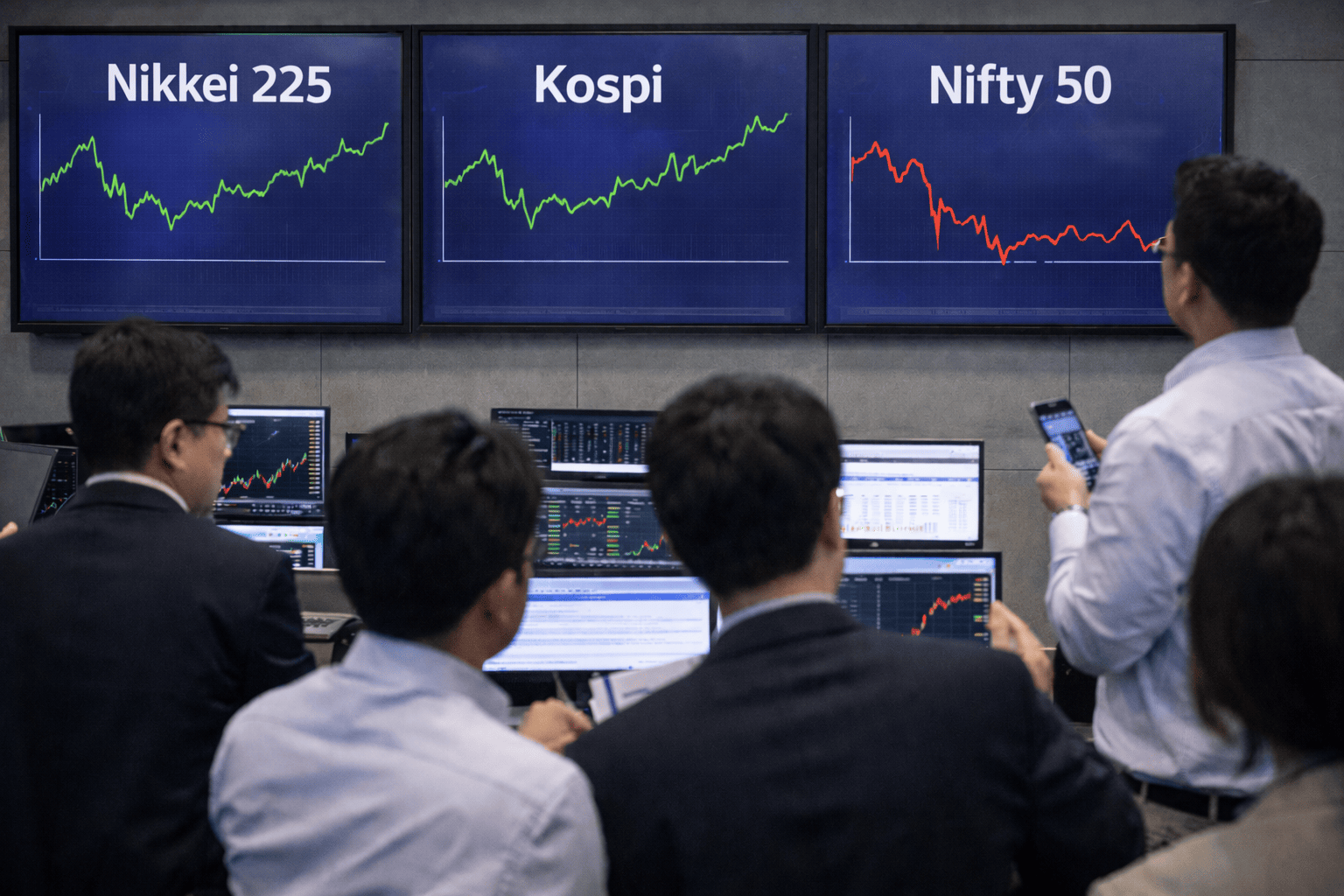
Across Asia, Japan's Nikkei rose 2.2%, Chinese blue chips added 0.2%, and MSCI's Asia-Pacific index outside Japan climbed 1.1%. European futures were softer, with EURO STOXX 50, DAX, and FTSE contracts all down about 0.1%, while S&P 500 and Nasdaq futures were fractionally lower during the U.S. holiday.
Oil and rate risks cap upside
The macro backdrop remains less comfortable. Brent crude rose about 0.7% toward $97 a barrel, and WTI gained roughly 0.8% to above $92 after fresh U.S.-Iran attacks around the Strait of Hormuz. ANZ analysts told The Wall Street Journal that the latest escalation reduced the chances of a quick normalisation in Middle East oil flows. Higher energy prices add to inflation concerns ahead of Friday's U.S. CPI report. The 10-year Treasury yield remained near 4.78%, while markets assigned roughly a 58% probability to a September Fed increase.
For investors tracking the broader tech trade, the KOSPI's move echoes similar strength in other AI-related names, such as AMD's recent bullish flag pattern and Snowflake's surge on AI-driven growth. Meanwhile, the ongoing Middle East tensions have also lifted tanker rates, as seen in the BWET ETF's extraordinary rally. For a broader perspective on Korean equities, see our earlier analysis on KOSPI consolidation near triangle apex.
This article is for informational purposes only and does not constitute financial advice.