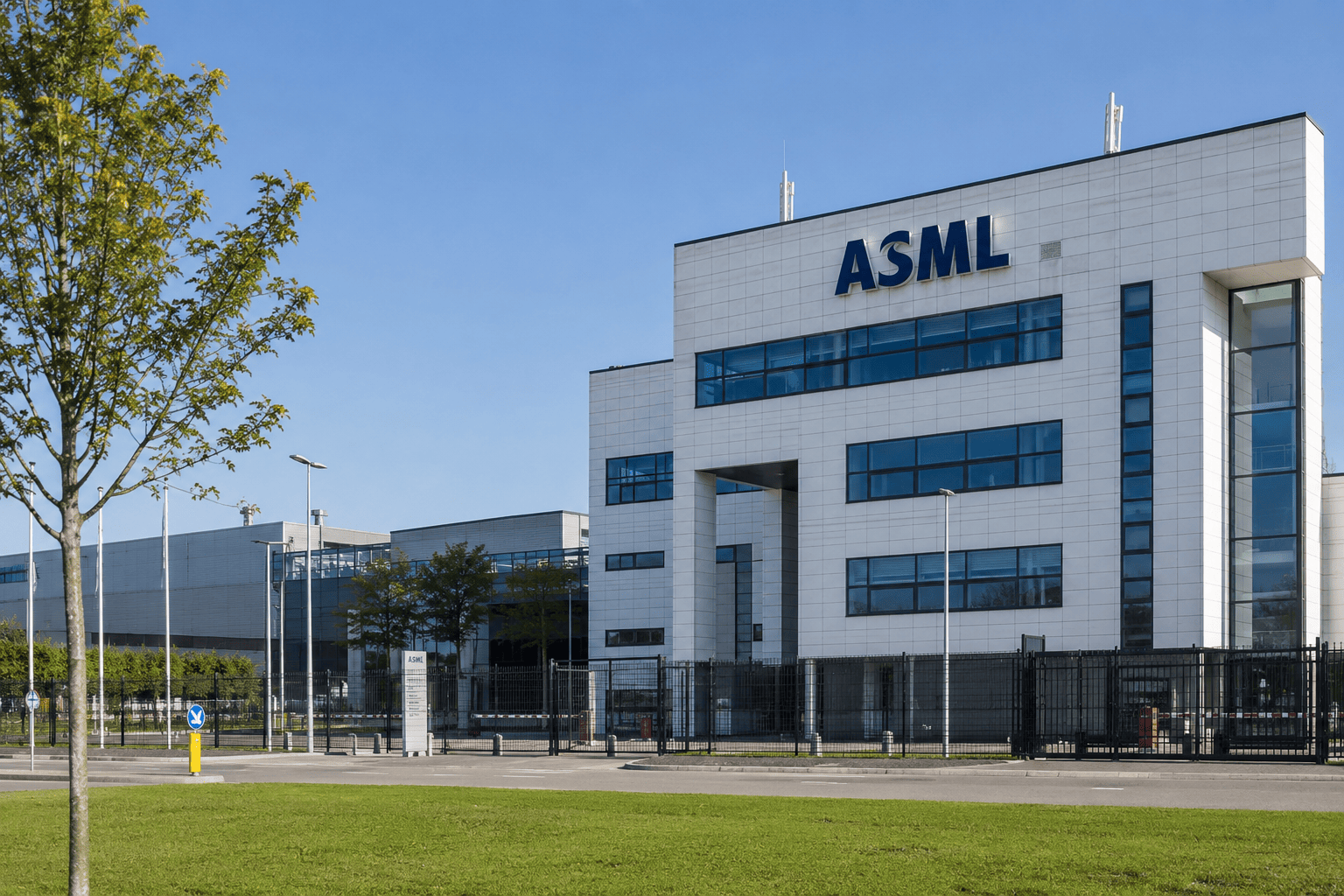
ASML Holding's shares advanced in early trading on Tuesday after two of the world's largest chipmakers signaled deeper adoption of its most advanced lithography systems, reinforcing expectations for sustained growth driven by artificial intelligence demand.
The Dutch semiconductor equipment maker saw its US-listed shares climb roughly 3% in premarket trading, while Amsterdam-listed shares added over 1%. The move followed announcements from Samsung Electronics and Taiwan Semiconductor Manufacturing Co. (TSMC) regarding their plans to integrate ASML's High Numerical Aperture Extreme Ultraviolet (High NA EUV) technology into future production.
Samsung and TSMC accelerate High NA adoption
Samsung said it intends to use High NA EUV for DRAM manufacturing starting in 2028, citing the technology's ability to extend the DRAM scaling roadmap and improve manufacturing efficiency. The decision comes as memory makers race to produce advanced chips required for AI systems.
TSMC, meanwhile, said it expects its use of High NA systems to increase, driven by the increasingly complex transistor architectures needed for AI applications. The Taiwanese chipmaker will begin adopting the technology from 2030, using existing 6-inch photomasks. TSMC had previously been cautious about the expensive equipment, questioning whether productivity gains justified the cost. Its latest commitment marks a notable shift in the economics of advanced chip production.
TSMC manufactures chips for major tech companies including Nvidia, Apple, AMD, and Qualcomm, while Samsung remains a key supplier of memory chips.
ASML gains visibility into next phase of chipmaking
The commitments from Samsung and TSMC add to ASML's growing customer base for High NA EUV. Intel is also using the technology, making these three companies among the most important early adopters of the next-generation equipment.
“This is a big step forward for the adoption of High NA in high-volume manufacturing,” said ASML Chief Technology Officer Marco Pieters. “This is a significant point where customers recognize the benefit of those systems compared to multi-patterning strategies.”
ASML plans to demonstrate a pilot production line using larger photomasks by 2031, with the technology expected to be ready for high-volume production by 2033. The company is also collaborating with Samsung and TSMC on next-generation 12-inch photomask technology, up from the current 6-inch format. Photomasks act as stencils for transferring circuit patterns onto silicon wafers, and larger masks are expected to improve productivity and reduce costs.
“If we're going to pull it off as an industry, then you'll actually see that the productivity of those systems will go up by 40%,” Pieters told Reuters.
AI strengthens the case for expensive lithography
The shift toward High NA EUV is closely tied to the semiconductor industry's AI investment boom. Advanced AI accelerators require increasingly complex transistor architectures, pushing chipmakers to improve manufacturing techniques while reducing the need for complicated multi-patterning processes. High NA EUV could thus be critical not only for future performance gains but also for manufacturing efficiency.
For ASML, stronger adoption could create a major new source of demand after years of working with customers to bring the technology from development to commercial manufacturing. TSMC is particularly important, accounting for roughly 16% of ASML's revenue, according to Bloomberg data. With TSMC, Samsung, and Intel now moving toward High NA, ASML has greater visibility into the potential market for its newest machines.
Investors see stronger growth ahead
Investors have already placed a substantial premium on ASML's position in the AI semiconductor supply chain. The stock has gained about 120% over the past year, and analysts increasingly view High NA adoption as a key factor supporting long-term growth.
Barclays said the latest announcements “should provide more visibility on adoption which has been a key debate,” adding that the news is “a positive.” The company has not recently provided a specific forecast for High NA machine sales, although it expects to increase total EUV capacity by about 30% in 2027. ASML raised its financial guidance for 2026 in July after reporting stronger-than-expected second-quarter earnings and announcing plans to expand capacity.
Barclays noted that stronger customer commitments could force ASML to consider expanding capacity beyond its existing plans. “We see ASML with a significant decision ahead on whether to further expand EUV capacity than the recently expanded targets it has already given. Demand is clearly strong,” the analysts said.
BofA Global Research maintains a Buy rating on ASML Holding with a price target of €2,452. Last month, the firm said it expects ASML to deliver one of the strongest growth profiles among large-cap semiconductor equipment makers.
For more on the broader semiconductor landscape, see our coverage of AI memory demand and AI-driven growth in tech.
This article is for informational purposes only and does not constitute financial advice.