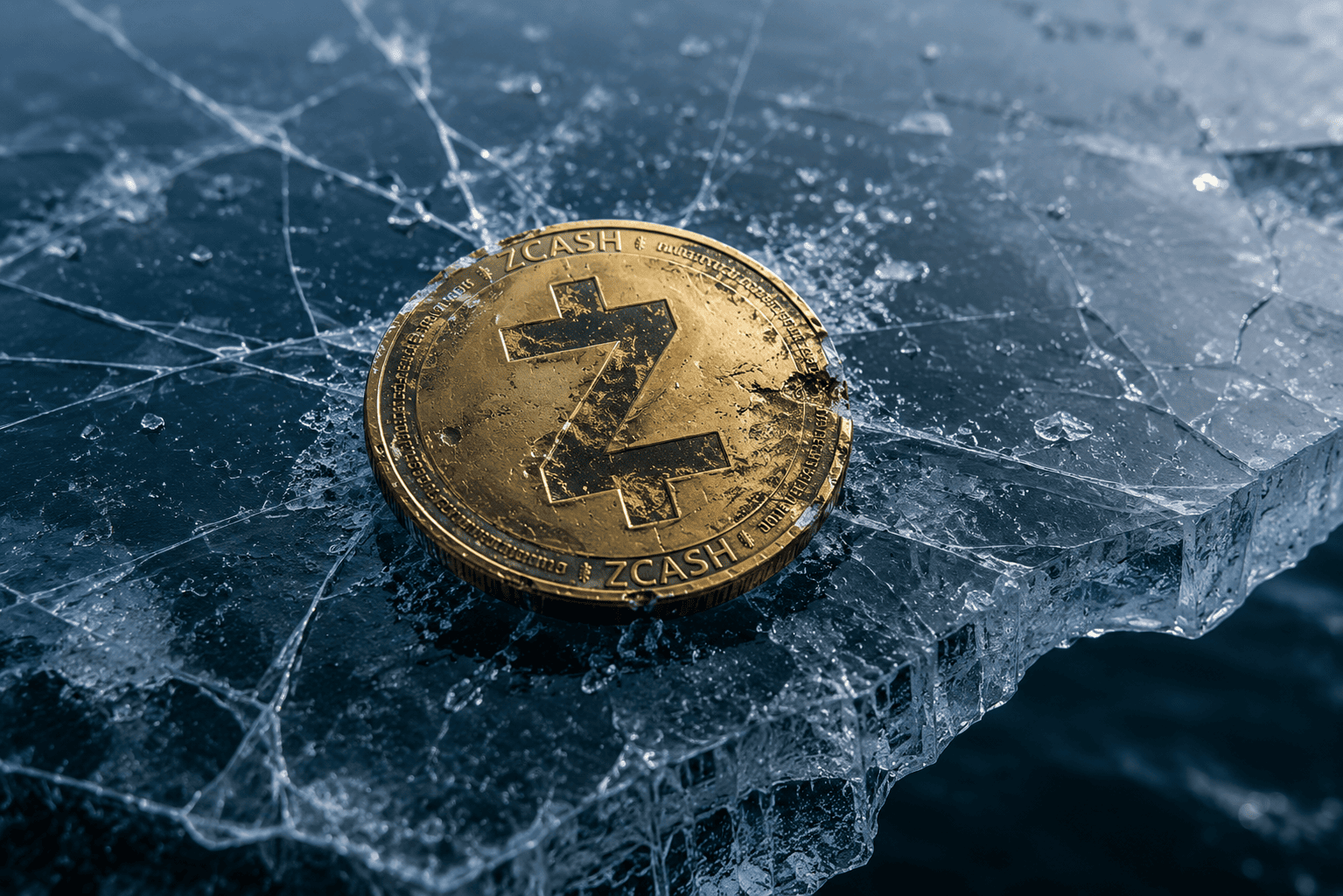
Zcash's ZEC token has experienced a sharp decline of over 36% from recent highs following the disclosure of a critical vulnerability in the network's Orchard shielded pool. The cryptocurrency is now approaching a key long-term support area around $367, drawing the attention of traders and analysts.
Vulnerability Discovery and Emergency Response
According to information released by Shielded Labs and the Zcash Open Development Lab, security engineer Taylor Hornby discovered the flaw on May 29 and promptly reported it to developers. An emergency hard fork was activated on June 3 to mitigate the risk. The vulnerability affected the cryptographic circuit underlying the Orchard privacy pool, and Hornby, assisted by Anthropic's Claude Opus 4.8 model, identified a flaw in an elliptic curve multiplication check. He successfully built a proof-of-concept exploit capable of generating counterfeit ZEC.

Researchers at Shielded Labs warned that if the same exploit had been executed on the live network before the patch, it could have produced “unlimited, undetectable counterfeit ZEC” inside an Orchard wallet. Despite the fix, uncertainty persists because Orchard's privacy design makes it impossible to cryptographically prove whether the flaw was exploited before disclosure.
Market Reaction and Technical Levels
ZEC traded near $390 on Thursday after briefly changing hands above $611 earlier this week, wiping more than $3 billion from its market capitalization. The selloff has pushed the token below its 20-day, 50-day, and 100-day exponential moving averages. The next major technical level sits near the 200-day exponential moving average around $367, a region that also aligns with a historically high-volume trading zone on the volume profile.
Momentum indicators have weakened significantly. The daily Relative Strength Index (RSI) has dropped to roughly 37, its lowest level in several weeks, indicating elevated selling pressure. The Bollinger Bands show ZEC pressing near the lower band after losing the middle band during the selloff, with the lower band in the high $300s, close to spot price. Combined with an RSI near 37, the setup highlights heavy downside momentum.
Liquidation Data and Support Levels
CoinGlass liquidation data indicates that much of the leveraged long positioning has already been cleared out during the decline. Remaining liquidation clusters are concentrated above the current market price, particularly between $430 and $500, with larger pockets extending toward the $550 region. Those levels could attract price if buyers return, though current market attention remains fixed on whether the $367 area can hold.
Beneath the current trading range, volume profile data indicates another historically active trading zone between approximately $220 and $260, where ZEC spent several months consolidating earlier this year. If the $367 region fails to hold, traders could begin monitoring that lower volume cluster as the next major area of historical support.
Industry Reactions and Historical Context
Arthur Hayes, co-founder of BitMEX, stated on Friday that illegal minting of ZEC through the Orchard flaw was unlikely, although he acknowledged there is no formal cryptographic proof that it never happened. “Sadly, due to the Orchard Pool exploit, I had to dump our entire ZEC bag,” Hayes wrote on X. “The Holy Trinity is dead,” he added, referring to Zcash, Hyperliquid, and Near Protocol, which he said he had sold this week.
Mert Mumtaz, co-founder and CEO of Solana infrastructure company Helius, noted that variants of the same issue exist across many privacy protocols because complex zero-knowledge circuits can contain bugs that are difficult to detect. “This same FUD comes back every five months as new people learn how privacy pools work,” Mumtaz wrote.
This incident is not the first counterfeiting-related concern for Zcash. In 2018, the Electric Coin Company discovered a vulnerability in the cryptography underpinning zk-proofs and later remediated the issue without any known losses.
Looking Ahead
As questions linger over whether the Orchard flaw was ever exploited, Shielded Labs said it is working with Zcash developers on a network upgrade that would allow users to verify the integrity of the circulating ZEC supply and prove the absence of counterfeit coins in the Orchard pool. For more on market dynamics, see our coverage of XRP's recent price action and global FX market trends.
This article is for informational purposes only and does not constitute financial advice.