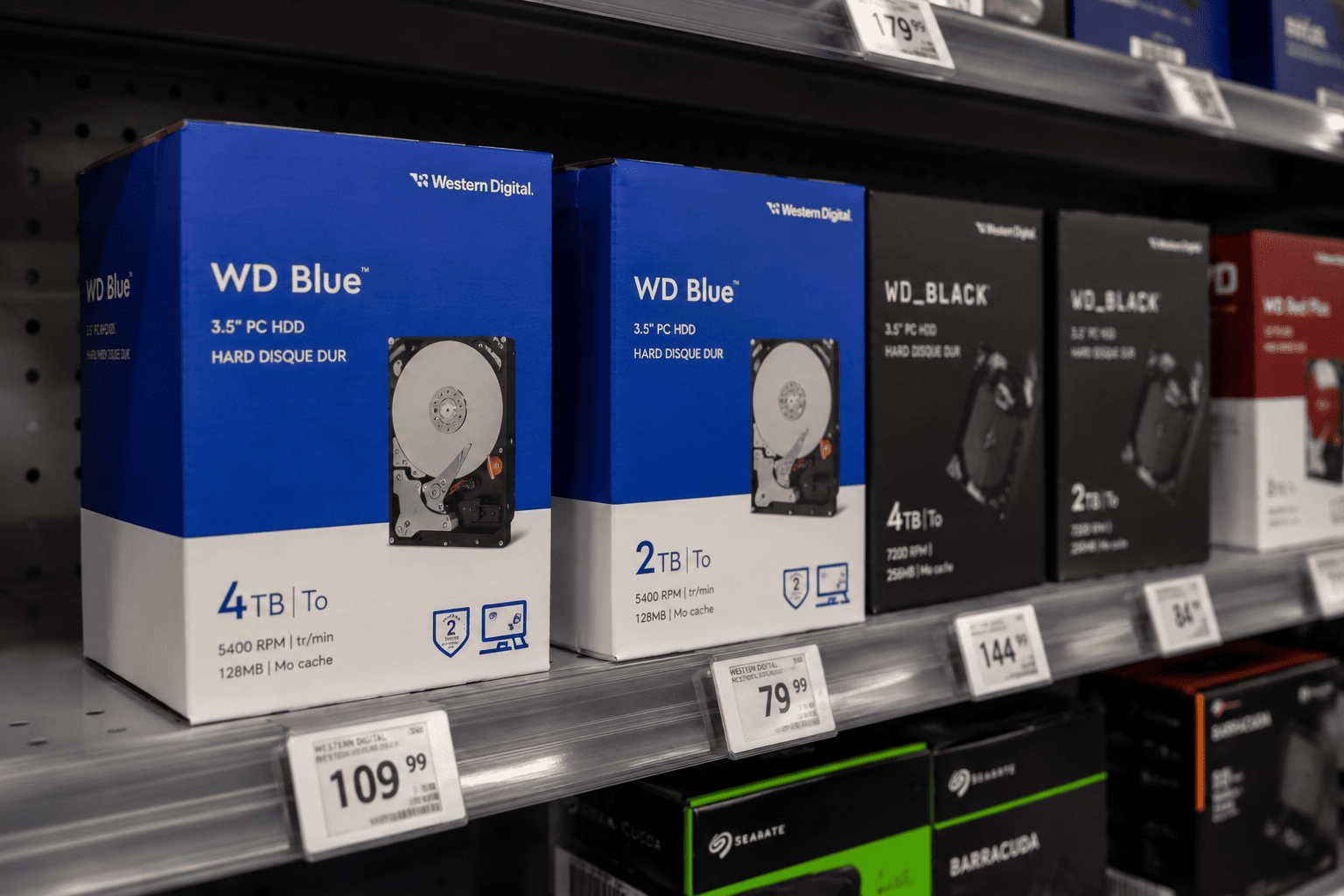
Western Digital shares have tumbled into bear market territory, shedding roughly half their value from an all-time high and dragging the company's market capitalization down to about $148 billion from a peak of $258 billion. The decline has unfolded alongside a broad retreat across the memory sector, with SanDisk off more than 31% from its high, Kioxia down 52%, and the DRAM-focused exchange-traded fund sliding over 27% from its record level.
Technical picture points to a bearish resolution
On the daily chart, the stock has retreated from a June high near $799.8 to around $408. That move has carved out a descending triangle, a formation defined by a flat support line and a downward-sloping resistance trendline. When those two lines converge, the pattern historically resolves to the downside more often than not.

Momentum indicators reinforce the cautious reading. The shares have slipped beneath both the 50-day moving average and the Supertrend indicator, while the Relative Strength Index has dropped below the neutral 50 mark. Should the stock break under the $410 support level, sellers could target the $300 zone next.
Fundamentals remain strong despite the sell-off
The price action stands in sharp contrast to the company's operating results. Revenue climbed 44% to $3.7 billion in the most recent quarter, lifted by robust storage demand in the United States and abroad. Gross margin expanded to 54.4% from 50.5% in the prior period, and operating income surged 126% to more than $1.65 billion.
Management has guided for continued top-line expansion. Analysts covering the company project first-quarter revenue of $4.13 billion, a 47% year-over-year increase, with full-year revenue reaching $19.19 billion and $26 billion the following year. Given the pace of AI-related infrastructure spending, those estimates could prove conservative.
Valuation also looks undemanding. The forward price-to-earnings ratio sits near 20, well below the five-year average of 35, which suggests the market is pricing in a meaningful slowdown.
Cyclical risk is the central concern
The memory industry is notoriously boom-and-bust, and the current upcycle could reverse if demand cools. A contraction in data center spending, or the bursting of an AI investment bubble as some prominent investors have warned, would hit results hard. Western Digital has sought to blunt that cyclicality through long-term supply agreements with major customers, which offer better revenue visibility and greater pricing power. However, pricing terms are still being finalized, leaving the company exposed to any pullback in hyperscaler capital expenditure.
Wall Street remains constructive on the name. Citigroup carries a $740 target, Morgan Stanley sees $676, and the average analyst estimate of $534 implies roughly 30% upside from current levels. Whether the chart or the fundamentals ultimately prevail will depend on whether the $410 support level holds.
This article is for informational purposes only and does not constitute financial advice.

