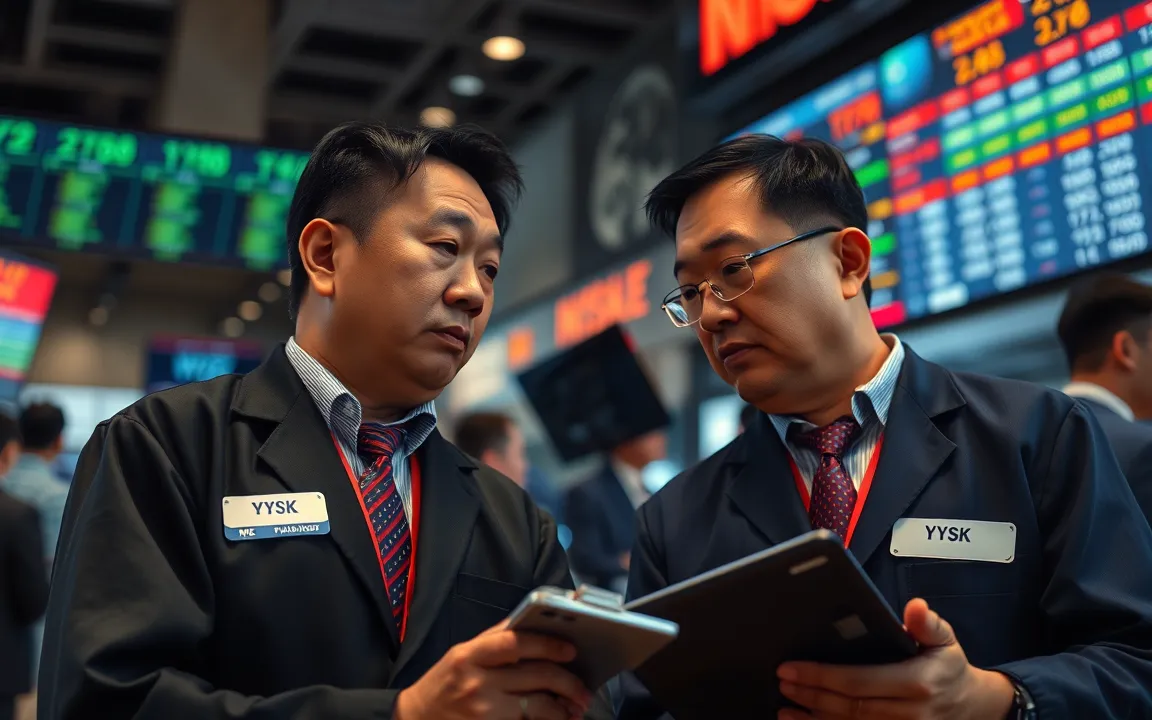
South Korean equities led Asian losses on Monday as foreign investors aggressively sold semiconductor heavyweights, while Japan's Nikkei 225 avoided the renewed AI sell-off due to a market holiday.
The KOSPI index fell as much as 3.15% before paring losses, with Samsung Electronics and SK Hynix at the forefront of the decline. By 12:30 pm in Seoul, the index was down 2.57% at 6,459.69 after touching a low of 6,417.27.

Foreign investors sold a net 1.36 trillion won of shares, while institutions offloaded another 850 billion won. Retail investors, however, bought more than 1 trillion won into the decline. Samsung Electronics fell 2.86% and SK Hynix lost 3.15%, with foreigners selling roughly 919 billion won of SK Hynix and 462 billion won of Samsung alone.
The selling appears particularly striking against the companies' fundamentals. Samsung last week forecast a record 107.4 trillion won quarterly operating profit, driven by AI-driven memory shortages that lifted prices and margins. Mirae Asset Securities analyst Kim Seok-hwan noted that Korea's two largest chipmakers were absorbing renewed AI-bubble concerns stemming from the OpenAI revenue debate.
The calendar amplified the move. Seoul was closed on Friday for Hangeul Day, forcing investors to digest Thursday's US technology sell-off and Friday's partial rebound in a single session.
Japan has avoided Monday's semiconductor pressure only temporarily. Tokyo cash equities are closed for Sports Day and reopen Tuesday, although Osaka Exchange derivatives are trading during the holiday. The Nikkei 225 ended Friday almost unchanged at 69,030.92, recovering from an early 1.3% drop but still finishing the week 0.39% lower. SoftBank Group fell about 4% as investors reassessed OpenAI's revenue trajectory and the increasingly expensive financing behind the AI investment boom.
The concentration matters, as Advantest and Tokyo Electron alone account for more than 22% of the Nikkei, making Tuesday's reopening an important test of whether Korea's semiconductor de-risking spreads into Japan's AI-heavy leaders.
The broader regional tape was considerably calmer. Taiwan fell about 0.5%, while MSCI's Asia-Pacific index excluding Japan slipped 0.3%. The CSI 300 edged 0.1% higher. The contrast is particularly notable in Taiwan, where TSMC is expected to report a sixth consecutive record quarterly profit this week, with net income forecast to jump about 65% to T$746.3 billion. Morgan Stanley analyst Charlie Chan expects the chipmaker to raise its full-year revenue-growth outlook as demand for advanced AI chips remains strong.
Hong Kong shares extended Friday's rebound, while Australia's ASX 200 gained about 0.6% in early trade. India joined the resilient side of the split, with the Nifty 50 opening 0.27% higher and the Sensex gaining 0.21%, helped by lower crude prices and Reserve Bank of India measures that strengthened the rupee.
This article is for informational purposes only and does not constitute financial advice.

