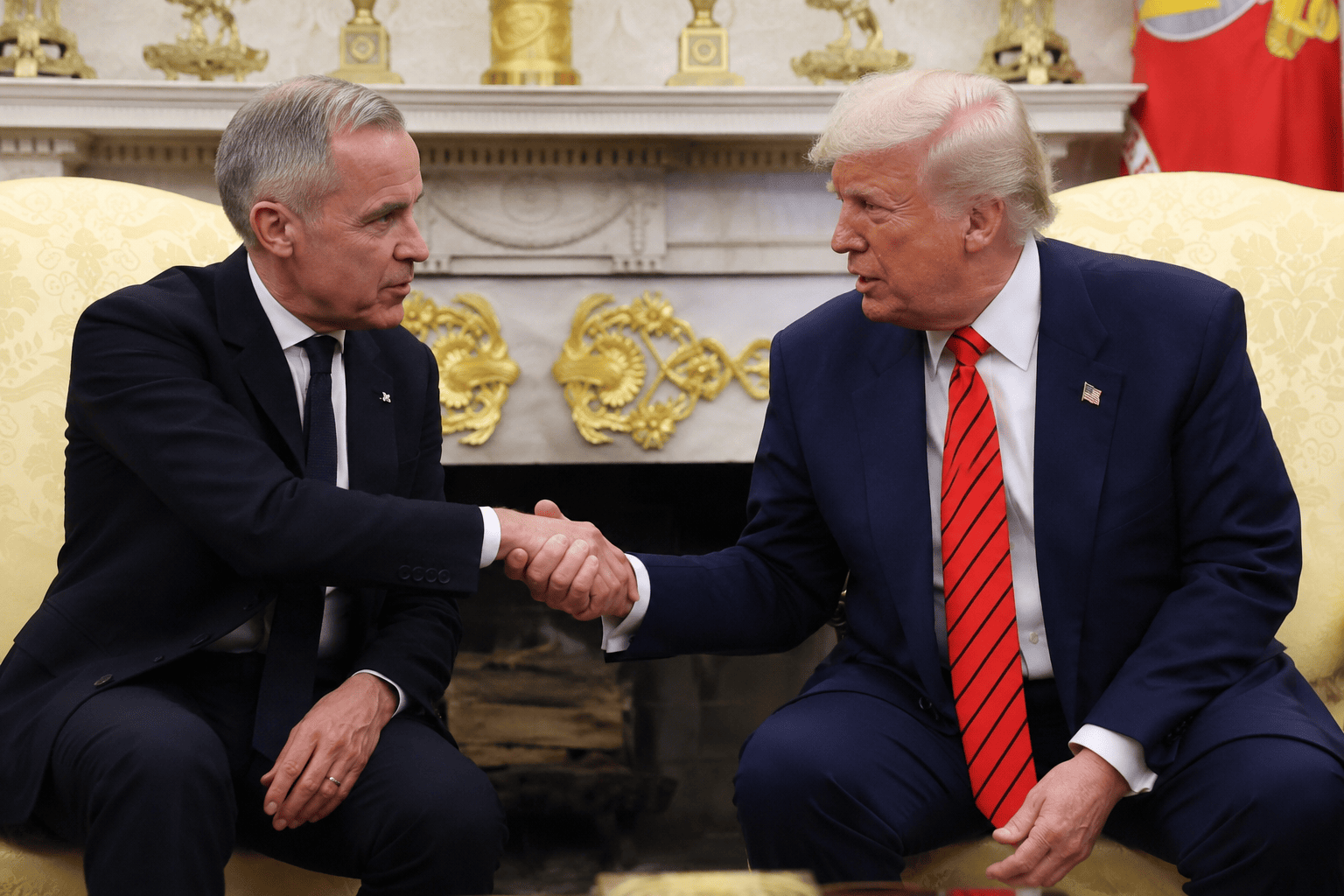
President Donald Trump has granted Canada a three-day reprieve from a new round of steep tariffs, announcing late Tuesday that Washington and Ottawa are close to finalizing a trade agreement. The pause, which came about 90 minutes before the duties were set to take effect, applies to a 50% tariff on approximately $20 billion worth of Canadian goods.
In a statement, Trump said the delay was based on the expectation that a deal would be completed. "I have paused the 50% Tariffs against Canada, that were scheduled to kick in tomorrow morning for a three day period, based on the fact that Canada and the U.S.A., subject to the finalization of documents, have a DEAL!" he wrote. The White House indicated that Canada had agreed to certain trade concessions, though specific terms have not been released.

The proposed tariffs were introduced last month in response to what the administration described as Canadian trade discrimination in the automotive, alcohol, and dairy sectors. The duties would be imposed under Section 338 of the Tariff Act of 1930, a rarely used provision from the Great Depression era. While the targeted imports represent a small fraction of the more than $383 billion in Canadian goods the U.S. imports annually, they include highly visible consumer products such as hockey equipment, wine, and forestry items.
For Canadian businesses, the 50% tariff would be particularly damaging. Dan Kelly, president of the Canadian Federation of Independent Business, told CNBC that a tariff of that size "essentially makes a product uneconomic to sell into a particular market." He noted that some of the organization's 103,000 members were already seeing U.S. buyers delay orders ahead of the deadline. Many businesses feared the duties could "grind their US sales to a halt," he added.
The three-day pause provides a narrow window for negotiators to convert the tentative agreement into a formal document. It also offers temporary relief for companies bracing for an immediate cost increase, though uncertainty remains because the underlying dispute has not been resolved. Canadian Prime Minister Mark Carney struck a cautious tone, acknowledging "substantial progress" but stressing that "important work still needs to be done." He also reiterated Canada's goal of building a "stronger, more independent, and more competitive economy at home."
Trump hinted that the agreement could involve reviving the Keystone XL Pipeline, a long-delayed project designed to transport crude oil from Alberta to the U.S. Midwest. The Office of the U.S. Trade Representative said the potential deal would include "comprehensive market access for all American goods, economic security commitments, digital trade alignment, and many important provisions that will continue to protect our market and American workers, along with our Canadian partners."
The tariff threat extends beyond the immediate dispute. Trade experts warn that prolonged tariffs could trigger job losses and business closures in vulnerable Canadian sectors, particularly lumber, wine, and dairy. The situation also complicates broader negotiations over the USMCA, the trade agreement governing commerce between the U.S., Canada, and Mexico. As markets digest the news, investors are also watching other geopolitical developments, such as rising oil prices on Iran tensions and Brent crude approaching $90.
For now, the three-day pause has prevented an immediate escalation. But unless the two countries finalize their agreement, Canadian businesses could soon face the same tariff threat that prompted this last-minute reprieve. The coming days will be critical for determining whether the deal holds or if the trade dispute escalates further.
This article is for informational purposes only and does not constitute financial advice.