
Oil markets opened the week with renewed geopolitical tension as Brent crude climbed toward $90 a barrel, driven by a sharp slowdown in tanker traffic through the Strait of Hormuz and the breakdown of US-Iran diplomacy. West Texas Intermediate (WTI) also advanced, trading above $82, though both benchmarks remain capped by a deteriorating global demand picture.
Brent rose as much as 1% to $89.40, while WTI reached $82.83. Last week, both contracts gained more than 5% following attacks on tankers and Saudi energy infrastructure, reviving concerns that supply disruptions could persist even as consumption weakens. The market's response, however, has been measured rather than disorderly, with analysts pointing to a tug-of-war between geopolitical risk and economic fundamentals.
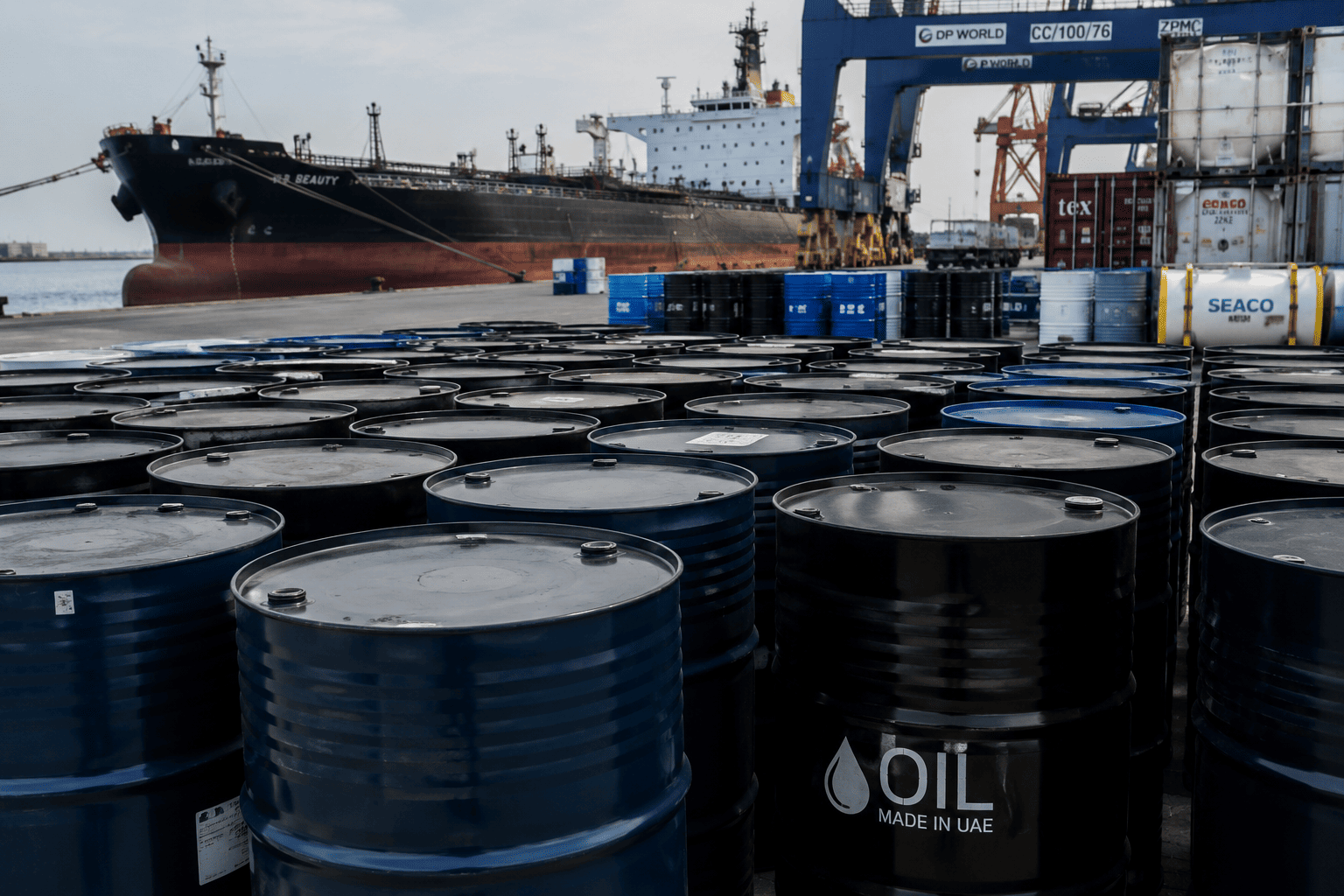
Hormuz disruptions keep upside risk alive
The immediate catalyst remains the Strait of Hormuz, where shipping activity has slowed dramatically. Only five commodity vessels crossed the strait on Saturday, and none were recorded on Sunday, compared with 31 the previous weekend. Washington and Tehran remain deadlocked over reopening the route, and Iran's Foreign Minister Abbas Araqchi has indicated that Tehran has not decided whether to resume negotiations with the US. The UAE has also accused Iran of targeting another ADNOC-operated tanker, adding to the friction.
Fresh violence in Lebanon has further heightened regional risk. Israeli strikes in southern Lebanon killed at least 11 people over the weekend, marking the deadliest escalation since a June truce with Hezbollah. These developments have restored a geopolitical premium to crude, but the market's reaction has been tempered by the realization that high prices are themselves a drag on demand.
Demand emerges as the main brake on crude
The bullish supply narrative is colliding with a rapidly weakening consumption outlook. The International Energy Agency (IEA) now expects global oil demand to decline by 1.6 million barrels a day in 2026, a larger contraction than previously projected. The agency also forecasts a year-on-year drop of 2.8 million barrels a day in the third quarter, citing high fuel prices and disrupted supply chains.
OPEC remains more optimistic, projecting demand growth of 580,000 barrels a day this year, though that estimate has been repeatedly cut. This divergence explains why Brent is struggling to break decisively above $90 despite severe disruption around Hormuz. Traders are pricing in a real supply shortage, but they are also increasingly questioning how much expensive crude the global economy can absorb.
Brent near $90 becomes the next test
The US Energy Information Administration (EIA) expects Brent to average about $85 a barrel in the third quarter before easing toward $78 in the fourth, assuming shipping improves and shut-in production gradually returns. WTI remains at a discount to Brent because international supply disruptions hit seaborne crude more directly than the US market, highlighting why the broader oil story cannot be read from WTI alone.
For investors using trading platforms to gain exposure to crude futures, energy shares, or oil-linked ETFs, the volatility is significant. With Brent approaching $90, shifts in Hormuz traffic or diplomatic headlines could produce sharp moves across the sector. As one market strategist noted, geopolitics is setting the floor and demand is setting the ceiling.
A further collapse in Hormuz traffic could push Brent through $90 quickly, while any credible diplomatic breakthrough would expose crude to the increasingly soft consumption outlook. The market remains in a delicate balance, with supply risks and demand weakness pulling in opposite directions.
This article is for informational purposes only and does not constitute financial advice.