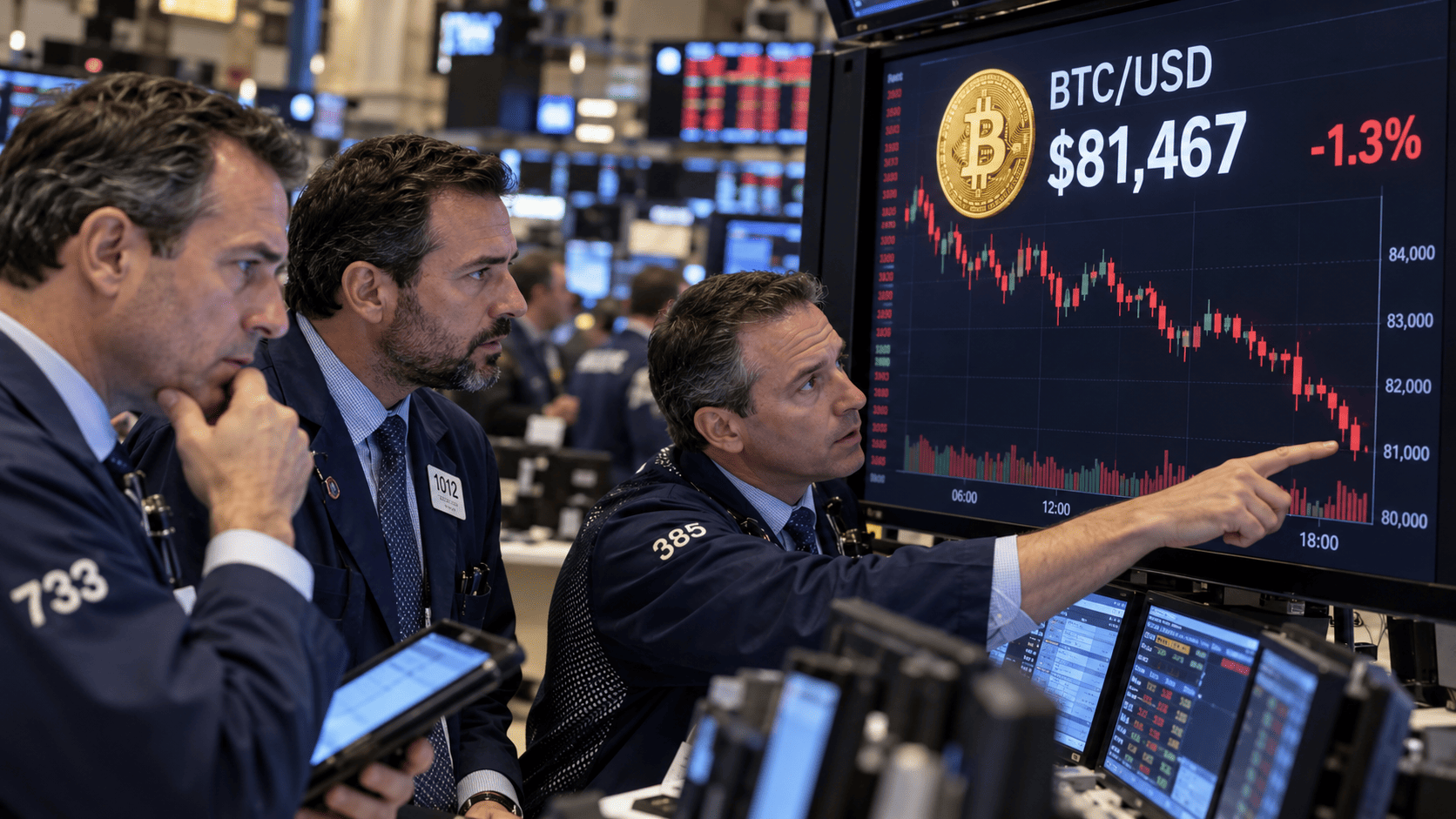
Bitcoin slipped below $81,500 on Tuesday, shedding 1.3% over the past 24 hours as a tentative recovery lost steam. The digital asset had briefly bounced after dipping under $80,000, but buyers have yet to clear overhead resistance, leaving the market in a consolidation phase between a psychologically significant support level and a resistance band near $84,000–$84,714.
The latest rebound shows that buying interest exists around recent lows, yet holding support and breaking resistance are separate challenges. Broader economic conditions are likely to influence both, with energy prices and monetary policy expectations playing a central role.

Oil's Climb Complicates Inflation Outlook
Brent crude rose to $111.32 a barrel, its highest level in five months, driven by geopolitical tensions and uncertainty over interest rates. Higher energy costs can reinforce inflation concerns, complicating expectations for Federal Reserve policy. For Bitcoin, that backdrop could limit risk appetite even when technical support attracts buyers.
The US crude oil inventory release scheduled for October 21 may serve as a near-term catalyst. A larger-than-expected draw could add upward pressure to oil prices, while a result that eases supply concerns might offer some relief. Attention will also turn to the Federal Reserve's October 27–28 meeting, where investors will assess the policy response to persistent inflation.
Analysts at Bitfinex Alpha, in an email to Invezz, noted that they expect $81,300 to act as the centre of the weekly range rather than its floor, and the bearish path is the more likely of the two. Bitcoin has lagged the fall in AI-linked equities, and with a 0.78 twenty-day correlation to the Nasdaq-100, a further leg down in technology shares would take price through $79,821 into the $77,600 to $80,400 accumulation band before the October 28 FOMC decision.
Liquidations and Leverage Risks
Thanks to the bearish performance over the past 24 hours, the broader crypto market recorded $160 million in liquidations, with long positions accounting for roughly $112 million of recent closures. Those figures cover the broader crypto market rather than Bitcoin alone. The concentration of liquidations among bullish traders shows how quickly leveraged positions can come under pressure when prices fall.
Forced selling can amplify a decline as traders lose the collateral needed to maintain their positions. Bitcoin's return above $80,000 has reduced immediate pressure, but another support failure could expose vulnerable longs to further losses.
Technical Levels and Scenarios
The BTC/USD daily chart remains bullish as Bitcoin has been consolidating between $80,000 and $84,000 over the past few days. The immediate resistance now stands at the $84,261 area, which serves as an estimated acquisition cost for spot Bitcoin ETF holders. A sustained recovery through the resistance zone would provide stronger evidence that buyers are regaining control. Until then, an intraday rebound remains consistent with consolidation rather than a confirmed change in trend.
The bullish scenario depends on Bitcoin holding $80,000 while oil-market pressure eases. Those conditions could support another attempt to reclaim the $84,261 resistance. The base case is continued trading within that range as investors wait for clearer economic and monetary policy signals.
The bearish scenario involves a decisive, sustained break below $80,000. That would weaken the recovery structure and increase the risk of renewed liquidation-driven selling. For now, Bitcoin's ability to defend support remains as important as its response to resistance, with energy prices and the approaching Fed decision shaping the backdrop.
This article is for informational purposes only and does not constitute financial advice.