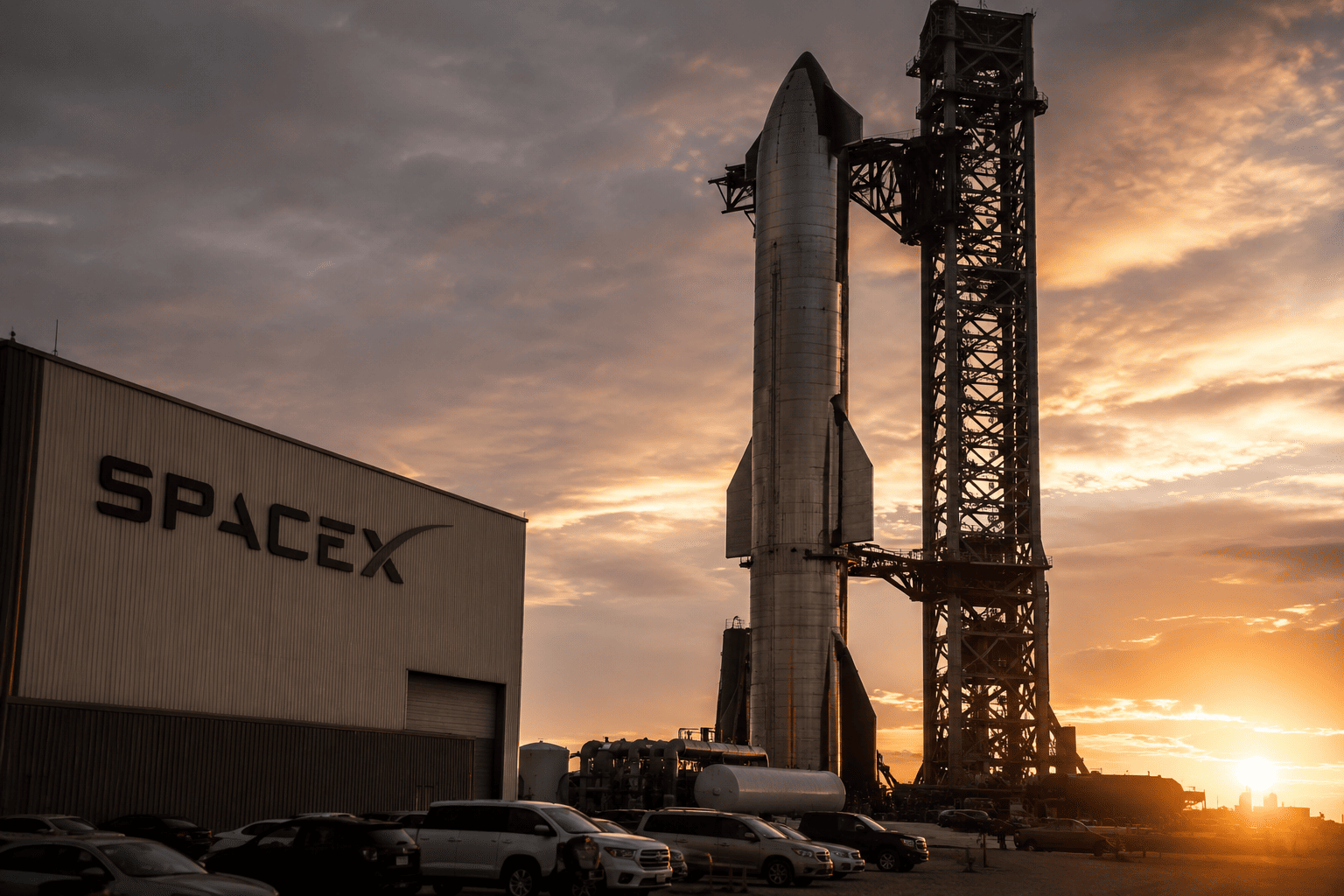
Space Exploration Technologies Corp. (SPCX) shares traded higher on Thursday, building on the prior session's rally, as investors weighed the company's accelerating launch cadence and the revised timeline for its next Starship test flight. The stock's upward momentum comes amid a busy period of mission activity and growing interest in the company's space-based revenue streams.
Starship Flight 14 rescheduled
SpaceX announced that the 14th test flight of its Starship vehicle has been moved to as early as September 28, pending regulatory approval. According to the company, the mission is expected to reach an altitude of approximately 275 kilometers and complete about six orbits over a nearly 10-hour flight, concluding with a splashdown in the Pacific Ocean west of Chile. The updated schedule adds to the momentum around SpaceX's launch business, which has been a key focus for investors.

Launch activity remains brisk
The company successfully launched the USSF-259 mission on Wednesday aboard a Falcon 9 rocket from Space Launch Complex 4E in California, with the booster landing on a droneship after liftoff. Additional missions are lined up, including a Starlink launch scheduled for September 19-20 and the USSF-385 mission on September 26. This steady cadence underscores SpaceX's operational tempo and its role as a primary launch provider for both government and commercial clients.
Analyst highlights three business pillars
Seeking Alpha analyst Danil Sereda noted that SpaceX's stock is trading about 41% above its August lows following the company's earnings report. He frames the business across three core areas: launch, connectivity, and AI. The launch segment includes Falcon 9, Starship V3, and Starshield, while connectivity is led by Starlink. The AI operations encompass xAI, Grok, and terrestrial and orbital compute initiatives.
Sereda pointed out the capital-intensive nature of the launch and AI businesses. The launch unit generated $962 million in second-quarter 2026 revenue, up 29% year over year, but recorded an operating loss of $542 million. Similarly, the AI business brought in $2.56 billion in revenue but posted a $1.26 billion operating loss. These figures highlight the heavy investment required to scale these operations.
Starlink remains the profit engine
Starlink continues to be the standout performer, with revenue rising 66% year over year to $4.29 billion in the second quarter. The segment's EBITDA margin reached 60.5%, and the company added 1.7 million net subscribers during the quarter. While average revenue per user declined from $99 to $66 per month, the figure stabilized on a quarter-over-quarter basis. Sereda emphasized that Starlink's growth and operating leverage distinguish it from SpaceX's more capital-intensive launch and AI ventures.
As of the second quarter, Starlink operated more than 10,200 low-Earth-orbit satellites across 167 markets and had 12 million active users. The service's expanding footprint and profitability make it a critical component of SpaceX's valuation.
Broader context and market sentiment
Wednesday's rally also followed comments from Cathie Wood, who suggested that a single Starship mission could eventually be worth close to $1 billion if the vehicle reaches a target of 10,000 flights annually by 2030. While speculative, such projections add to the narrative around SpaceX's long-term potential. Additionally, Air Force Secretary Troy Meink recently discussed the presence of weapons already positioned in orbit, which, while not specific to SpaceX, contributes to the broader backdrop for the space industry.
Investors are also weighing the five-year outlook for SpaceX, which hinges on AI revenue and Starship's success. The company's latest launch activity and Starship plans continue to draw attention, even as lockup overhang and Starship test risks have caused some volatility in the stock.
With a packed launch schedule and a rescheduled Starship test, SpaceX remains a focal point for investors tracking the commercialization of space. The company's ability to balance growth across its launch, connectivity, and AI segments will likely determine its trajectory in the coming quarters.
This article is for informational purposes only and does not constitute financial advice.

