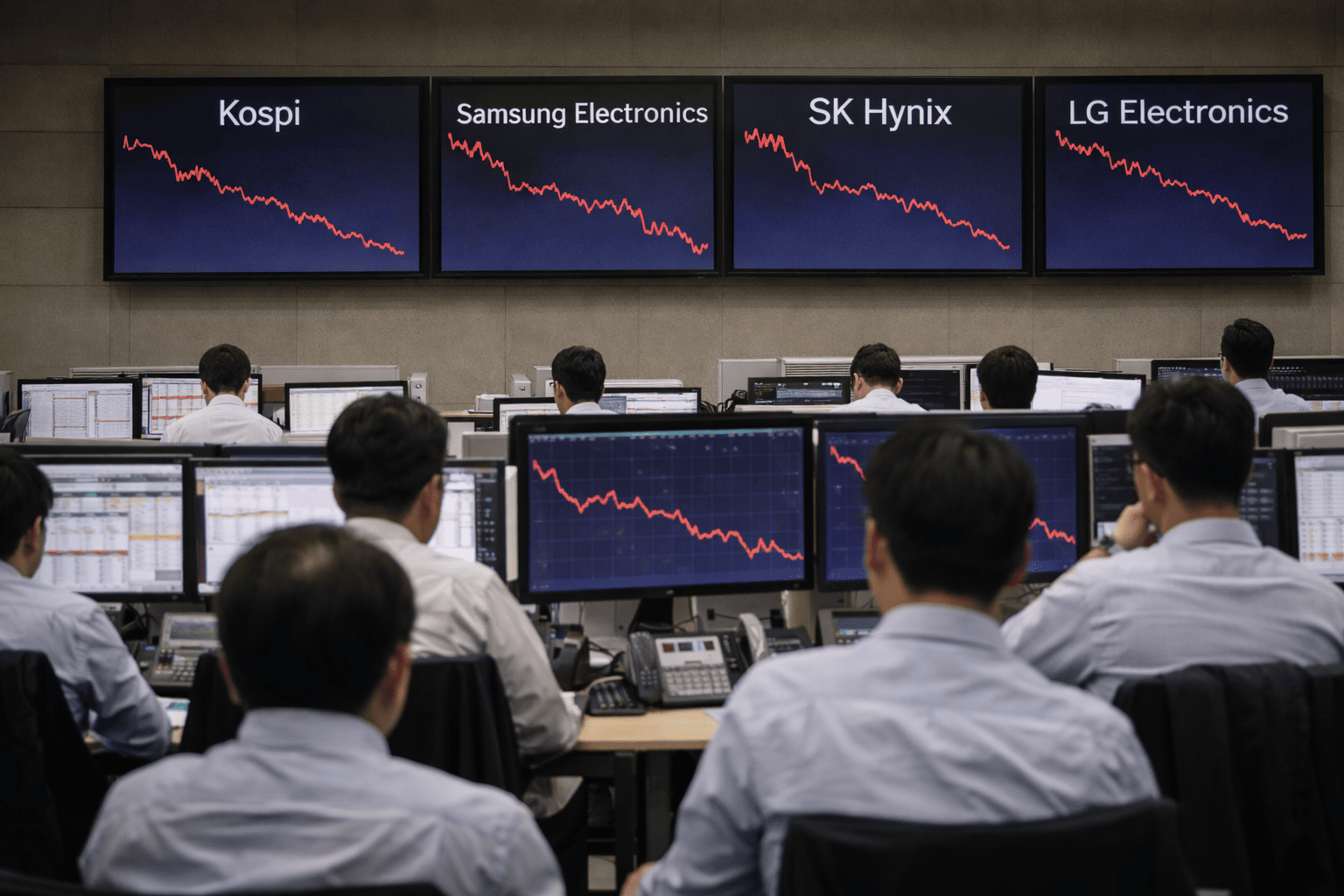
South Korean equities suffered a sharp decline for the third consecutive session on Wednesday, with the benchmark KOSPI index tumbling 5.2% as concerns over artificial intelligence valuations triggered a broad sell-off in semiconductor stocks. The index closed at 7,260.55, marking a drop of more than 20% from its record high of 9,114.55 set on June 22—a threshold that officially confirms a bear market.
Intraday Volatility and Trading Curbs
The session was marked by extreme volatility. After opening lower, the KOSPI briefly rebounded, rising as much as 1.8% in early trading. However, the rally quickly faded, and the index reversed course to fall by up to 5.3%. The sharp intraday swing triggered a sidecar trading curb, temporarily halting algorithmic trading to stabilize market conditions.
Major chip stocks initially gained before reversing. Samsung Electronics rose as much as 1.4% in the morning but ended the day down 6.25%. SK Hynix, which had surged up to 5.8% earlier, closed 3.59% lower. The weakness followed a 4.7% drop in the Philadelphia Semiconductor Index overnight, as investors questioned whether spending on AI infrastructure can sustain its recent pace.
AI Valuation Scrutiny Intensifies
The sell-off reflects growing skepticism about the lofty valuations of AI-related stocks. Investors are increasingly focused on whether future earnings can justify the sector's strong rally, which has driven much of the market's gains over the past year. The broader pressure on Seoul's market mirrors similar concerns globally, as seen in recent moves by US tech giants. For context, AI-driven earnings surge sparks debate over US stock valuations.
Newly introduced single-stock leveraged ETFs tied to semiconductor companies have amplified market volatility, adding to the instability. South Korea's Finance Minister Koo Yun-cheol said authorities would closely monitor risk factors that could increase stock market volatility, including these leveraged products.
Government Monitoring and Market Support
The latest decline follows Tuesday's 4.9% drop in the KOSPI, which triggered a circuit breaker for the sixth time this year and the 12th time in the market's history. Large swings in heavyweight semiconductor stocks have remained a key source of instability. Deputy Finance Minister Moon Ji-sung noted that supply and demand dynamics in the dollar-won market were expected to improve in the second half of the year, with pressure from foreign investor profit-taking and portfolio rebalancing likely to ease.
Moon also pointed to expected demand for the South Korean won stemming from SK Hynix's planned US share sale, which is expected to be among the world's largest new equity offerings. This could provide some support for the currency and broader market sentiment.
Foreign Selling Slows, Won Strengthens
Foreign investors remained net sellers, offloading shares worth 487 billion won ($323.18 million). However, the scale of selling was notably smaller than in recent sessions, when daily outflows reached the trillion-won level. Meanwhile, the South Korean won strengthened 0.5% to 1,508.4 per US dollar on the onshore settlement platform, after touching 1,505.2 earlier—its strongest level since June 15.
Despite optimism surrounding SK Hynix's planned US listing, which has supported investor interest in high-bandwidth memory and AI-related supply chains, sentiment remained dominated by concerns over semiconductor valuations. The broader market continues to grapple with the implications of AI-driven growth and its sustainability, as seen in other markets. For instance, Dow breaches 53,000 as AI chip rally fuels S&P 500, Nasdaq gains highlights the contrasting optimism in US markets.
This article is for informational purposes only and does not constitute financial advice.