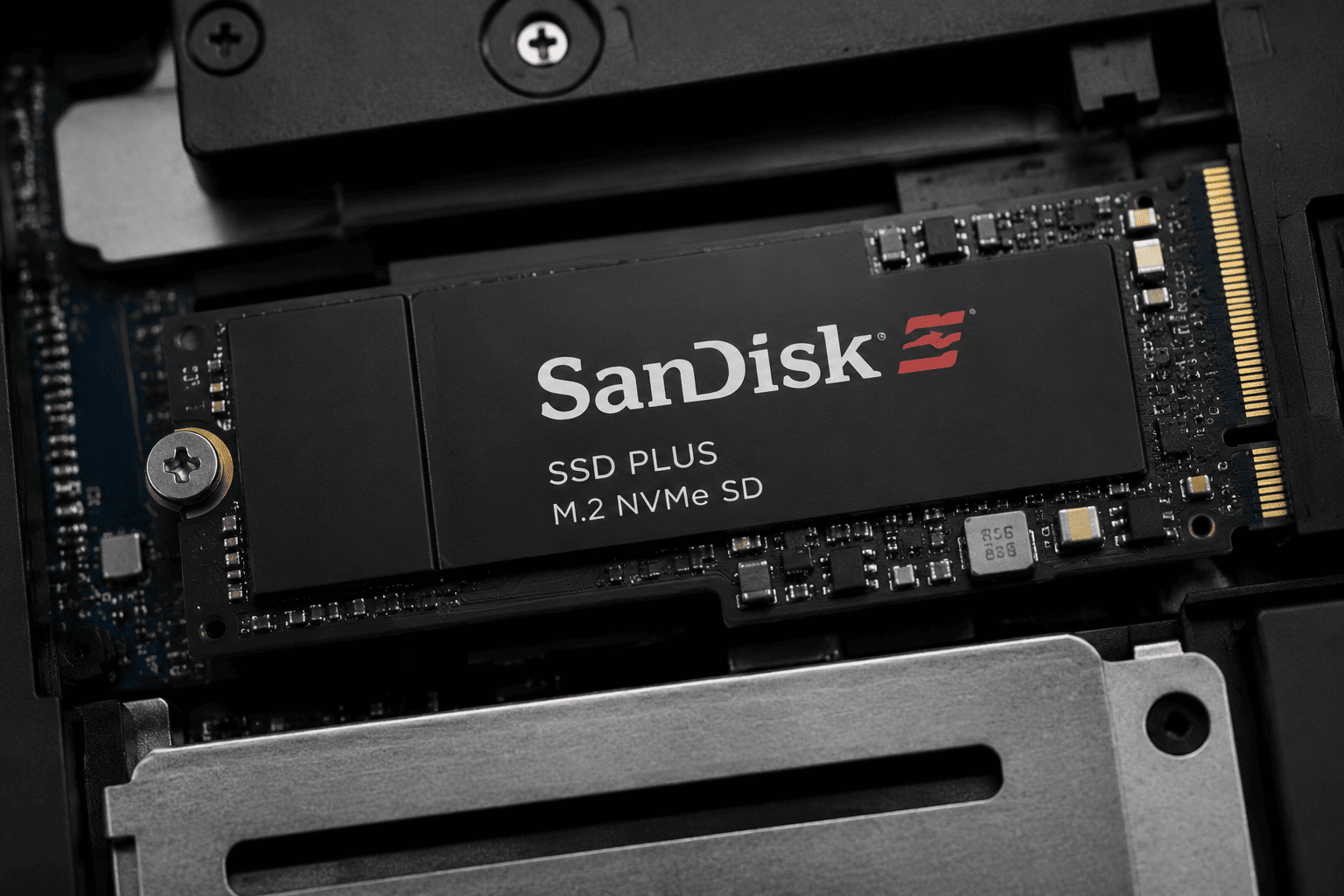
SanDisk (NASDAQ: SNDK) has seen its share price cut in half from its all-time high, yet the company's fundamentals remain robust. The stock recently touched $1,037, its lowest level since late July, pulling the company's market capitalization down to roughly $147 billion from a June peak of $347 billion. Despite this slide, the memory-chip maker is pressing ahead with an 8-for-1 stock split scheduled for November 19.
Technical picture points to further weakness
The stock has been in a sustained downtrend, falling from a September high of $1,914 to the current level. It has already broken below both its 50-day and 200-day exponential moving averages, and a death cross appears imminent. The Percentage Price Oscillator (PPO) has also been declining, with its lines at the lowest point since August.
If the selling pressure continues, the first support level to watch is $937, which corresponds to the 61.8% Fibonacci retracement. A break below that could open the door to $547, the 78.6% retracement level. The stock's recent price action suggests that the near-term bias remains bearish, even as the company's operational performance improves.
Strong fundamentals despite the sell-off
SanDisk's latest earnings report showed revenue of $11 billion, up 23% from the prior quarter and 378% year over year. Net income reached $8 billion, reflecting the surge in demand for memory products, particularly for AI applications. Analysts expect full-year revenue to jump 144% to $50 billion, with another $60.6 billion projected for the following year. Earnings per share are forecast to climb to $227.8 this year, up from $70.8 in the prior year.
The company has also taken steps to stabilize the memory market. It has signed major supply agreements with several large customers, setting both floor and ceiling prices for future sales. This reduces the volatility that has historically plagued the memory industry.
Valuation and shareholder returns
Despite the strong earnings outlook, the stock trades at a forward price-to-earnings ratio of just 4.95, far below the sector median of 21. That makes SanDisk one of the cheapest large-cap tech stocks on Wall Street. The company has also returned $5 billion to shareholders and plans to continue buybacks and dividends.
The upcoming 8-for-1 split will lower the share price to around $130, making it more accessible to retail investors. While splits do not change a company's intrinsic value, they can sometimes attract additional buying interest.
Is the bargain worth the risk?
The key question is whether the low valuation is justified or a value trap. The stock's technical indicators suggest that more downside could be ahead, and the broader semiconductor sector has been under pressure recently. However, the company's revenue growth and profitability are undeniable, and the forward P/E suggests that much of the bad news is already priced in.
Investors will be watching to see if the stock can hold above the $937 support level. If it does, the current price could represent a compelling entry point for long-term investors. If it breaks below, the next stop could be much lower.
This article is for informational purposes only and does not constitute financial advice.