Nvidia (NASDAQ: NVDA) shares slipped about 1.5% to around $227 on Tuesday, pausing after three consecutive sessions of gains, even as several major semiconductor peers moved sharply higher. The pullback came amid broader market weakness driven by rising oil prices and renewed geopolitical tensions in the Middle East.
While Nvidia took a breather, other chipmakers surged. Intel jumped more than 8% after Northland Capital Markets analyst Gus Richard upgraded the stock to Outperform from Market Perform. AMD gained roughly 5%, and Broadcom rose about 3%, helping the PHLX Semiconductor Sector index climb around 2%. In contrast, the Dow Jones Industrial Average fell 574 points (1.1%), the S&P 500 dropped 0.4%, and the Nasdaq Composite slipped 0.3%. U.S. markets were closed Monday for the Labor Day holiday.
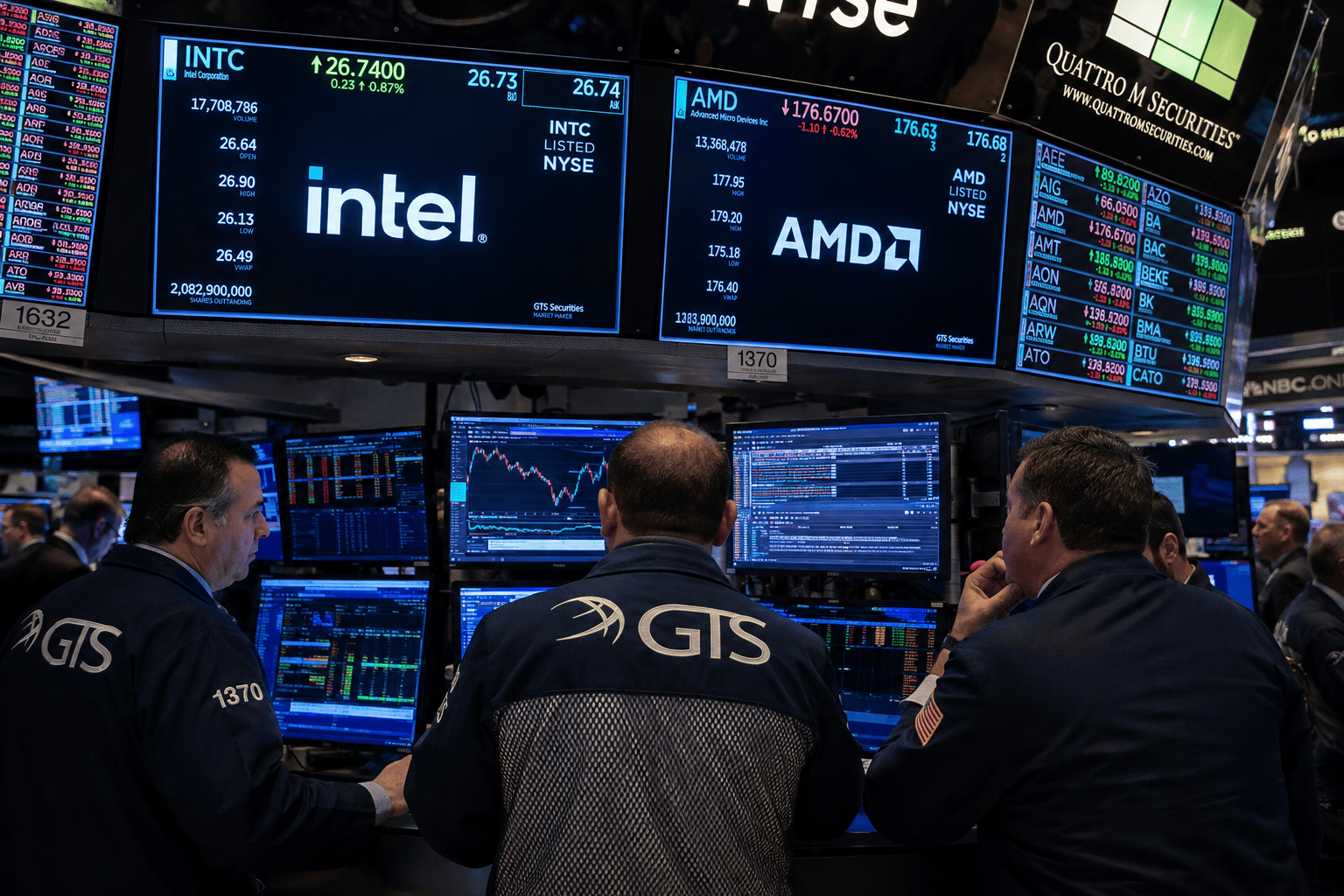
The divergence highlights Nvidia's recent underperformance relative to some peers. Over the past six months, Nvidia is up about 24%, but AMD and Intel have each gained more than 100%. Nvidia remains just below its record high of $236.54, set earlier this year.
Oil prices remained a key overhang for equities, with West Texas Intermediate crude futures rising for a sixth consecutive session, the longest winning streak since March. Brent crude traded near $98 a barrel as tensions between the U.S. and Iran escalated over the weekend.
Analysts remain bullish
Despite the day's dip, Wall Street analysts continue to see upside. Cantor Fitzgerald reiterated its Overweight rating on Nvidia with a $350 price target, implying roughly 54% upside from current levels. Analyst C.J. Muse highlighted sustained demand for AI infrastructure, though he acknowledged supply constraints across the semiconductor industry. He noted that investors remain divided over the durability of the AI investment cycle amid macroeconomic and debt concerns.
Cantor also emphasized Nvidia's position as Taiwan Semiconductor Manufacturing Co.'s largest customer and argued that the stock trades at the cheapest valuation among compute companies based on calendar 2028 earnings estimates. The firm believes Nvidia remains under-owned by both hedge funds and long-only investors. Muse addressed Nvidia's high-bandwidth memory specifications, characterizing HBM de-specification as an economic decision aimed at optimizing gross margins and GPU sales around a finite number of bits.
Morningstar also sees further upside, raising its fair value estimate to $310 from $280 earlier this month, implying roughly 30% upside. The firm pointed to Nvidia's fiscal 2028 outlook as the most significant part of its latest earnings report. Nvidia reported $96 billion in fiscal second-quarter revenue, up 106% year over year and above its $91 billion guidance. The company expects October-quarter revenue of $108 billion, ahead of the FactSet consensus of $105 billion.
Nvidia's guidance for 70% revenue growth next year implies nearly $700 billion in total revenue, compared with Morningstar and FactSet estimates of roughly $570 billion. That long-term outlook reinforces the bullish case even as shares pause after recent gains.
For investors tracking the AI trade, Nvidia's moves remain closely tied to broader sentiment. Recent developments, such as Nvidia's $3.5B MediaTek stake and Dell's AI server backlog, underscore the ongoing demand for AI infrastructure. Meanwhile, ARK's shift from AMD to Nvidia reflects a bet on AI visibility, and analysts see potential for a rally driven by growth and valuation.
This article is for informational purposes only and does not constitute financial advice.