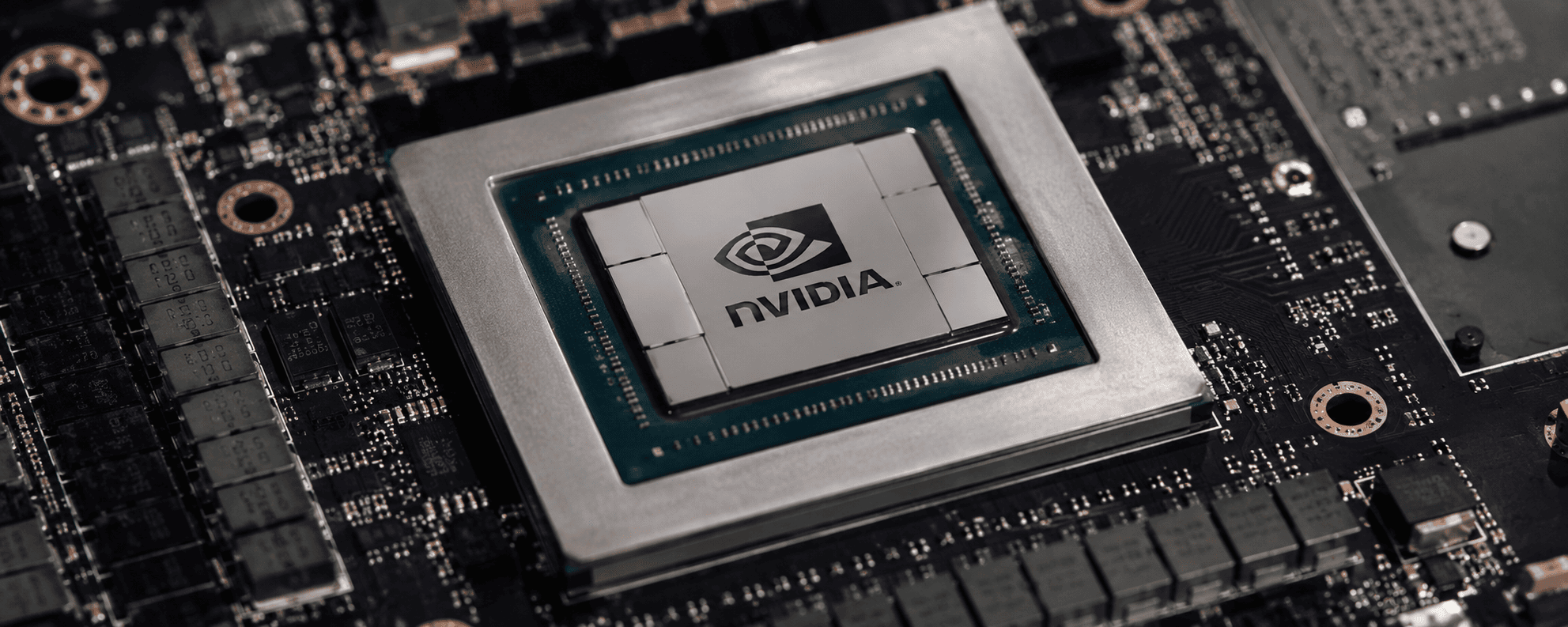
Nvidia (NVDA) shares advanced more than 4% on Wednesday, buoyed by a stronger-than-expected earnings report from Dell Technologies that underscored the durability of spending on artificial intelligence infrastructure. The move came as U.S. equities rebounded from three straight sessions of losses, with the S&P 500 up about 0.7%, the Dow Jones Industrial Average gaining roughly 0.9%, and the Nasdaq Composite advancing approximately 0.5%.
Dell's AI server backlog provides a key read-through
Dell reported fiscal fourth-quarter results that beat expectations and raised its full-year revenue and earnings guidance for the second time this year. The company now projects fiscal 2027 revenue of $192 billion, up sharply from its prior forecast of $167 billion, and adjusted earnings per share of $25.50, up from $17.90.

Dell's Infrastructure Solutions Group, which includes its data-center hardware operations, generated $31.78 billion in quarterly revenue, an 89% year-over-year increase and above the $29.61 billion consensus estimate. AI-optimized servers brought in $16.40 billion, slightly ahead of expectations and double the level from a year earlier.
More striking was the strength of future demand. Dell said AI server orders reached $60.9 billion during the quarter, while its AI-related backlog surged to $95 billion from $51.3 billion in the previous earnings report. The company also raised its fiscal 2027 forecast for AI-optimized server revenue to $74 billion from $60 billion.
"The AI momentum spoke for itself," said analysts at J.P. Morgan, pointing to Dell's record orders and backlog.
Why Dell's numbers matter for Nvidia
Dell's AI servers incorporate Nvidia's processors and are being purchased by customers such as AI cloud providers Nscale and CoreWeave to build computing clusters for training and running AI models. That creates an important read-through for Nvidia: Dell's growing order pipeline suggests demand for the infrastructure surrounding Nvidia's accelerators remains strong, rather than being limited to a handful of hyperscalers.
Dell has continued expanding its portfolio around Nvidia's latest technology. The company unveiled servers powered by Nvidia's Blackwell Ultra chips last year and has said its systems will support Nvidia's Vera central processing units, which are expected to succeed its Grace server processor. Dell also plans to support Nvidia's Vera Rubin platform, extending the relationship into future generations of AI infrastructure.
Morgan Stanley analysts led by Erik Woodring noted that Dell had essentially no AI-related revenue four years ago but now expects $74 billion in annual revenue from AI servers alone. That shift illustrates how rapidly AI infrastructure has moved from an emerging market into a major source of hardware demand.
Nvidia's own outlook and broader AI push
The Dell results arrive shortly after Nvidia's own fiscal second-quarter earnings, where the chipmaker offered an unusually strong longer-term outlook. Nvidia said it expects revenue growth of 70% in fiscal 2028, significantly above analyst expectations for about 45% growth.
Nvidia is also widening its influence across the AI infrastructure stack through a new partnership with MediaTek. Nvidia plans to invest $3.5 billion in convertible bonds issued by Taiwan-based MediaTek, while MediaTek will adopt Nvidia's NVLink Fusion platform. The technology allows customers to develop customized processors that can connect to Nvidia's NVLink-based rack-scale AI systems. The partnership could help Nvidia participate in the growing custom-chip market without having to design every accelerator itself.
Supply-chain analyst Ming-Chi Kuo said MediaTek can develop customized chips for customers while Nvidia provides the connectivity and rack-scale infrastructure needed to integrate those processors into AI systems. The two companies will also continue working together on future generations of Nvidia's RTX Spark and DGX Spark platforms, as well as technologies for AI-powered vehicles.
"Nvidia is just covering all its bases here & abroad," said Paul Meeks, head of technology research at Freedom Capital Markets, in a MarketWatch report. He added that Nvidia was "continuing to boost its influence in the AI infrastructure ecosystem even beyond" its graphics processing units.
Analyst actions and valuation
Meanwhile, JPMorgan, which had been among the more conservative banks on Nvidia, lifted its price target to $320 from $280 while maintaining an Overweight rating. Analyst Harlan Sur recently met with Nvidia's Toshiya Hari, vice president of investor relations and strategic finance, who said the 70% growth framework reflected broad-based demand across customer groups. The company also said it had offered an out-year forecast because it sees a meaningful gap between Wall Street estimates and its own internal projections.
Nvidia's recent financial performance reinforces that confidence. Revenue has grown 83% over the past 12 months, while 35 analysts have raised earnings estimates for the upcoming period. Perhaps more importantly, Nvidia continues to describe its business as supply-constrained rather than demand-constrained. Hari indicated that without supply limitations, Nvidia's business could potentially more than double year over year.
The composition of AI workloads is also changing. Hari said the mix between training and inference revenue was roughly 50/50 about a year ago, but inference is now growing faster as AI models are deployed at scale.
For more context on Nvidia's recent moves, see our coverage on the MediaTek investment and the $99B AI financing push. Also, check out how Nvidia's forecast fueled a tech rally and Michael Burry's valuation warning.
This article is for informational purposes only and does not constitute financial advice.