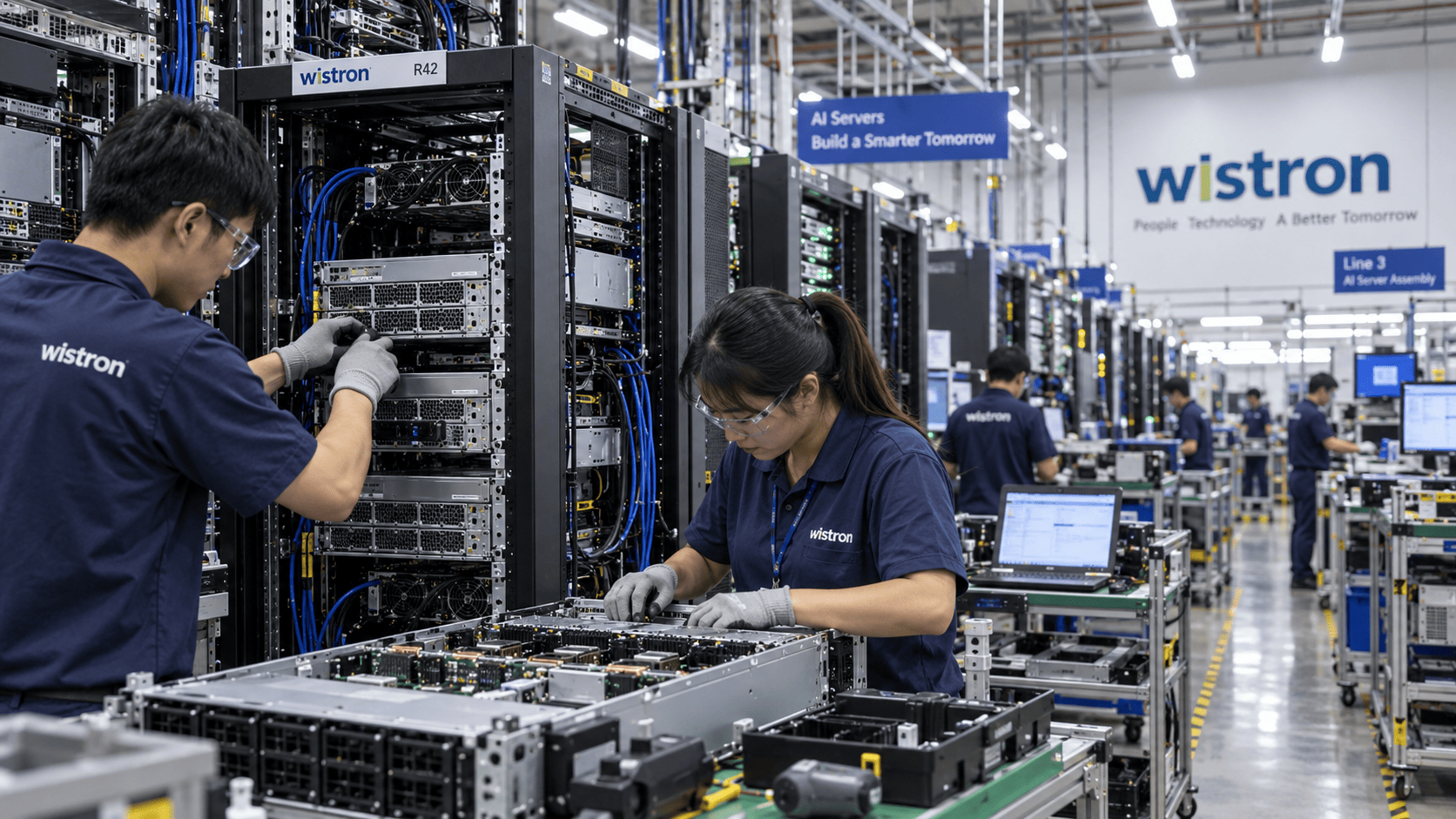
Wistron, a key supplier to Nvidia, is seeing its stock slide despite a booming AI server business. The company announced a global share sale raising approximately $1.47 billion, which will dilute existing shareholders by about 7.29%. The move is aimed at funding purchases of raw materials in foreign currencies as it scales up production to meet surging AI demand.
The share sale involves issuing 25 million global depositary receipts (GDRs), each representing 10 new ordinary shares, for a total of 250 million new shares. Priced at $58.88 per GDR (equivalent to NT$186.24 per share), the offering represents a 5.5% discount to Wistron's September 7 closing price. Investors reacted negatively, sending shares down about 5% on Tuesday, extending Monday's 0.5% decline. The stock had jumped 5% in the prior session and remains up strongly for the year.
Dilution, not weak demand, is the immediate concern
The short-term issue is straightforward: Wistron is creating more shares, reducing existing shareholders' ownership percentage. New investors get exposure at a price below Monday's close of NT$197, which pressures the stock as the market adjusts to the cheaper issuance. JPMorgan acknowledged Wistron's "robust AI order outlook" but noted the GDR issuance would create roughly 7% dilution as the company supports growing working-capital needs. The bank still upgraded the stock to Overweight from Neutral and set a target of NT$260.
Wistron must purchase expensive GPUs, memory, networking equipment, and other components before customers pay for finished systems. As production scales, more cash becomes tied up in inventory and operations, necessitating the capital raise.
AI boom forces Wistron to spend first
This is not a sign of deteriorating demand. In August, Wistron reported that AI server demand from cloud-computing and enterprise customers continued to exceed supply. Second-quarter revenue climbed 64% year-over-year, while net profit jumped 128%. In July, the company opened a $700 million facility in Fort Worth, Texas, where Nvidia's GB300 Grace Blackwell Ultra systems are manufactured. Additional expansion spending in Taiwan has also been approved.
Morgan Stanley remains bullish on Wistron's expansion despite the near-term funding pressure. The bank expects AI-server momentum to continue at least through the first half of 2027, supported by existing customers, new cloud-service-provider business, and additional platforms including AMD's MI400 series. Morgan Stanley raised its price target to NT$275 from NT$210 and maintained an Overweight rating.
Can AI growth outrun the dilution?
The longer-term question is whether the capital raised will generate enough additional profit to offset the larger share count. Industry conditions remain supportive. TrendForce forecasts global AI server shipments to rise nearly 31% in 2026, with hyperscale cloud providers ramping up AI spending. However, stronger revenue alone may not settle the debate.
Wistron is committing large sums to factories, inventories, and expensive components. It operates in a business where powerful hyperscale customers can influence pricing and margins. If AI-server sales expand without a corresponding improvement in profitability, shareholders could absorb dilution without receiving enough incremental earnings in return. That makes margins and cash conversion increasingly important alongside shipment growth.
For context on the broader AI infrastructure landscape, see our coverage of Dell's AI server backlog and software stocks' rebound. Also, Oracle's recent gains highlight the ongoing debate over AI spending sustainability.
This article is for informational purposes only and does not constitute financial advice.