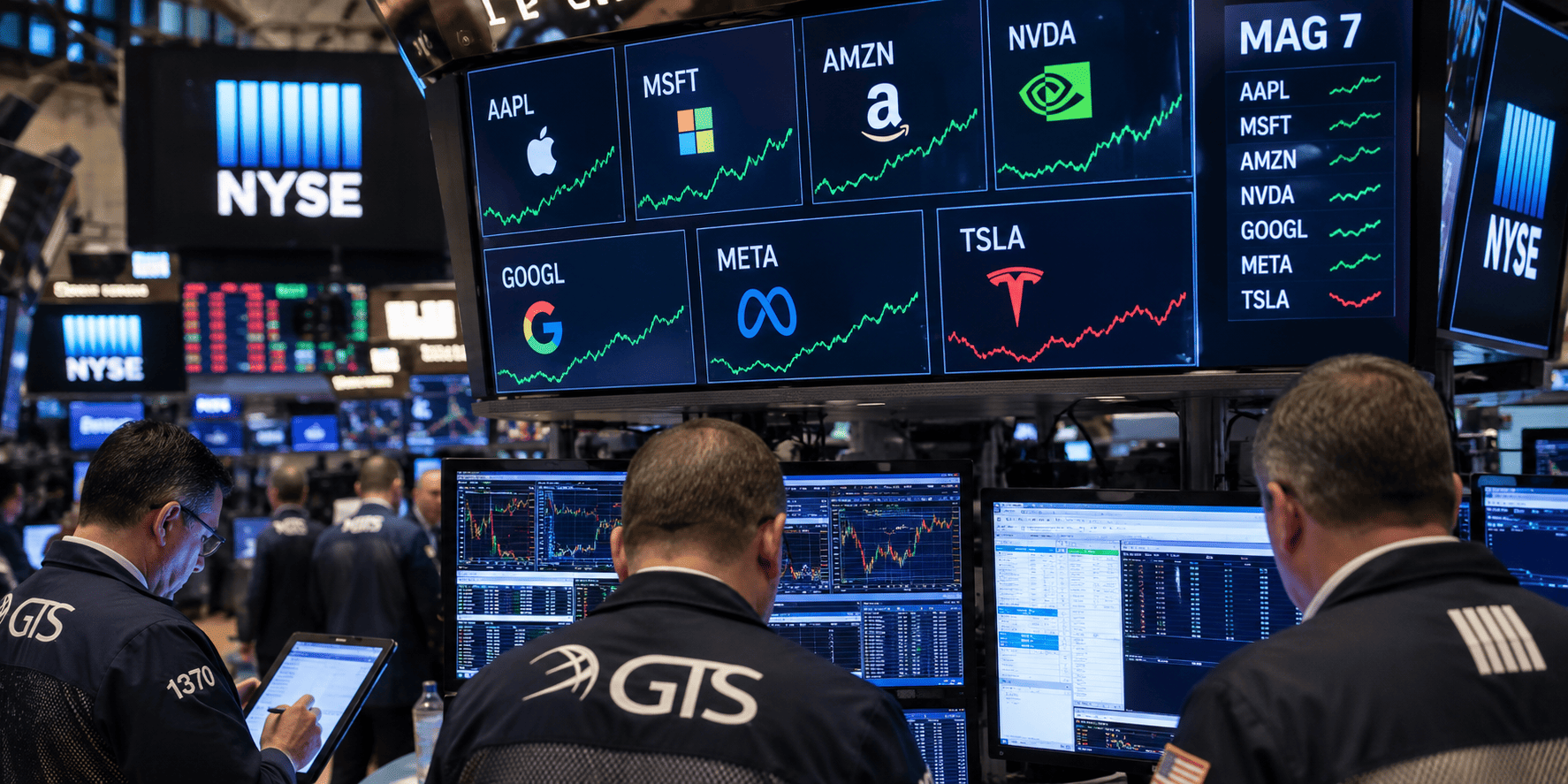
The Magnificent Seven are regaining their footing on Wall Street, but this time the rally is being led by a different set of names than earlier in the year. Nvidia has re-emerged as the standout in the artificial-intelligence trade after spending much of 2026 trailing smaller semiconductor stocks.
The chipmaker's renewed strength is helping lift the broader group of megacap technology companies closer to record levels. The Roundhill Magnificent Seven ETF rose nearly 3% on Thursday to $70.63, approaching its all-time closing high of $70.94, which was set in May. The fund tracks Nvidia, Apple, Meta Platforms, Amazon, Alphabet, Microsoft, and Tesla.
Nvidia regains momentum
Nvidia has been among the biggest beneficiaries of renewed enthusiasm around AI spending. Shares have gained momentum since the company delivered a strong earnings report last week and projected revenue growth of more than 70% for the fiscal year ending in January 2028. The forecast reinforced expectations that spending on AI data centers remains far from exhausted.
“There is still no end in sight to the AI infrastructure build-out,” Joe Tigay, portfolio manager at Equity Armor Investments, wrote in a note last week.
Nvidia received another boost Thursday after announcing its acquisition of Hugging Face, an open-source AI developer platform. The deal is expected to strengthen Nvidia's position beyond chips and deeper into the software ecosystem supporting AI development. Jeff Pollard, vice president and principal analyst at Forrester, said the acquisition could give Nvidia greater control and visibility into the open-source software layer. The move highlights Nvidia's broader strategy of building an AI ecosystem around its hardware rather than relying solely on demand for graphics processing units.
Semiconductor leadership rotates back to Nvidia
The latest Nvidia rally is notable because the stock had been overshadowed earlier in the year by companies such as Micron Technology and Advanced Micro Devices. Those stocks helped push the iShares Semiconductor ETF to record levels as investors looked for faster-growing or more differentiated opportunities outside Nvidia.
The semiconductor ETF remains up 67% this year, but recent performance tells a different story. Nvidia shares have gained about 7% over the past three months, while the semiconductor ETF has fallen 18%. The reversal suggests investors are reassessing whether some of the smaller semiconductor winners had moved too far ahead of their fundamentals. At the same time, Nvidia's latest earnings outlook has strengthened the argument that its enormous size does not necessarily prevent it from continuing to benefit from the AI investment cycle.
Cramer urges investors to revisit the Magnificent Seven
The rotation is also bringing the rest of the Magnificent Seven back into focus. Nvidia and Apple are now within about 3% of their record highs. Alphabet, Meta, and Tesla, however, remain more than 10% below their respective peaks. That divergence has created an unusual situation for a group that dominated the market for much of the past decade.
CNBC's Jim Cramer believes that gap could represent an opportunity. “We’re witnessing the revenge of the Magnificent Seven and most people don’t even seem to know it,” the “Mad Money” host said on Thursday. “I think it’s time to buy.” Cramer argued that investors have spent too much time chasing newer market leaders while overlooking companies that previously drove the technology rally. “We have to go back and pick at this market’s old leadership, the forgotten Mag Seven, because a lot of them have gotten real cheap,” he said. “On a price-to-earnings basis, they’ve fallen way behind and that’s just plain wrong.”
About Nvidia, Cramer said that despite being one of the biggest beneficiaries of the AI boom, the chipmaker trades at roughly 17 times expected earnings over the next 12 months, a relatively modest multiple compared with several slower-growing technology companies. He argued that Nvidia’s valuation reflects investor concerns over whether its exceptional earnings growth can be sustained, particularly as questions grow around the durability of data-center spending. Cramer believes those concerns are overblown, pointing to Dell’s latest results as evidence that customers are beginning to see tangible returns from their AI investments. “What the heck is Nvidia doing with such a low price-to-earnings multiple despite the phenomenal growth?” Cramer said.
Meta too has been seen to be trading at a significant discount to its historical valuation, with Morgan Stanley believing the recent settlement and its suite of consumer AI offerings could provide the next leg of growth for the stock. The stock has also rallied 7% in the last five trading sessions.
For investors looking to position for a continued rebound, the Dell's AI server backlog and Nvidia's growth and valuation are key signals. Meanwhile, ARK's shift from AMD to Nvidia underscores the renewed conviction in the chipmaker.
This article is for informational purposes only and does not constitute financial advice.