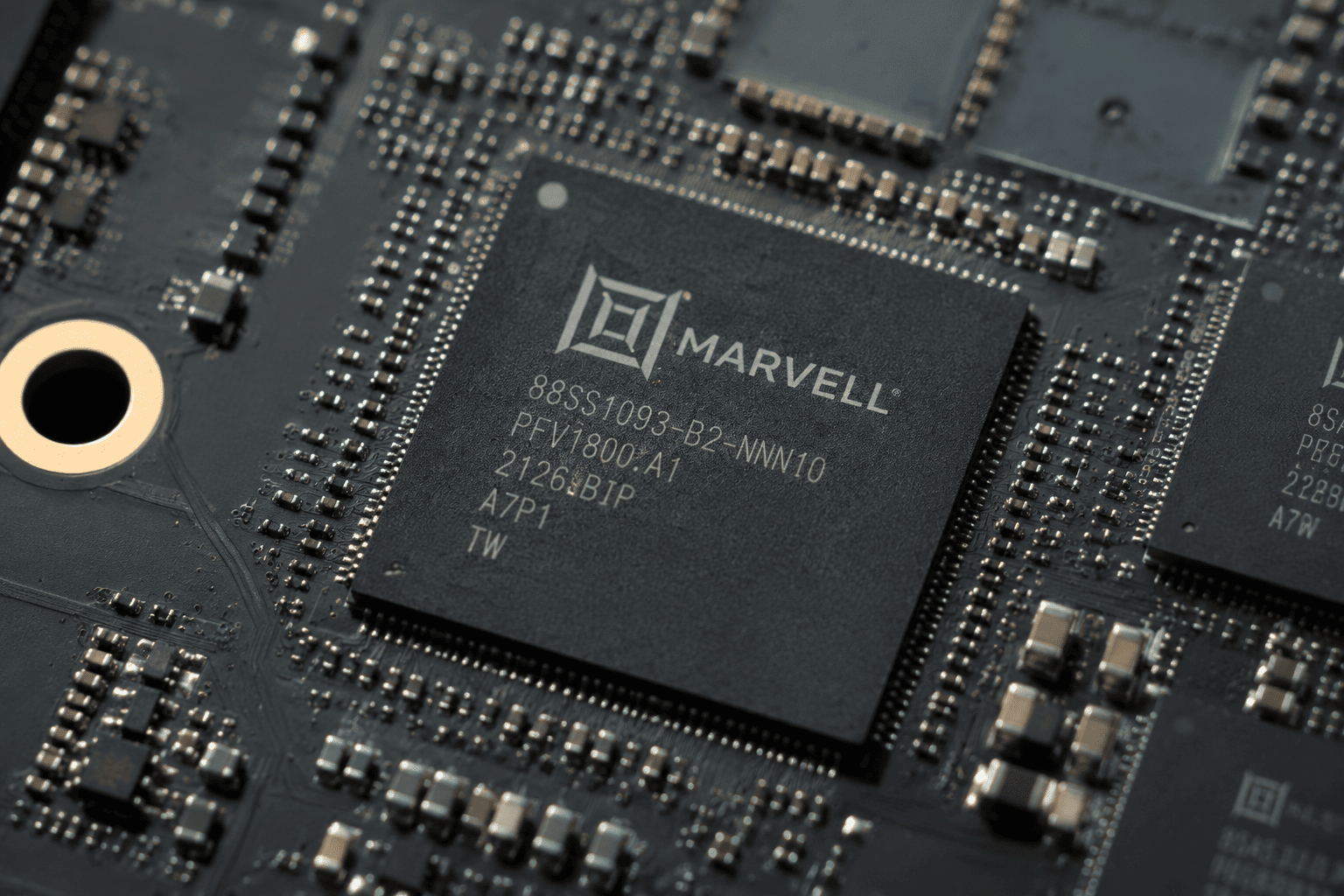
Marvell Technology (MRVL) shares have retreated from recent weekly highs, settling near $235 after touching $252 earlier in the week. The pullback comes as investors weigh the implications of the company's landmark $12 billion agreement with Alphabet to develop custom AI chips. Despite the deal's potential, the stock remains in a local bear market, down nearly 30% from its 2025 peak, with the upcoming earnings report on August 27 serving as the next major catalyst.
Google deal and strategic positioning
The agreement with Alphabet marks a significant expansion of Marvell's existing relationship with Google, which already uses Marvell-designed TPUs. Under the new terms, Alphabet gains warrants to purchase Marvell shares worth over $12.2 billion, contingent on revenue milestones. This structure aligns incentives and underscores the strategic importance of Marvell's custom silicon capabilities. Beyond Google, Marvell supplies chips to Amazon and Microsoft, both of which are aggressively expanding their ASIC (application-specific integrated circuit) efforts.

Industry leaders have taken note. Nvidia's CEO Jensen Huang has publicly stated that Marvell could eventually reach a $1 trillion market capitalization. Nvidia itself has taken a $2 billion stake in Marvell, with the two companies collaborating on silicon photonics—a technology critical for high-speed data transmission in AI clusters.
Analyst expectations and growth trajectory
Wall Street remains broadly optimistic about Marvell's growth prospects. According to Yahoo Finance data, analysts expect revenue to have jumped 35% in the last quarter to $2.7 billion. For the full fiscal year, the consensus estimate stands at $11.5 billion, representing a 40% year-over-year increase. Looking further ahead, revenue is projected to grow another 45% to $16.7 billion.
Profitability is also expected to improve. After posting GAAP earnings per share of $2.84 last year, analysts forecast EPS of $4.05 this year and $6.25 next year. This growth is partly attributed to the recent acquisition of Celestial AI, a photonics company that enhances connectivity between AI chips in large-scale clusters.
Several analysts have reiterated bullish ratings, though they acknowledge valuation concerns. Roth Capital's Suji Desilva maintains a $350 price target, while BMO's Blayne Curtis raised his to $325. RBC Capital has a target of $360. These targets imply significant upside from current levels, but the stock's rich valuation—trading at roughly 30 times forward earnings—remains a point of debate.
Technical analysis and market context
From a technical perspective, MRVL has rebounded off its July low of $162.93, climbing to a high of $252 this week before pulling back. The stock remains above its 50-day exponential moving average (EMA) and the 38.2% Fibonacci retracement level, suggesting underlying bullish momentum. The Supertrend indicator also points to a bullish bias.
However, the recent price action has formed a small bearish engulfing pattern, which could signal further near-term weakness. If the stock can hold above key support levels, a move toward the psychological $300 mark is possible. Conversely, a break below the 50-day EMA could open the door to deeper losses.
The broader semiconductor sector has been volatile, with Nvidia shares lagging the chip rally despite analyst optimism. Marvell's earnings will be closely watched for guidance on AI-related demand and the impact of the Google deal. Investors are also monitoring Broadcom's reaction to Marvell's Google win, as competitive dynamics shift in the custom chip market.
While Marvell's growth story is compelling, the stock's valuation leaves little room for error. The upcoming earnings report will be a critical test of whether the company can justify its premium multiple. As always, earnings resilience will be key in a market that remains sensitive to interest rate movements.
This article is for informational purposes only and does not constitute financial advice.