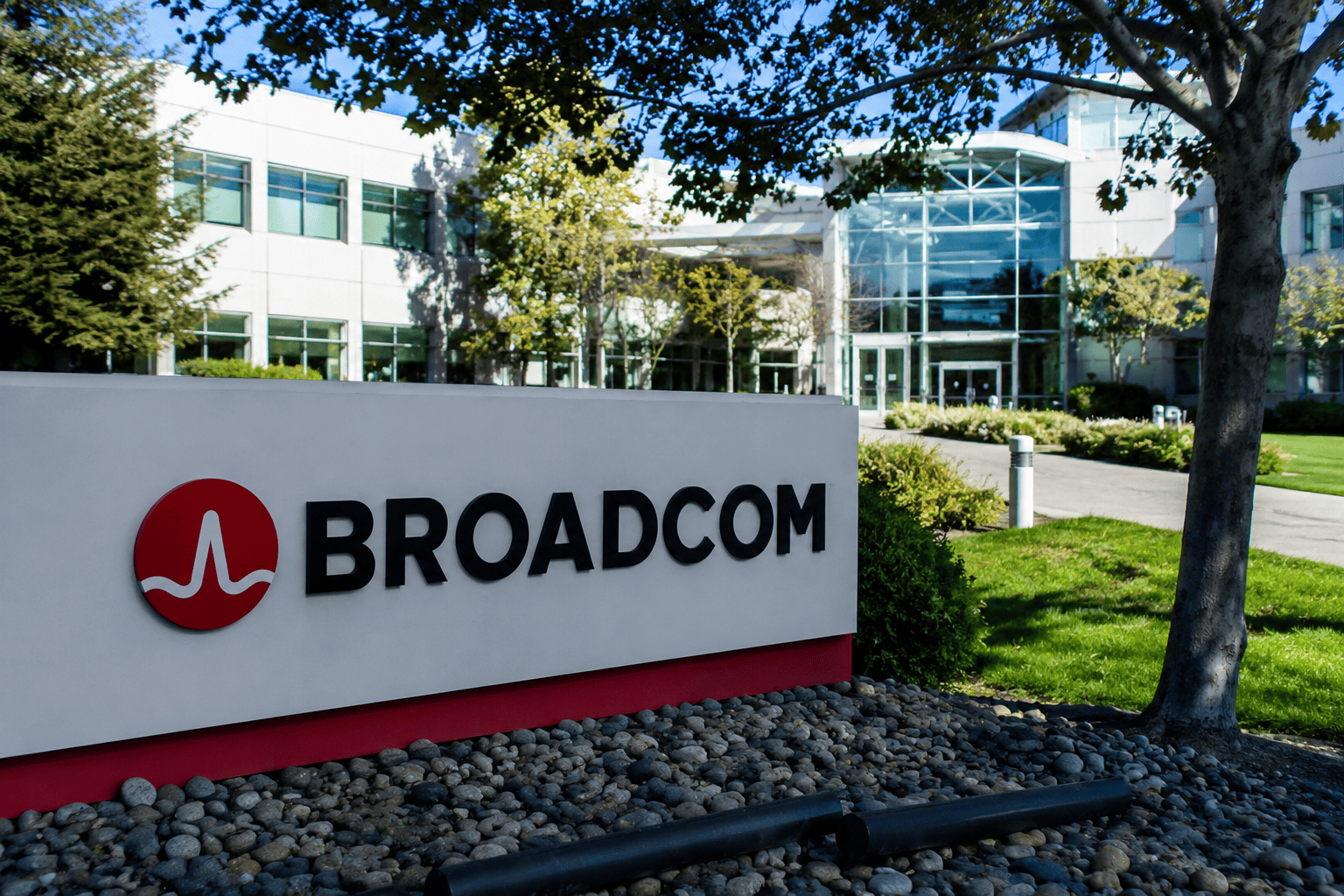
Broadcom (AVGO) shares opened sharply lower on Wednesday after Marvell Technology announced a deal to help Google develop custom artificial intelligence chips, with an option for Alphabet to acquire up to $12.2 billion in Marvell stock. The news sent Marvell shares up about 7% while Broadcom, historically Google's main custom chip partner, dropped roughly 5% at the open.
The agreement reignites concerns about Broadcom's dominance in Google's custom AI chip supply chain, especially as demand for specialized processors like Google's Tensor Processing Units (TPUs) accelerates. TPUs have become increasingly critical as tech giants seek alternatives to Nvidia's GPUs and optimize chips for specific AI workloads, particularly inference.

Broadcom has been instrumental in designing and producing TPUs, and its relationship with Google is a cornerstone of its AI growth story. In April, the two companies signed a long-term agreement covering development and supply of custom AI chips and components for Google's next-generation AI racks through 2031. That deal is part of Broadcom's $73 billion AI backlog, which includes XPUs, switches, digital signal processors, and optical components, with deliveries expected over the next 18 months.
Google's planned capital expenditure of $175 billion to $185 billion for 2026 provides a substantial demand pipeline for its AI infrastructure suppliers. Broadcom's recent financial results underscore the importance of custom AI chips to its growth: second-quarter revenue rose 48% year over year to $15 billion, with AI revenue more than doubling to $10.8 billion. CEO Hock Tan expects AI revenue to reach $16 billion in the current quarter.
Despite this momentum, Broadcom shares have struggled, down about 25% from their June 2 record close of $481.57. The decline reflects investor anxiety that Google's increasing in-house chip development and partnerships with other suppliers could erode Broadcom's market share. Macquarie downgraded Broadcom to Neutral in June, setting a $437 price target, and analyst Arthur Lai noted that Google is working with MediaTek while building internal capabilities. Macquarie expects Broadcom's market share to decline meaningfully in 2027 and 2028.
The Marvell deal reinforces the bearish narrative that Google's massive AI spending may benefit multiple semiconductor suppliers rather than Broadcom alone. However, not all analysts share this view. JPMorgan reiterated an Overweight rating and a $580 price target, arguing that investors should disregard reports of delays to Google's next-generation TPU v9 2-nanometer program. JPMorgan believes Broadcom remains on track to ramp TPU v9 in 2028 and is fully qualified for the current-generation TPU v8i 3-nanometer program, with production ramping this quarter. The bank also noted that Google's internal chip team is working with MediaTek on the Zebrafish TPU v8t program, but Broadcom still has an 18-month lead.
The five-year agreement between Google and Broadcom is expected to cover four generations of TPU chips through v11, with commitments to increase TPU revenue annually through 2031. This long-term visibility provides some reassurance, but the market is clearly weighing the risk of share loss against the growth opportunity.
Nova Capital believes the recent sell-off has gone too far, arguing that Broadcom's expertise in custom chips and leading position in high-end networking remain undervalued. The firm estimates that applying about 30 times fiscal 2027 earnings could support a valuation of $585.90.
For now, Marvell's deal serves as a reminder that Google's AI ambitions are large enough to support multiple chip suppliers. For Broadcom, the challenge will be demonstrating that its long-term TPU roadmap remains intact even as Google increasingly diversifies its AI infrastructure technology. Investors will get more clarity when Broadcom reports its third-quarter results next month.
This article is for informational purposes only and does not constitute financial advice.