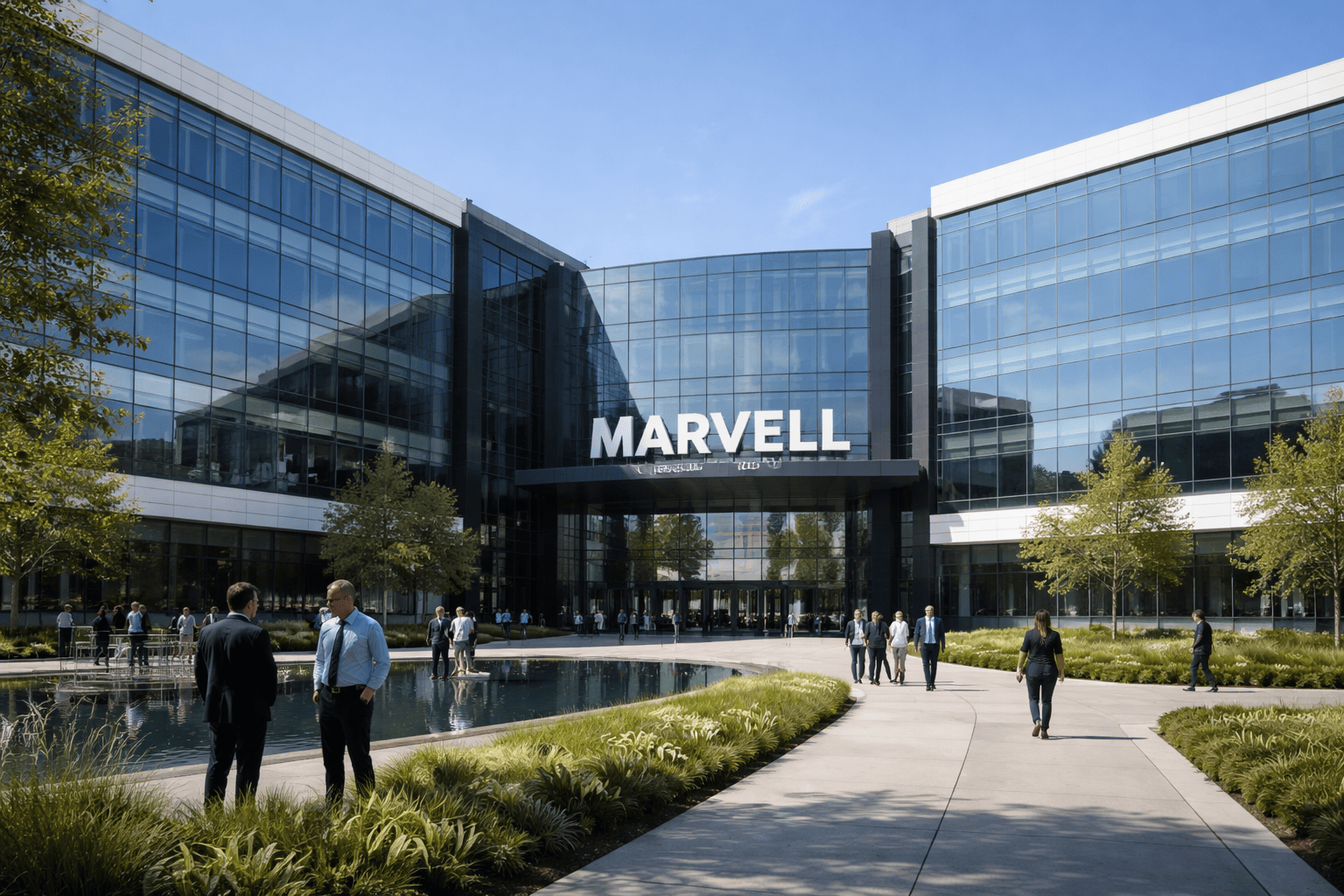
Marvell Technology (NASDAQ:MRVL) shares slid nearly 8% in premarket trading Friday, as investors digested a solid quarterly beat but focused on the delayed revenue impact from its massive Google AI chip deal. The company's fiscal second-quarter revenue rose 37% year over year to $2.74 billion, beating expectations, and management raised its fiscal 2027 revenue outlook to about $12 billion and fiscal 2028 to roughly $18 billion. Yet the market's reaction was muted, with the stock having already gained about 184% in 2026.
The crux of the selloff lies in the timing of the Google agreement, which could be worth up to $120 billion over its lifetime. On the earnings call, JPMorgan analyst Harlan Sur pressed CEO Matt Murphy on why the program wasn't showing up more clearly in fiscal 2028 estimates. Sur noted that Marvell still appeared to be guiding toward only about $5 billion to $6 billion of custom-chip revenue in calendar 2027. Murphy responded that revenue from programs already underway is included in next year's numbers, but newer programs should contribute much more significantly in fiscal 2029.
That distinction explains the market's disappointment. Investors had treated the Google deal as a reason to immediately raise Marvell's growth trajectory, but management suggested that much of the fiscal 2028 benefit was already embedded in forecasts. In effect, the market had pulled part of Google's future success into Marvell's current valuation before the revenue actually arrived.
Fiscal 2029 becomes the critical year
Murphy told analysts that the larger incremental impact should emerge in fiscal 2029 and beyond, with more details promised at the company's October 6 investor day. That left analysts trying to bridge an unusually large modeling gap. Melius Research analyst Ben Reitzes said investors were "just wrestling with this" and added that "these numbers are huge." His point was straightforward: a potential $120 billion opportunity spread over roughly six and a half years implies an enormous annual revenue pool, but investors still don't know how much is incremental, when individual programs ramp, or what margins they will carry.
Marvell has given the market the size of the prize without yet providing enough detail about the path to collecting it. The selloff reflects that uncertainty, not a deterioration in the underlying AI business.
AI growth remains intact
Data-center revenue rose 46% year over year to $2.17 billion in the quarter, and management expects data-center sales to grow more than 60% in fiscal 2028. TECHnalysis Research chief analyst Bob O'Donnell told Reuters that expectations around custom AI accelerators are "getting ahead of themselves." That explains how a beat-and-raise quarter can still produce a sharp decline.
Citi said it was encouraged by Marvell's data-center outlook, while Morgan Stanley noted that the stock tends to react more to changes in long-range forecasts than individual quarterly beats. Melius also raised its price target to $350 from $325 on Friday, arguing that Google, Microsoft, and AI connectivity remain significant long-term opportunities. The Google deal may ultimately prove as large as bulls expect, but the near-term problem is that investors have already paid for part of that future.
For more context on Marvell's recent performance, see the latest quarterly results and valuation concerns around the Google deal. The broader AI trade also remains in focus, as seen in Asian markets reacting to Nvidia's AI wave and Marvell's earnings as an AI demand test.
This article is for informational purposes only and does not constitute financial advice.