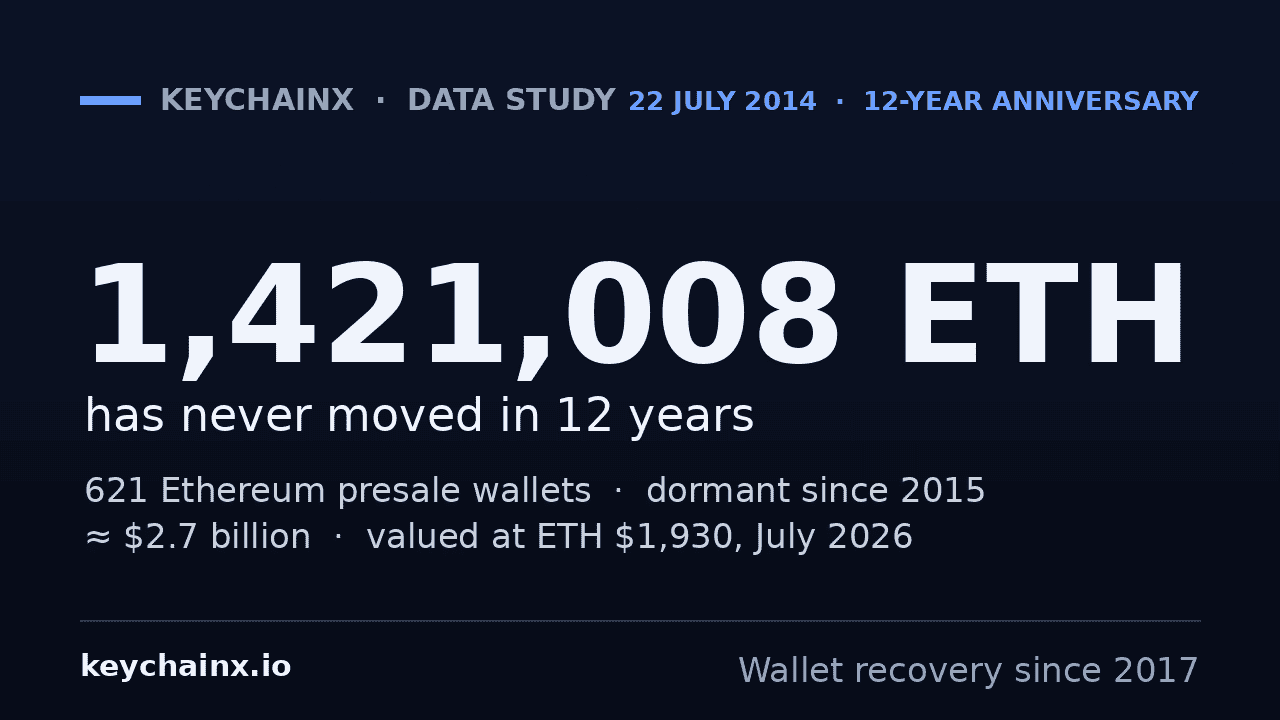
A new on-chain study from Swiss wallet-recovery firm KeychainX reveals that 621 Ethereum presale genesis wallets—holding approximately 1.42 million ETH, valued at roughly $2.7 billion at current prices—have never initiated a single outgoing transaction since the network's launch in 2015. The findings underscore the scale of dormant ETH from the original crowdsale, which took place 12 years ago.
The Ethereum presale ran for 42 days from July 22 to September 2, 2014, selling about 60 million ETH at roughly $0.31 each, raising around 31,500 BTC. Buyers received their allocations in the network's genesis block in 2015. KeychainX scanned all 8,893 presale genesis addresses, measuring each wallet's transaction nonce and ETH balance as of July 19, 2026. A nonce of zero indicates the address has never broadcast an outgoing transaction, meaning the original allocation remains untouched.

Of the 621 dormant wallets, 29 hold 10,000 ETH or more, accounting for 825,321 ETH—about 58% of the total dormant supply. The ten largest wallets alone hold 523,322 ETH. At the other end, 186 wallets with balances under 100 ETH collectively hold less than 0.5% of the dormant total. The largest single dormant wallet, containing 250,000 ETH (worth about $483 million), has collected airdropped tokens for years but never sent a transaction.
The study also identified 30 presale wallets that moved for the first time in 2025 and 2026 after roughly a decade of inactivity. In 2025, 20 wallets transferred about 52,755 ETH, led by a single wallet moving 40,000 ETH. In 2026 to date, another 10 wallets moved about 15,164 ETH. Together, these 30 wallets transferred roughly 67,900 ETH, worth about $131 million. Of these, 22 wallets were emptied almost completely, while eight moved only part of their balance.
KeychainX reports that it has recovered access to several 2014 presale wallets for their owners during this period, in cases where the wallet file survived but the stored password no longer decrypted it. “Every time one of these wallets moves, it is a reminder that a large share of this ETH is not gone—it is stuck,” said Peter M., Chief Financial Officer of KeychainX. “In most of the cases we see, the owner is convinced the password is correct and cannot understand why it fails. It usually comes down to how a 2014 browser encoded a single non-standard character. When we reproduce that, the wallet opens.”
Dormant does not necessarily mean lost. The study notes that some holdings are deliberate long-term positions, while others may belong to early contributors or foundations. However, a portion is likely lost or forgotten—misplaced wallet files, forgotten passwords, or abandoned presale files. Independent researchers have reached similar orders of magnitude; Coinbase executive Conor Grogan has estimated that more than 900,000 ETH is likely lost permanently.
Documented cases include a 250,000-ETH wallet attributed to Rain Lõhmus, a founder of Estonia's LHV Bank, who bought the stake for about $75,000 in 2014 and has said he lost access. Other reported cases include a family unable to access roughly $6 million in presale ETH, and a buyer of about 1,970 presale ETH who lost the wallet file after storing it in a deleted folder.
The findings come amid broader market dynamics, with Ethereum's price fluctuating and investor interest in dormant supply patterns. For context, the study's data was captured at an ETH price of about $1,930 on July 21, 2026. As the crypto market evolves, the fate of these dormant wallets remains a topic of interest for investors tracking supply dynamics and potential market impacts.
For more on market trends, see our coverage of SUI nearing $0.80 resistance and Coinbase's surge on exchange expansion.
This article is for informational purposes only and does not constitute financial advice.