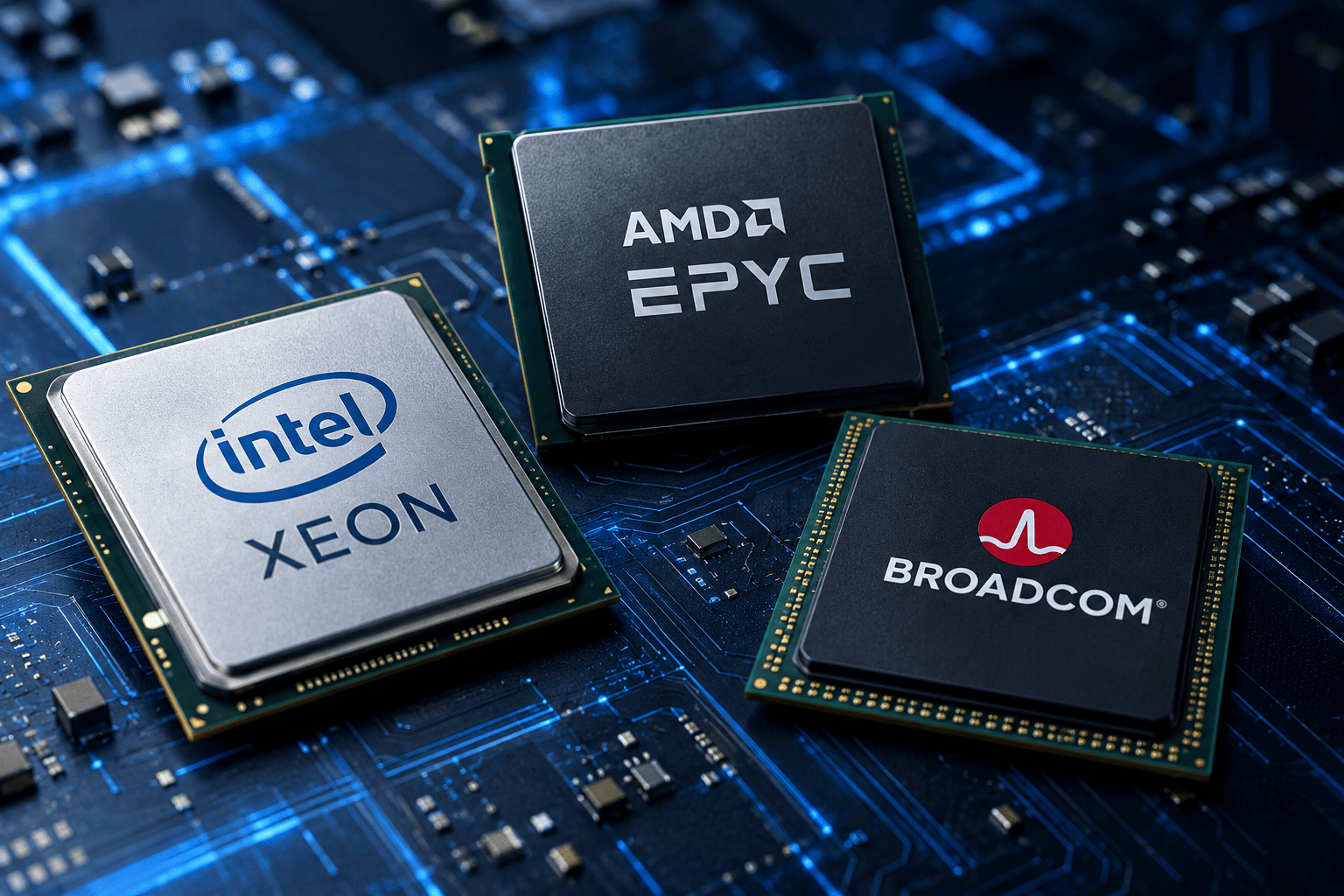
Semiconductor stocks came under heavy selling pressure on Friday, led by a historic decline in Intel shares after the chipmaker delivered a fourth-quarter outlook that fell far short of analyst expectations. The weakness rippled across the sector, with Advanced Micro Devices and Broadcom both losing ground as investors reassessed demand for chips tied to personal computers and artificial intelligence infrastructure.
Intel plunged as much as 28% by late morning in New York, a move that erased over $120 billion in market capitalization and put the stock on pace for its steepest single-day drop on record. AMD slid roughly 9.5%, while Broadcom declined about 5%. The Philadelphia Semiconductor Index fell 6.65%, reflecting broad-based weakness across chip names.

Intel's guidance misses the mark
Intel's third-quarter results actually topped expectations on an adjusted basis. Revenue climbed 21% year over year to $16.5 billion, matching consensus, while adjusted earnings of 52 cents per share beat the roughly 40 cents analysts had projected. The problem was what came next.
Management guided fourth-quarter revenue to a range of $15 billion to $16 billion, well below the approximately $17 billion Wall Street was modeling. Adjusted earnings were forecast at 25 cents per share, versus expectations near 43 cents. The company also cautioned that gross margins would face pressure.
A central source of weakness is the personal computer market, which remains a major revenue driver for Intel. The company expects PC-related sales to decline more than 20% sequentially in the current quarter. Executives cited a memory-chip shortage, as surging demand from AI data centers tightens supplies and drives up component costs. Higher prices and constrained availability are weighing on both consumer and business PC purchases, and Intel expects these pressures to persist at least through the first half of 2027.
Analysts turn cautious
The downbeat forecast prompted several analysts to revise their views. BofA Securities downgraded Intel to Neutral from Buy and slashed its price target to $100 from $145, noting the company has yet to demonstrate sufficient progress in attracting external foundry customers. Roth Capital's Suji Desilva also moved to Neutral from Buy, cutting his target to $70 from $120.
Morgan Stanley analysts led by Joseph Moore said the shares remain unattractive despite the sharp decline, pointing to the risk that Intel could cede market share to fabless competitors with lower capital spending requirements.
AMD and Broadcom feel the read-across
AMD fell in sympathy with Intel as investors weighed the implications for PC demand and server processor competition. The company is scheduled to report quarterly results on November 3. BofA estimated that PC market weakness could create a headwind of up to $750 million for AMD, though stronger server CPU revenue could partially offset that impact.
Broadcom, a key supplier of networking equipment and custom AI chips, declined less sharply but was still caught in the broader semiconductor pullback. Despite its exposure to AI infrastructure demand, the stock moved lower as investors reassessed valuations and spending expectations. William Blair recently downgraded Broadcom to Market Perform from Outperform, flagging elevated valuation risk with the stock trading at more than 40 times earnings, which leaves shares vulnerable during sector-wide technology selloffs.
Amazon amplifies AI spending concerns
Pressure on the broader market intensified after Amazon reported third-quarter results on Thursday. The company posted a substantial free-cash-flow drain tied to heavy investment in AI data centers, sending trailing 12-month free cash flow deeply negative. Amazon shares also fell.
The results renewed questions about how quickly spending on data centers, chips and related infrastructure will translate into returns. Intel's weaker outlook raised concerns about demand for traditional computing, while Amazon's cash-flow figures underscored the financial burden of AI expansion. Together, these developments weighed on semiconductor stocks and broader technology sentiment.
This article is for informational purposes only and does not constitute financial advice.