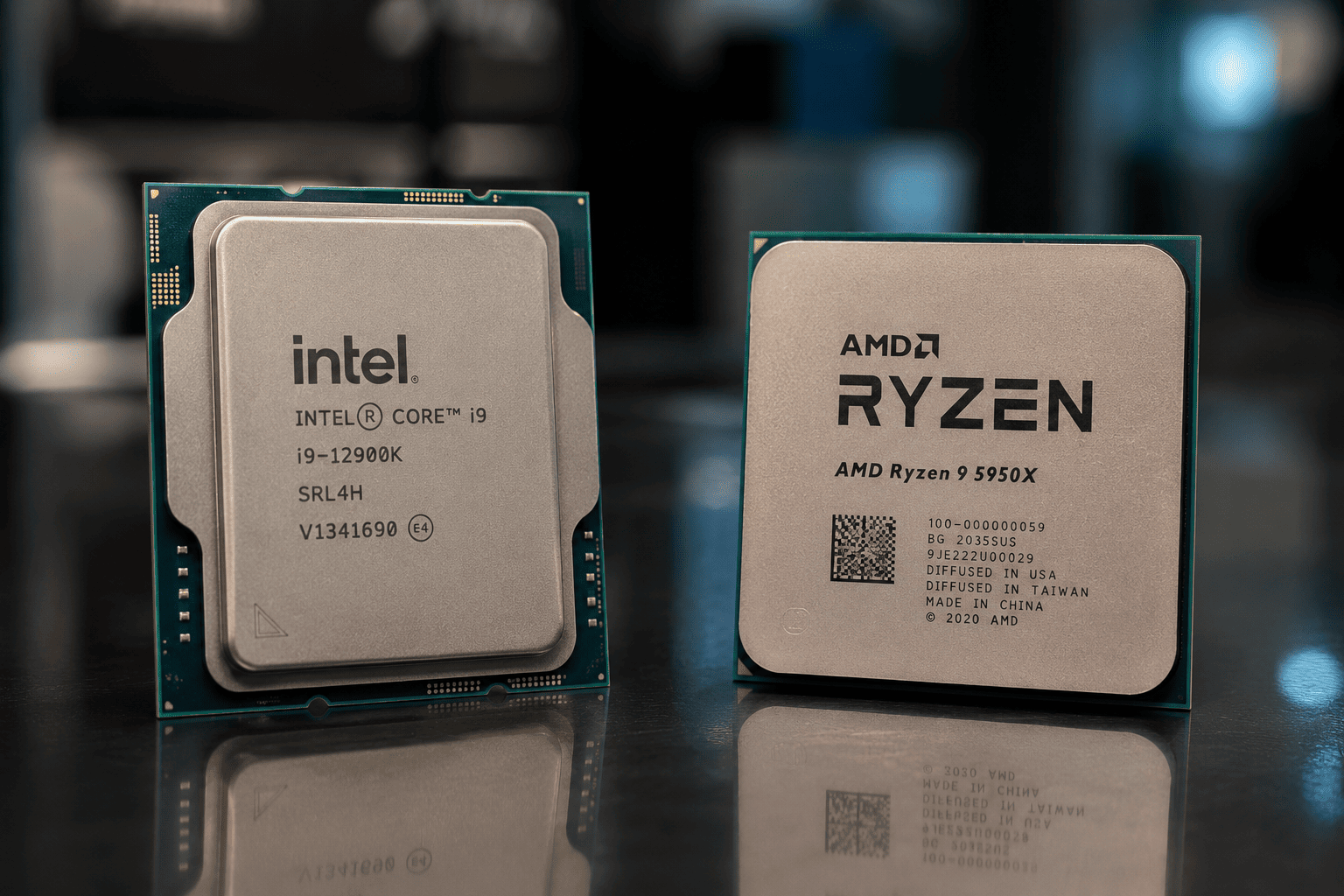
Intel and AMD shares declined on Tuesday, joining a broader selloff in semiconductor stocks that has been fueled by intensifying competition from China and growing worries that rising financing costs could slow the expansion of artificial intelligence infrastructure.
By 11 a.m. ET, Intel was down about 1.4%, while AMD shares fell just over 1%. The S&P 500 was largely flat, trading 0.1% lower, while the Nasdaq Composite declined 0.3%. The Philadelphia Semiconductor Index, however, fell more than 2%, reflecting the pressure on chipmakers.

China's CXMT advances fuel semiconductor selloff
China's ChangXin Memory Technologies (CXMT) announced "key progress" in developing a new memory-cell architecture designed to increase storage density, a technology also being pursued by Samsung Electronics and SK Hynix. CXMT President Cao Kanyu said at an industry event in Shanghai over the weekend that the company planned to introduce a new server-memory product based on the technology by the end of 2026, according to a company statement.
The development has raised concerns about the competitive threat facing the world's three leading memory chipmakers — Micron, Samsung, and SK Hynix. South Korea's benchmark stock market, which has significant exposure to the semiconductor industry, tumbled on Tuesday, led by steep losses in Samsung Electronics and SK Hynix. Micron and SK Hynix had also declined on Monday following the news and continued to fall on Tuesday. Storage companies, including SanDisk, Western Digital, and Seagate Technology, also came under pressure on Tuesday. European semiconductor stocks, including ASML, also declined.
CXMT has been steadily expanding its memory production, although analysts have cautioned that the company has yet to demonstrate its ability to manufacture at scale. A Counterpoint Research report published last month showed that CXMT captured 10% of the global dynamic random-access memory (DRAM) market in the second quarter of 2026, compared with 4% in the same period a year earlier and 8% in the first quarter.
HBM remains a key advantage for established chipmakers
Despite CXMT's progress, analysts expect established memory chipmakers to retain an advantage in high-bandwidth memory (HBM), which is critical for advanced AI accelerators. However, CXMT's ambitions in the segment are attracting attention. The Information reported in August that the company had begun producing advanced HBM in small quantities. CXMT plans to expand production in 2027, while Alibaba's T-Head semiconductor unit and Chinese AI chip designer Cambricon are already testing its HBM products with their processors.
The prospect of additional Chinese supply has also raised concerns about the cyclical nature of the memory industry, where periods of strong demand and investment can be followed by oversupply and sharp price declines. Investor Cathie Wood warned on Tuesday that China's expanding memory chip capacity could intensify the boom-and-bust cycles that have historically affected the sector, according to Bloomberg. Speaking to investors in Hong Kong, Wood said ARK avoids conventional memory chip companies because of the risk of sharp price declines when supply exceeds demand. "The trend is up, but the cycles are vicious," Wood said, according to Bloomberg. If "you get a few more incremental competitors, especially out of China, the volatility will increase." Wood identified state-backed Chinese manufacturers such as CXMT as a potential source of additional supply pressure, which could make pricing more volatile across the sector.
Rising bond yields put AI spending under scrutiny
Beyond the threat from China, semiconductor stocks are facing heightened pressure from growing concerns over the cost and sustainability of the AI infrastructure buildout. Rising bond yields have increased the cost of financing data centres and other capital-intensive projects, while investors are becoming more selective about companies seeking funds to expand their AI capabilities.
Earlier this month, Australian data centre operator Firmus, which is backed by Nvidia, shelved its planned $5 billion initial public offering and opted instead for a private fundraising round. The offering would have been the second-largest new share sale in Australia's history but attracted lukewarm demand, according to reports. The decision added to concerns about AI valuations and the sustainability of the enormous investments required to build computing infrastructure.
On Tuesday, BlackRock Investment Institute, the research arm of the world's largest asset manager, downgraded its outlook on US stocks to neutral, citing "potential volatility around the AI buildout", while turning bullish on short-term Treasuries. However, BlackRock continues to favour AI-related companies and technology stocks, maintaining that its fundamental conviction in artificial intelligence remains intact. Demand for the technology and the limited availability of critical infrastructure continue to support its investment outlook. The firm said it was managing near-term risks rather than abandoning its core convictions. It also noted that higher interest rates were increasingly distinguishing companies capable of generating earnings and returns above their cost of capital.
This article is for informational purposes only and does not constitute financial advice.