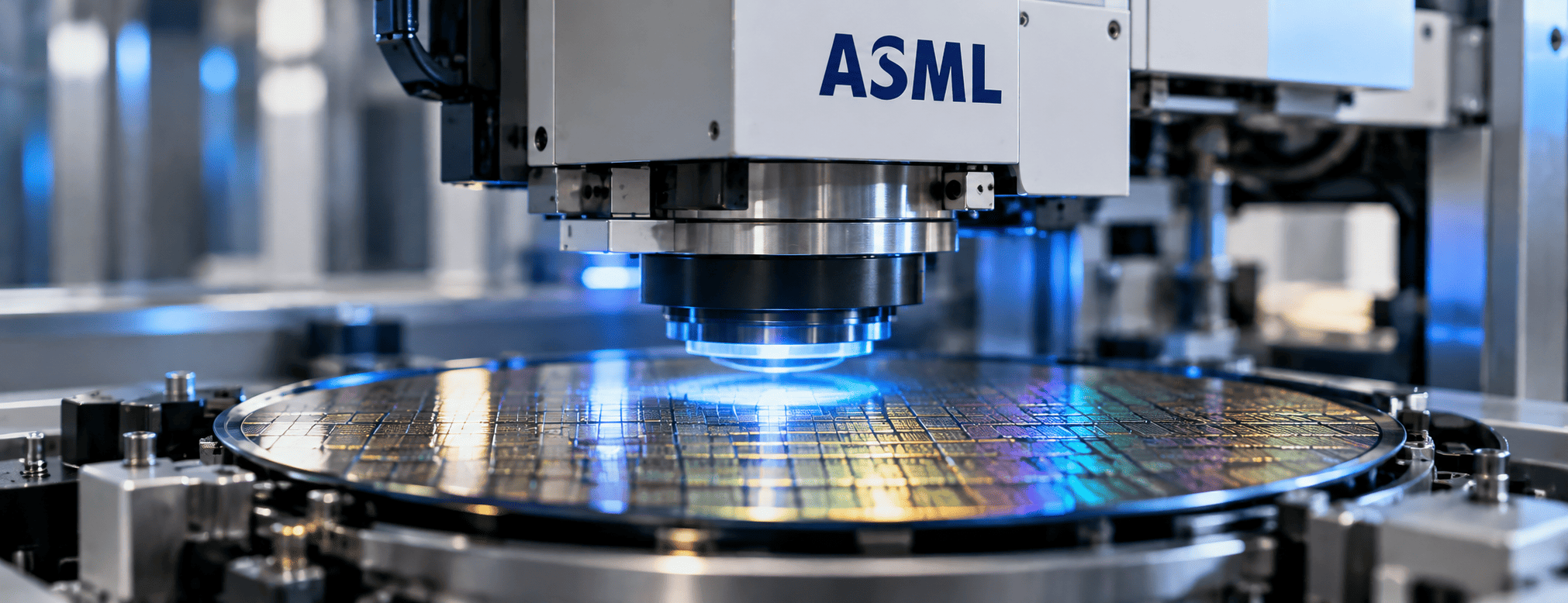
European semiconductor stocks fell sharply on Tuesday, with ASML leading the decline, as investors weighed competitive threats from Chinese memory chipmaker CXMT and growing concerns about the sustainability of AI infrastructure financing.
ASML shares dropped more than 3% in Amsterdam, while STMicroelectronics and Infineon each fell over 4%. Dutch chip equipment makers BE Semiconductor Industries and ASM International also declined, losing 2.5% and 3.7%, respectively.
The selloff extended a global tech rout that began on Monday, when US chip stocks fell and South Korean semiconductor shares plunged on Tuesday. Investors are increasingly focused on the cost of capital for AI projects, following warnings from Intel and Broadcom executives that financing constraints could limit industry expansion.
CXMT's Memory Technology Advances
ChangXin Memory Technologies (CXMT) announced progress on a new memory-cell architecture designed to increase storage density, a technology path also being pursued by Samsung and SK Hynix. The company's president, Cao Kanyu, said at a Shanghai event that CXMT plans to introduce a server-memory product based on the technology by the end of 2026.
The architecture, known as "4F square," reduces the area per memory cell to four square F, where F is the minimum line width. This could allow more memory cells per chip, boosting density and potentially improving manufacturing efficiency. Mainstream DRAM currently uses a 6F square structure.
SK Hynix unveiled its 4F square plan in 2025, and Samsung is reportedly targeting mass production of sub-10-nanometre DRAM using the design by 2028. The news triggered a sharp selloff in memory stocks: Micron fell about 4% on Monday, Samsung dropped over 7% in Seoul, and SK Hynix plunged more than 10%.
Phillip Wool, chief market strategist at Rayliant Global Advisors, called CXMT's breakthrough a significant milestone for Chinese chipmakers, showing they can overcome technology restrictions and challenge incumbents sooner than expected. However, he cautioned that the market reaction may be disproportionate, as CXMT has yet to demonstrate large-scale production and still lags in market share.
"More importantly, we're not even talking about HBM here, and the Korean chipmakers are still unquestionably dominating that space," Wool said, referring to high-bandwidth memory, which is critical for AI accelerators.
CXMT is also making inroads in HBM, with reports of small-scale production and plans to expand in 2027. Alibaba's T-Head and Cambricon are already testing its HBM products. Counterpoint Research data shows CXMT captured 10% of the global DRAM market in Q2 2026, up from 4% a year earlier.
AI Financing Concerns Add Pressure
Beyond competition, warnings from chip executives about capital access have heightened investor anxiety. Broadcom CEO Hock Tan said capital could become the biggest constraint on industry growth, even as demand outstrips supply. Intel CEO Lip-Bu Tan echoed this, citing rising capital costs and questions about returns on AI investments.
These comments have raised concerns that higher bond yields could make financing data centers and chip purchases more expensive. Such projects require massive upfront investment, with returns potentially years away. If financing costs rise or revenue disappoints, the economics of some AI projects could deteriorate.
The worries weighed on US chip stocks on Monday, with the Philadelphia Semiconductor Index falling 2.7%. Nvidia dropped 1.3%, Intel and AMD fell 3%, and Broadcom declined 2%.
Investors are now closely watching whether the AI-driven rally can sustain itself amid rising capital costs and intensifying competition from Chinese players.
This article is for informational purposes only and does not constitute financial advice.