Hunting for a 100x crypto presale is a high-risk endeavor that demands rigorous due diligence. While the allure of massive returns is strong, the reality is that such gains are rare and depend on a confluence of market demand, liquidity, project delivery, and a realistic starting valuation. A token priced at $0.0001 is not inherently cheaper than one at $0.10; supply determines valuation. Investors often begin by looking at price, social media followers, or influencer endorsements, but these signals do not predict future returns. Instead, a systematic approach focusing on audits, tokenomics, and smart contracts can expose critical risks before capital is committed.
Start with Valuation, Not the Number of Zeros
The first step in evaluating a presale is to calculate its fully diluted valuation (FDV) by multiplying the token price by the total or circulating supply. This reveals whether a 100x increase would result in a market cap that is realistic compared to similar projects. For instance, MemeToro's presale price of $0.00430 and its displayed launch target of $0.05186 describe its sale plan, but neither guarantees a market return. Similarly, Nexchain's $0.12 entry price and $0.30 stated listing target require the same caution. Investors should examine total, circulating, public-sale, team, and treasury allocations, as well as vesting dates that could release large supplies into the market. Wallet concentration and links between major holder addresses are also critical to assess.
Audits and Contracts Reveal Who Holds Power
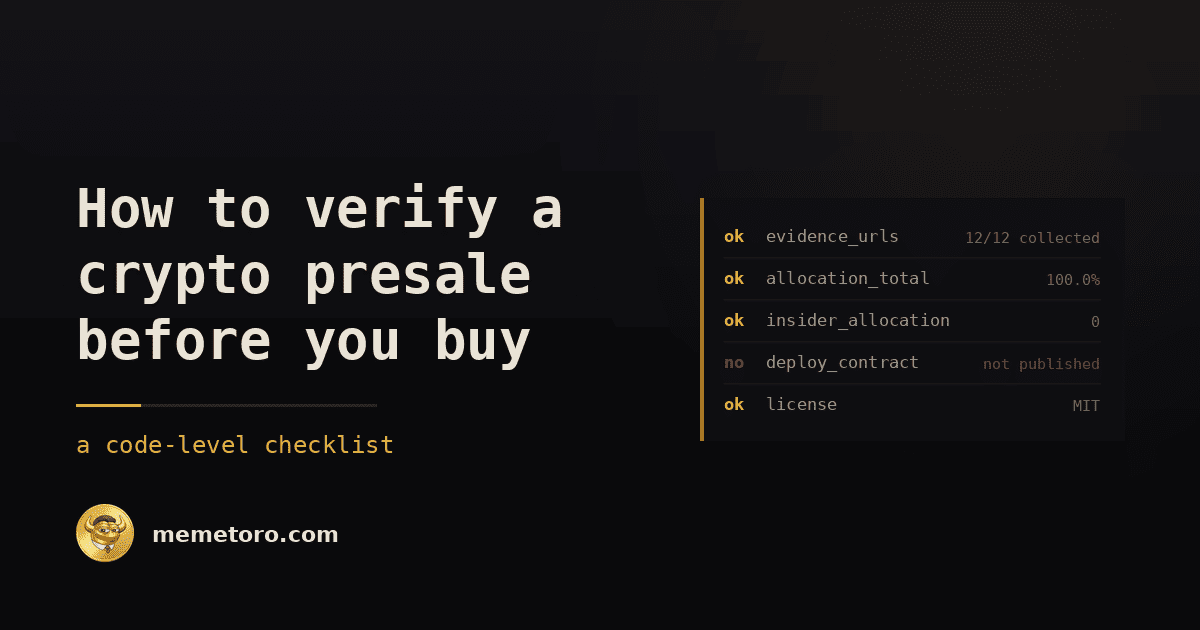
An audit can identify known coding errors, but its scope, version, findings, and fixes must be scrutinized. A badge does not prove that the live contract matches the reviewed code, nor does it guarantee honest marketing, strong liquidity, or future demand. Public source code allows buyers to inspect ownership, minting, pausing, upgrading, withdrawals, wallet caps, refunds, and allocation rules. A clear example is MemeToro's new FairLaunchEscrow, which has no owner, admin, or upgrade path, and its contributor and liquidity shares must total 100%. Funds can return to contributors or move to a future liquidity executor, with no direct developer or treasury path. These limits matter because hidden control can quickly destroy a bullish case.
Liquidity and Delivery Decide Whether Upside Is Tradable
A token can show a high screen price while holding too little liquidity for buyers to sell. Check pool depth, trading volume, slippage, liquidity-provider token ownership, and lock terms. A vague promise to "lock liquidity" is insufficient without a verifiable contract and end date. Product delivery also matters. Projects like AlphaPepe's AlphaSwap, Remittix's PayFi products, Nexchain's Layer 1, and MemeToro's AI launch system should be separated into live, tested, and planned components. Announced utility does not create usage by itself.
Practical Steps for Evaluating Presales
To improve your odds, remove projects with unclear contracts, supply, or fund destinations. Prefer public development that can be tested independently. Demand evidence for user, partnership, and listing claims. Set loss limits because even well-documented presales can fail. As noted in bear markets reveal real revenue, projects with clean tokenomics and actual usage tend to survive downturns. Additionally, understanding MemeToro's fixed supply and AI utility can provide insight into how tokenomics models are evolving. For broader context, Gate DexBuilder's event contracts builder shows how smart contract innovation is expanding, but each project must be evaluated on its own merits.
FAQs
Can an audit identify a 100x token?
No. An audit reviews code within a fixed scope. It cannot predict market demand, liquidity, exchange support, product adoption, or a token's future price reliably.
Why is token supply important?
Supply turns unit price into valuation. Learning how to find 100x potential memecoins requires calculating the market value a 100x move would create. An unrealistic future valuation can expose a misleading return claim.
Does public code make a presale safe?
No. Public code helps independent reviewers find permissions and flaws, but it may remain unfinished or unaudited. Buyers must also verify deployment addresses, liquidity, vesting, audits, claims, team behavior, and broader market risks.
This article is for informational purposes only and does not constitute financial advice.