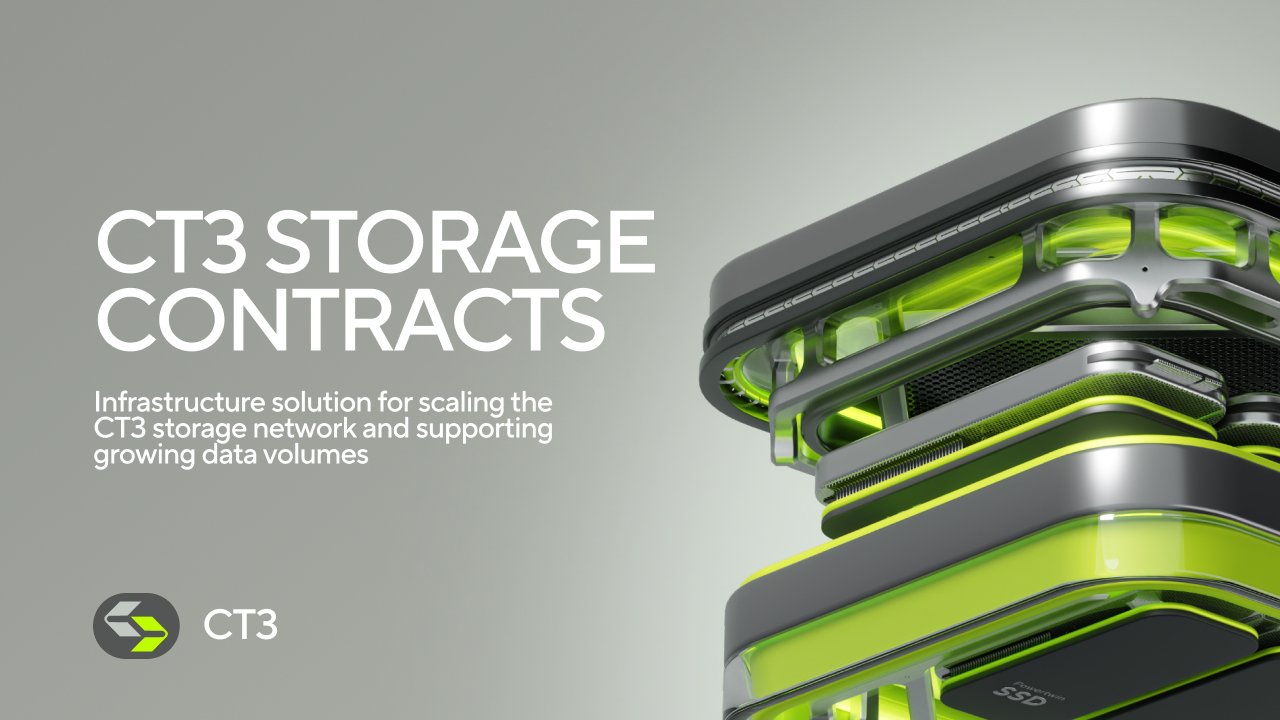
CT3 has announced a shift to a dedicated Storage Contracts model for its decentralized storage infrastructure, aiming to support platform growth, improve scalability, and expand capacity in response to rising demand. The move comes as the ecosystem surpasses 180,000 unique users and 500,000 uploads, each linked to an NFT access key for on-chain verification.
Infrastructure Segmentation
Previously, CT3 processed all uploads through a single main collection and smart contract, which limited scaling flexibility as network activity increased. Under the new architecture, uploads are distributed across multiple Storage Contracts, each operating as an independent segment with its own capacity, utilization metrics, and on-chain statistics. This segmentation reduces pressure on the main NFT key issuance process and allows individual areas of the platform to scale without a full system rebuild.

How Storage Contracts Work
Each Storage Contract is tied to a fixed amount of storage capacity supplied by network nodes. The allocated space is used for standard user files, corporate archives, automatic backups, long-term datasets, and future CT3 products. Larger contracts can accommodate heavier files and corporate data flows, directing workloads to segments with sufficient capacity.
Economic Model and Participant Incentives
The commercial model is based on real infrastructure usage. CT3 acquires storage from node operators and sells it to ct-3.cloud customers at market prices. Participants can finance the deployment of new Storage Contracts, expanding available capacity. Once launched, the capacity stores personal and corporate data, and the resulting profit is shared between the participant and CT3. The financial performance of each contract depends on actual utilization and the margin between acquisition cost and end-user pricing. The more actively capacity is used, the greater the potential return.
On-Chain Transparency
Each Storage Contract's operation is verifiable on the blockchain. Files stored within allocated capacity are represented by NFT keys containing storage metadata. Investors can verify issued NFTs, collection activity, and actual capacity use via the smart contract address. This enables independent verification of key creation, data volume, utilization, and the link between usage and profit generation.
For ct-3.cloud users, the experience remains unchanged. Existing and new NFT keys continue to be supported, and no action is required for the transition.
CT3's model combines independent nodes, the ct-3.cloud interface, NFT access keys, and blockchain verification. As user numbers and uploads grow, the network must continuously expand capacity. The new Storage Contracts model is designed to address this need, allowing participants to directly contribute to infrastructure growth and potentially earn income tied to real demand for storage services.
For broader context on decentralized infrastructure and tokenized assets, see ONDO Surges 17% as Tokenized Stock Offerings Expand; $0.40 in Sight and Bitrue Launches Explainable AI Trading Tool Amid 333% Surge in AI-Linked Futures Volume.
This article is for informational purposes only and does not constitute financial advice.