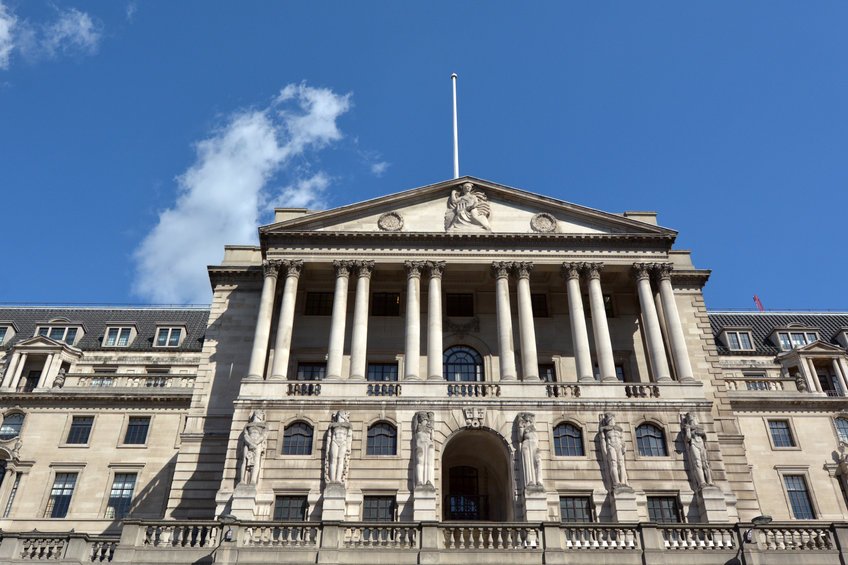
The Bank of England is reportedly preparing to suspend sales of its longest-dated government bonds, a move that would mark a significant adjustment to its quantitative tightening (QT) programme amid renewed stress in UK debt markets.
According to a report from The Telegraph, the central bank is set to stop selling 20- and 30-year gilts, with an announcement expected alongside Thursday's monetary policy decision. This would deepen an existing shift rather than signal a sudden reversal, as the BoE has already scheduled no sales of maturities beyond 20 years for the current quarter.

The potential pause comes after a particularly turbulent period for long-dated UK debt. Last week, Britain sold £4.25 billion of 30-year gilts at a yield of 5.8168%, the highest borrowing cost on such a syndicated sale since the Debt Management Office was established in 1998. Market yields on 30-year gilts have also approached 6% during the latest global bond sell-off.
Demand for the auction remained robust, attracting over £87 billion in orders, but the composition of buyers has shifted. Defined-benefit pension schemes, traditionally the largest buyers of long gilts, have reduced their appetite as their liabilities mature. Fund managers at Allianz Global Investors and RBC BlueBay have noted that continued long-dated sales are becoming harder to justify as structural demand weakens.
The question of whether quantitative tightening has gone too far is complex. The BoE estimates that cumulative QT has added roughly 20 to 30 basis points to 10-year gilt yields since the programme began, describing the effect as modest relative to the larger rise driven by changing rate expectations, global bond supply, and higher term premiums. However, other analyses suggest a more significant impact, with some research indicating QT may have increased UK borrowing costs by as much as 0.7 percentage points.
Costas Milas, a professor at the University of Liverpool, argued that continuing aggressive QT while global yields are already climbing would be increasingly difficult to defend. Slowing the pace of balance-sheet reduction, potentially to around £50 billion over the next year from the current £70 billion, is widely expected by markets.
Stopping long-gilt sales should be viewed as a change in implementation rather than a pivot towards monetary easing. Bank Rate remains the primary tool for controlling inflation, and with oil prices above $100 and UK inflation risks rising, the BoE could maintain a restrictive policy stance through interest rates while avoiding unnecessary pressure on the weakest part of the gilt curve.
If Thursday's announcement confirms this approach, the message may be that quantitative tightening itself has not gone too far, but selling long gilts into a structurally thinner market perhaps has. This development comes amid broader global bond market volatility, as seen in Japan's 10-year yield hitting 3% for the first time since 1996 and the Nikkei 225 sliding 1.25%.
Investors will be watching closely to see whether the BoE's move signals a broader reassessment of QT, which could have implications for UK banking stocks and the wider economy.
This article is for informational purposes only and does not constitute financial advice.

