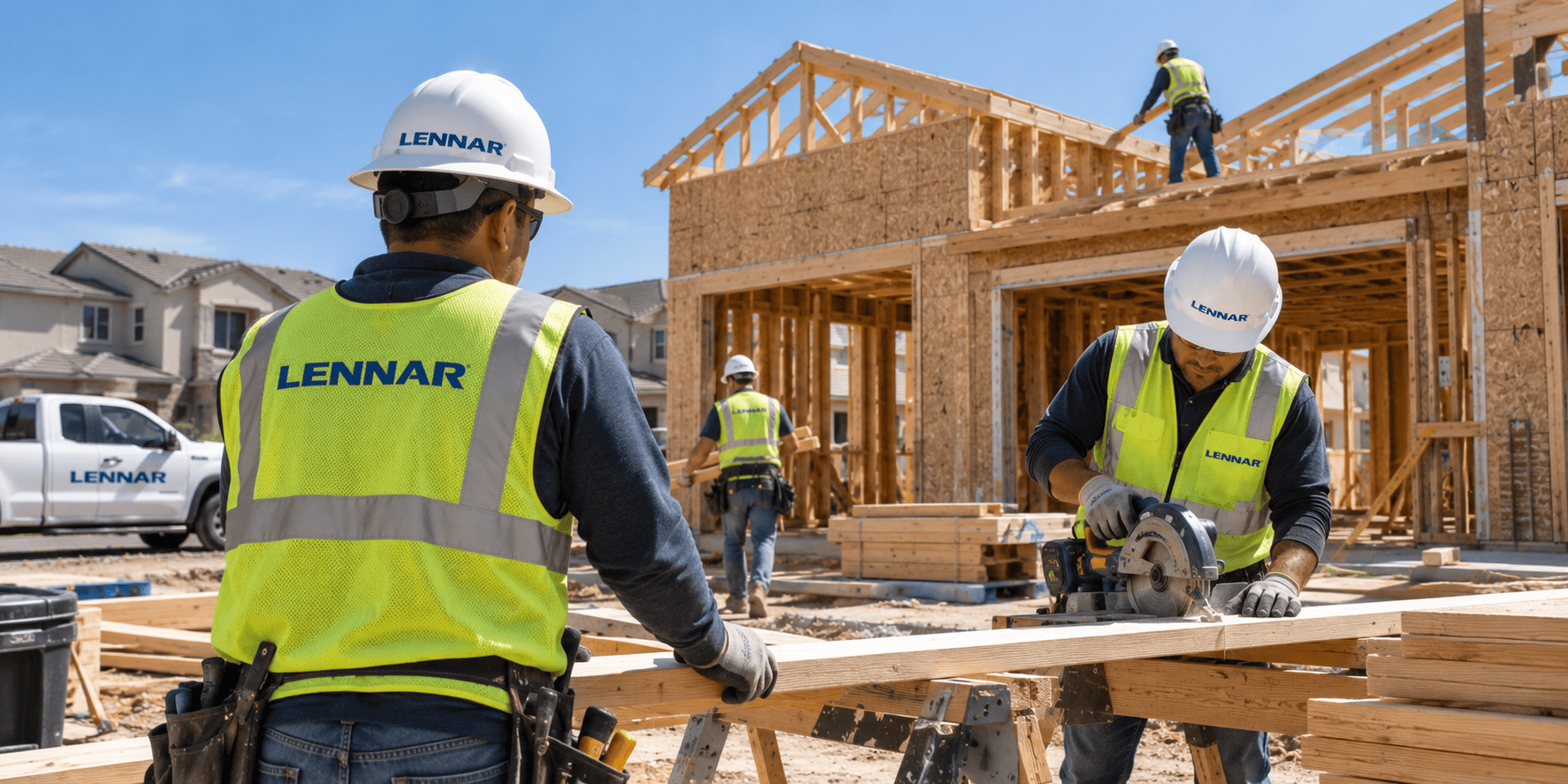
Berkshire Hathaway has accumulated 2.74 million shares of Lennar, including both Class A and Class B stock, in a series of purchases spread across three trading days. The position is valued at roughly $212.4 million and lifts Berkshire's ownership of the Miami-based homebuilder to slightly more than 10%. Lennar shares rose 5% on Tuesday following disclosure of the buying.
The move deepens Berkshire's exposure to the U.S. housing market at a moment when that market is under visible strain. Mortgage rates remain elevated, affordability has eroded for many buyers, and Lennar's stock has shed nearly 20% of its value so far this year. Rather than waiting for a clearer turn in sentiment, Berkshire added to its position during the downturn.

A broader housing bet
Lennar is not an isolated wager. Berkshire also holds a stake in D.R. Horton and completed a $6.8 billion acquisition of Taylor Morrison in July. Together, those positions suggest a deliberate strategy of building scale across the single-family homebuilding sector, where land, labor and financing costs are cyclical and valuations have compressed.
Berkshire has reshuffled other parts of its equity portfolio this year as well. It increased its Alphabet holding by about 48.1 million shares and added to positions in Delta Air Lines and Macy's. The Lennar purchases fit a pattern of deploying capital into sectors where prices have fallen and long-run demand remains intact.
Third-quarter results miss estimates
Lennar's latest quarterly report illustrates the pressure the company is navigating. Net earnings came in at $284 million, down sharply from $591 million a year earlier. Adjusted earnings per share were $1.23, or $1.19 on a GAAP basis, below the $1.30 consensus estimate. Revenue of $8.05 billion also fell short of the $8.31 billion analysts expected.
New orders declined 9% year over year to 20,879 homes, while deliveries slipped 3% to 20,840. Gross margin narrowed to 15.8% from 17.5%, reflecting the use of incentives and pricing adjustments to keep buyers engaged. Management lowered its full-year 2026 delivery outlook to 80,000-81,000 homes from a prior range of 82,000-83,000.
The balance sheet remains a relative bright spot. Lennar closed the quarter with $1.2 billion in cash and $3.6 billion in total liquidity. Its construction cycle time improved to 116 days, and homebuilding debt represented 16.6% of total capital.
For the fourth quarter, Lennar projects new orders of 19,500-20,500 homes and deliveries of 22,000-23,000. It guided to gross margins of 15.5%-16% and earnings per share of $1.30-$1.65.
Analysts trim targets
Wall Street has turned more cautious. CEO Stuart Miller said the operating environment "has deteriorated since our last earnings call." The average selling price for new orders was $359,000, below the $370,000 consensus cited by Truist Securities, and the sales pace slowed to 4.1 homes per community per month, down 12% year over year.
Bank of America analyst Rafe Jadrosich flagged "ongoing pricing pressure despite lower incentive levels," pointing to soft demand and affordability headwinds. Citigroup kept a Neutral rating and cut its target to $85 on September 21. RBC Capital maintained Underperform and lowered its target to $69 on September 18, while Barclays stayed Underweight with a $70 target. Raymond James reiterated Underperform, Keefe, Bruyette & Woods cut its target to $75, and Truist maintained Hold with a $75 target.
For Berkshire, the calculus appears to rest on valuation and cycle timing rather than near-term earnings momentum. Buying into a homebuilder whose shares have fallen and whose guidance has been reduced is a contrarian posture, and it carries the risk that affordability constraints persist longer than expected.
This article is for informational purposes only and does not constitute financial advice.