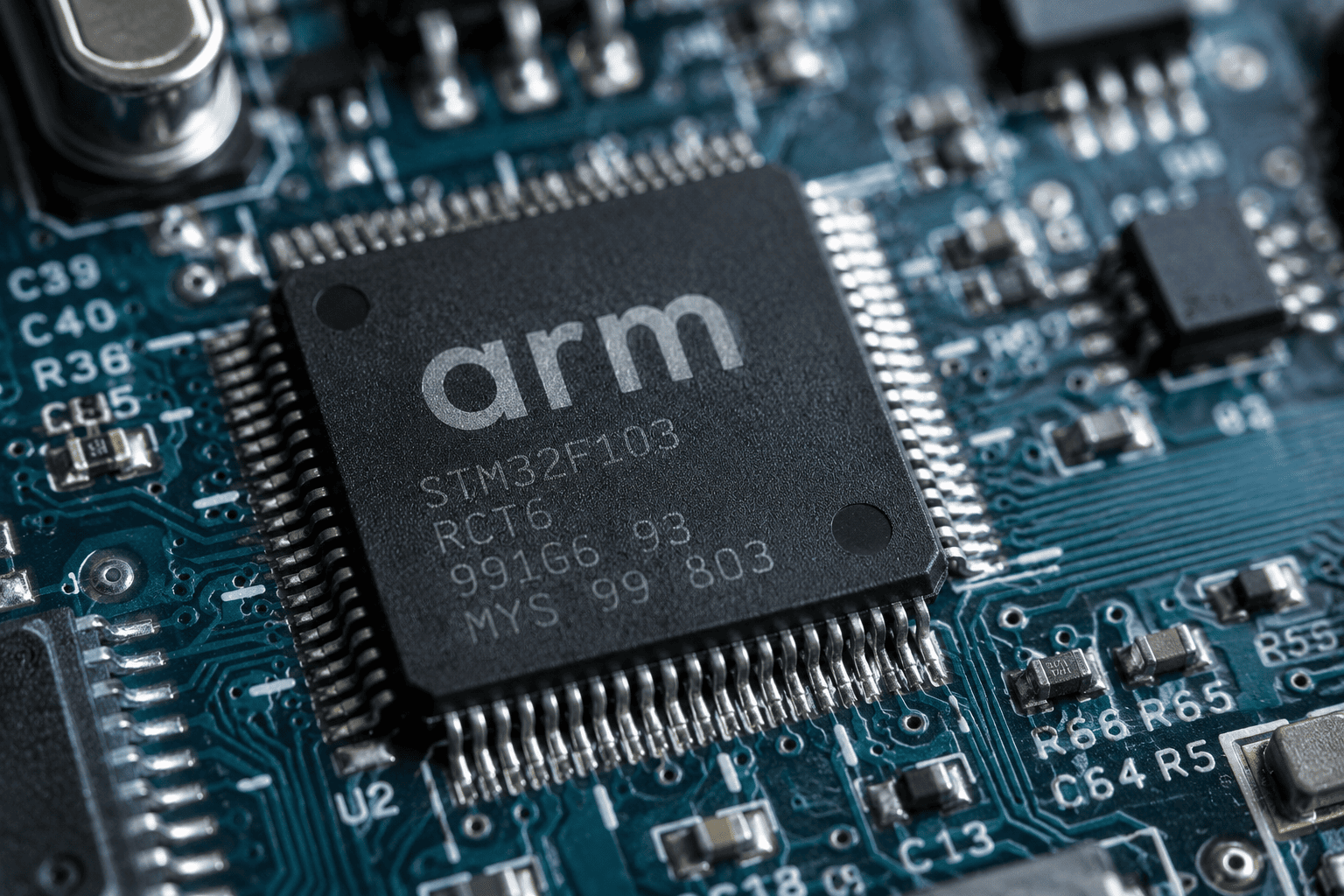
Arm Holdings (ARM) experienced a 7% decline in premarket trading on Monday, as a broad risk-off sentiment swept through technology and semiconductor stocks. The drop was exacerbated by a sharp fall in the Nasdaq Composite, which pressured high-multiple companies in the chip design sector.
The sell-off was triggered by warnings from leaders of major AI companies about the risks associated with rapid AI development, leading to a decline in AI-linked stocks. This added to existing pressure on Arm shares, which have remained significantly below their all-time high of $452.70 reached earlier this year.

Valuation and regulatory concerns weigh
Arm's valuation has been a persistent concern for investors. The stock trades at approximately 110 times forward earnings, according to Stockanalysis.com. In July, an HSBC analyst downgraded the stock to Hold, citing foundry capacity constraints at advanced process nodes and a valuation that had already priced in several years of future growth.
Regulatory scrutiny is also a factor. The U.S. Federal Trade Commission is investigating Arm's chip licensing practices, adding another layer of uncertainty. Additionally, concerns about majority owner SoftBank's leveraged AI investment strategy have weighed on sentiment. Investors are assessing whether a potential slowdown in AI development could expose risks in SoftBank's approach and reduce the perceived upside for Arm.
Strengths and risks
Despite near-term pressures, Arm's licensing and royalty model remains a key strength. The business generates strong margins and robust cash flow, providing financial resources to continue investing in chip designs and AI-related technologies even as market conditions become more challenging. The increasing adoption of Arm-based CPUs in data centers and AI infrastructure could help diversify beyond smartphones and create more stable recurring revenue streams.
However, several risks could limit Arm's performance in the near term. Weakness in the global smartphone market could pressure royalty income, while supply bottlenecks for advanced chips could slow the rollout of its AGI CPUs. New AI-focused products also initially carry thinner margins than Arm's traditional business, potentially limiting profitability until the platform matures and scales.
Piper Sandler sees server CPU opportunity
On September 9, Piper Sandler initiated coverage with an Overweight rating, citing momentum from server CPU design wins. The firm highlighted Arm's dominant position in CPU intellectual property, with a 50% market share of its target markets. Piper Sandler expects Arm's IP revenue to grow at approximately a 20% compound annual growth rate to around $12 billion by fiscal 2031.
The investment bank also noted Arm's expansion into accelerator intellectual property as a potential upside. Piper Sandler estimated that capturing approximately 10% of the ASIC market could double Arm's current earnings. The firm valued Arm using a fiscal 2031 sum-of-the-parts enterprise-value-to-EBIT approach, while acknowledging that the stock trades at an expensive valuation.
Related market movements include Nvidia's recent rebound and Marvell's slide from its peak, reflecting broader valuation concerns in the chip sector. Additionally, CoreWeave's GPU shortage highlights supply dynamics, while Bitcoin's test of $78K signals market shifts amid geopolitical risks.
This article is for informational purposes only and does not constitute financial advice.

