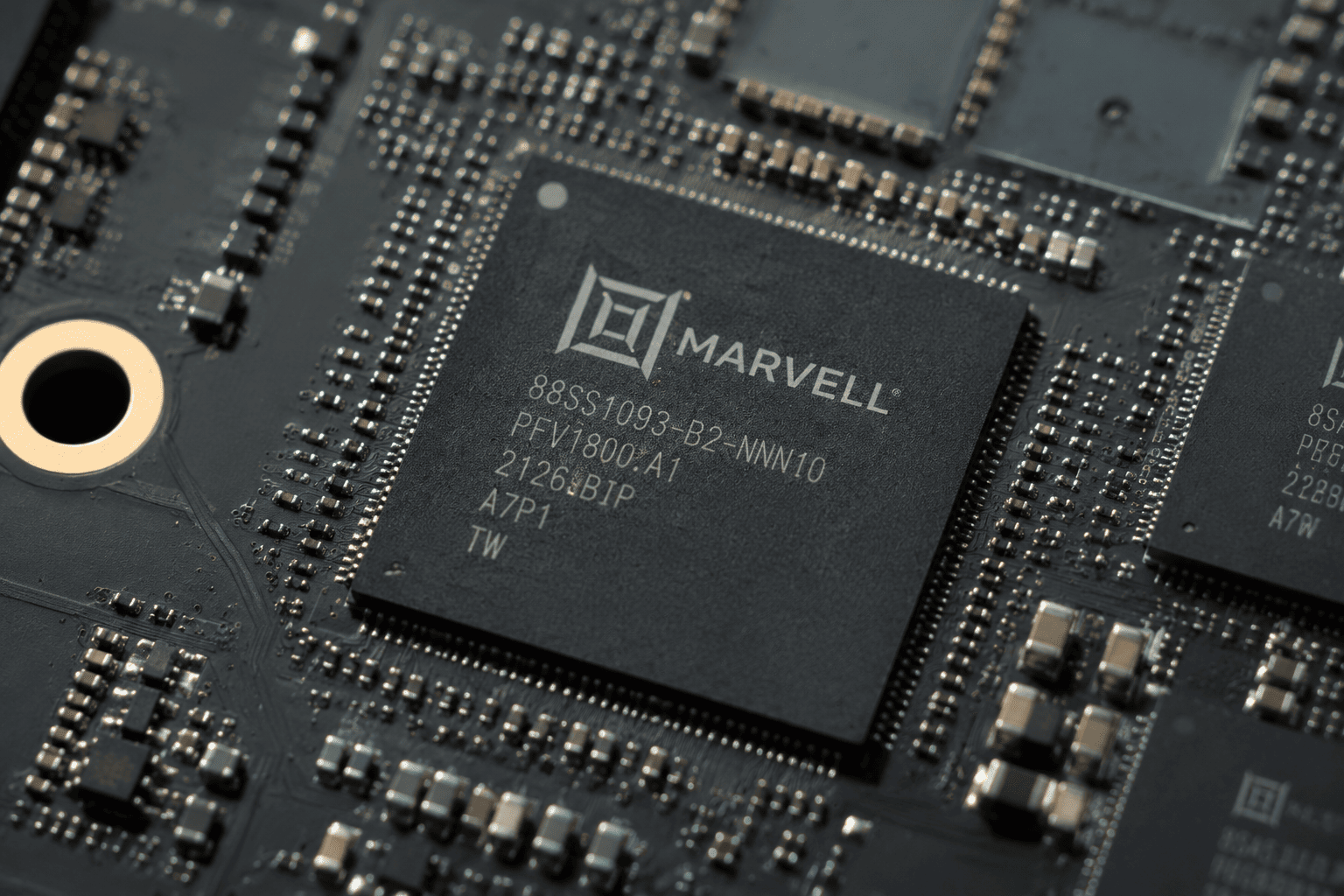
Marvell Technology (MRVL) shares have retreated roughly 31% from their 2025 peak, trading near $223, as the broader semiconductor sector faces a pullback. The Schwab Semiconductor Index Fund (SOXX) and the VanEck Semiconductor ETF (SMH) have each dropped more than 19% and 15% from their yearly highs, respectively, reflecting a wider industry correction.
Strong revenue, but guidance disappoints
Marvell's fiscal second-quarter results showed robust growth, with revenue climbing 37% year over year to $2.73 billion. Data center revenue, a key growth driver, surged 46% to a record $2.17 billion, while communications revenue rose 10% to $568 million. The company's top clients, including Google, Amazon, and Microsoft, continue to expand their AI and cloud infrastructure spending.
However, the stock dropped after management issued third-quarter guidance that fell short of analyst expectations. The company projects revenue of $3.15 billion for the quarter, representing 50% growth, and expects full-year revenue to increase 60%. Management also outlined longer-term targets of $12 billion in fiscal 2027 and $18 billion in fiscal 2028 revenue.
Marvell's growth is underpinned by significant custom chip deals, including a $12.2 billion agreement with Google. According to a Reuters report, this business could generate over $120 billion through fiscal 2033, with annual revenue reaching $25 billion by 2028. Similar partnerships with Amazon and Microsoft are also contributing to the pipeline.
Analyst optimism vs. valuation concerns
Wall Street remains largely optimistic about Marvell's trajectory. Consensus estimates project revenue of $12 billion this year (up 46%) and $18.2 billion next year (up 51%). Earnings per share are expected to reach $4.20 in 2025 and $6.72 in 2026.
Yet valuation metrics suggest the stock is priced for perfection. Marvell trades at a forward price-to-earnings ratio of roughly 75, compared with the industry average of 22. On a GAAP basis, the forward P/E stands at 124, versus a sector median of 28. These multiples are higher than those of major peers like Nvidia, Microsoft, and Google, raising questions about whether the current price already reflects future growth.
Technical outlook points to further downside
From a technical perspective, Marvell's daily chart shows the stock rebounding from a July low of $162.80 to its current level, holding just above the 100-day exponential moving average (EMA) and the 50% Fibonacci retracement. However, the formation of a bearish flag pattern—a classic continuation signal—suggests the recent consolidation may be a pause before another leg down.
The stock is also trading between the first and second support lines of the Andrews pitchfork tool, a technical indicator that often defines trend channels. If the bearish pattern plays out, Marvell could revisit its July low of $162. A break below the 100-day EMA and the lower pitchfork line would confirm this bearish scenario.
Investors should weigh the company's strong fundamentals and growth prospects against its rich valuation and technical warning signs. While the long-term story remains compelling, the near-term risk of further price declines appears elevated.
This article is for informational purposes only and does not constitute financial advice.