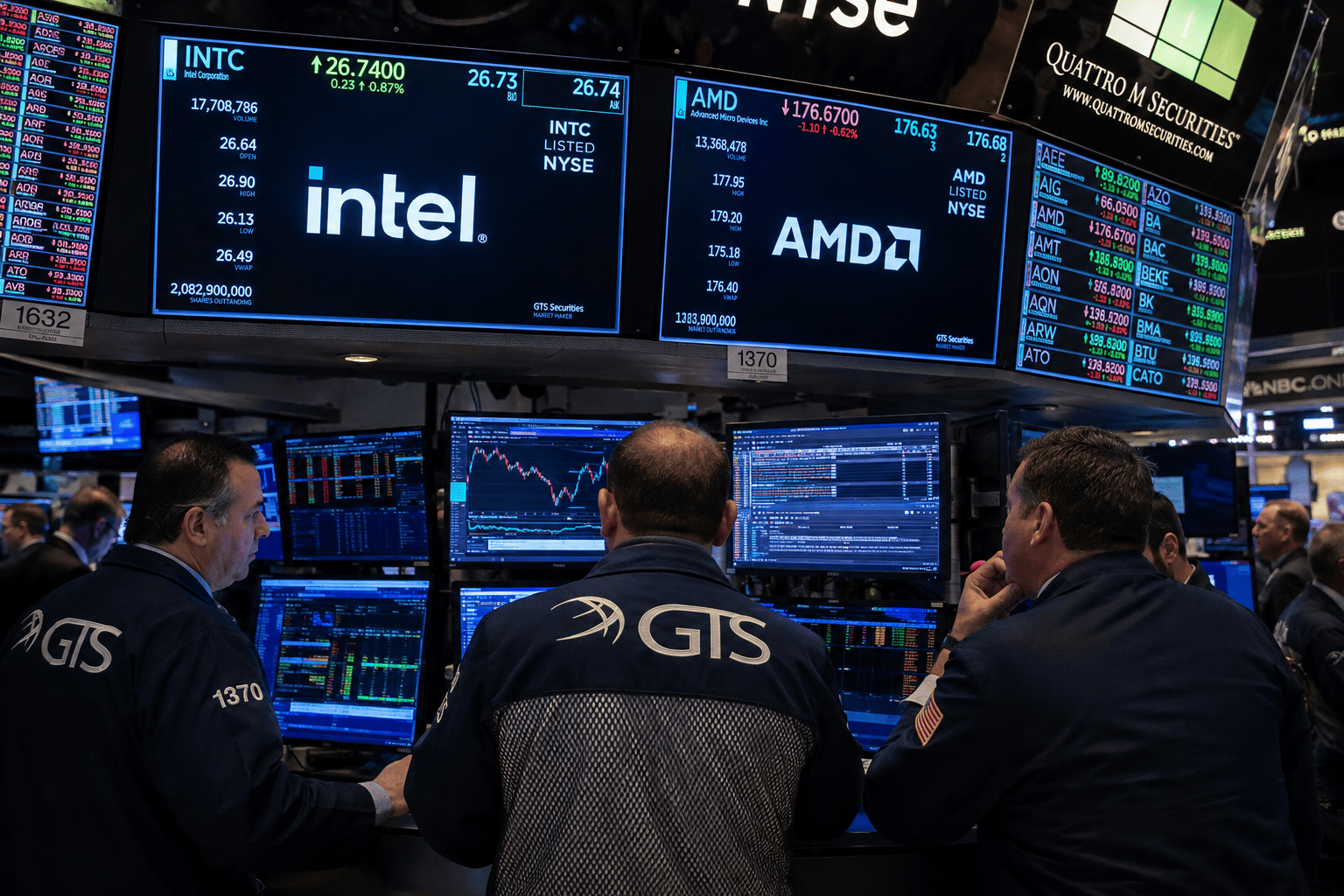
Advanced Micro Devices (AMD) and Intel shares rebounded on Friday, recovering from a sector-wide sell-off a day earlier, as investors selectively returned to technology names despite broader market softness. AMD rose 2%, while Intel gained 1.76%, outperforming the major indices. The Nasdaq Composite slipped 0.10%, the S&P 500 fell 0.42%, and the Dow Jones Industrial Average declined 1.09%.
The technology sector advanced 0.43%, making it the second-best performer among S&P 500 sectors, trailing only energy, which surged 2.50%. Only two of the 11 sectors ended higher, underscoring the selective nature of the buying.

Intel's Fab 62 Expansion Draws Analyst Scrutiny
Intel's gains were partly driven by analyst commentary on its manufacturing expansion. Wedbush Securities highlighted the potential revenue contribution from additional capacity at Intel's Fab 62 facility in Arizona. Analyst Matt Bryson noted that equipment installation at the site aligns with expectations for production to begin in 2028, though it remains unclear whether the initial lines will use Intel's 18A or 14A process technology.
Bryson emphasized that additional capacity is critical because existing constraints are limiting Intel's ability to meet customer demand, particularly for Xeon server processors. These constraints are also weighing on revenue growth and the company's ability to optimize its product mix.
Intel Foundry CTO and COO Naga Chandrasekaran confirmed this week that construction and equipment installation are underway at Fab 62, the company's sixth high-volume manufacturing facility at its Ocotillo campus in Arizona. Operations are expected to begin by the end of 2027, though Intel has not disclosed the manufacturing node or planned production capacity. Progress is also reported at other U.S. facilities, including the New Albany, Ohio plant and an Oregon development fab that integrated a High-NA EUV lithography machine.
AI Demand Supports Server Chips as PC Market Weakens
Susquehanna updated price targets for several semiconductor companies ahead of earnings season, reflecting divergent outlooks. The firm raised its AMD target to $620 from $550 and increased Qualcomm's target to $185 from $160, but lowered Intel's to $105 from $115.
Analyst Christopher Rolland said artificial intelligence will likely drive much of the sector's upside, while the broader industry upcycle continues. Semiconductor lead times expanded by approximately two weeks for a second consecutive quarter, and pricing has become increasingly aggressive, with a 12% quarter-on-quarter increase in Q3 2025 and further hikes expected into 2027.
However, the PC market outlook has deteriorated. Rolland noted that third-quarter original design manufacturer builds are tracking significantly below expectations, pointing to potentially below-seasonal second-half results for AMD and Intel's client businesses. Both companies are shifting wafer capacity from PC processors toward server products to address demand from agentic AI.
The scale of potential server growth will depend on how quickly additional capacity becomes available. Rolland also noted that Arm-based hyperscale CPUs are expected to gain share as host processors for custom AI accelerators, while memory supply constraints could weigh on smartphone demand. Meanwhile, expanding hyperscaler capital expenditure plans continue to support data center demand, though power and infrastructure constraints raise questions about how much planned capacity can be delivered.
This article is for informational purposes only and does not constitute financial advice.