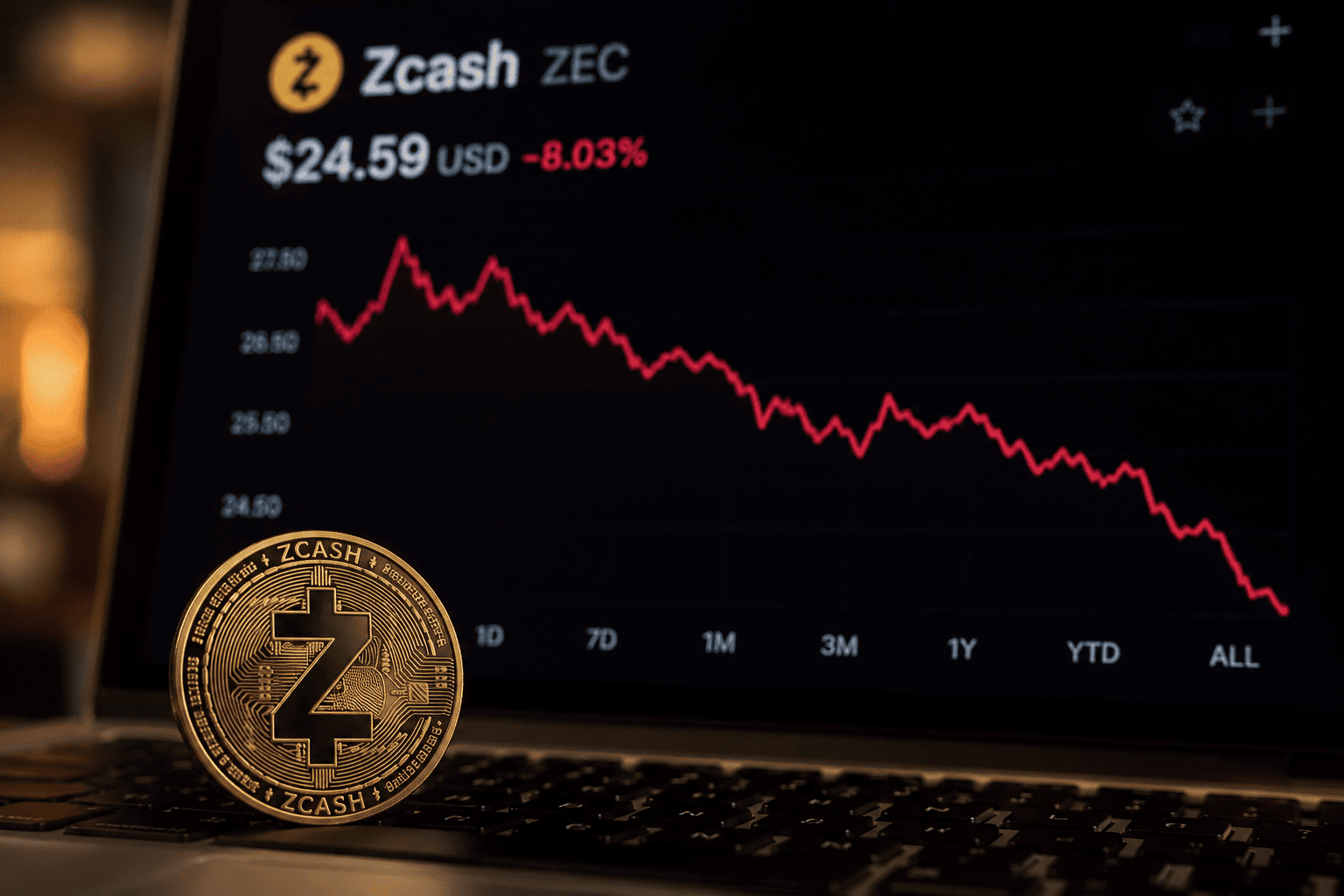
Zcash (ZEC) has slipped below the $1,500 mark, reversing sharply from its September highs as profit-taking and a wave of leveraged long liquidations weighed on the privacy coin. The pullback comes amid a broader crypto market downturn and lingering uncertainty from the Bitget exchange hack, which involved ZEC tokens.
At the time of writing, ZEC was trading near $1,422, down 7.9% over the past 24 hours and 5.5% over the past week, according to CoinGecko. The token briefly touched $1,360 on September 29 before recovering some ground.

The decline follows an unusually strong September performance. ZEC remains up 69% over the past 30 days, having climbed from around $1,000 earlier in the month to a recent high near $1,700. However, repeated failures to hold the $1,600–$1,700 resistance zone triggered profit-taking, which accelerated on September 28–29, pushing the price through $1,500 and toward $1,350.
Derivatives and Liquidations Amplify the Sell-Off
Derivatives positioning has exacerbated the move. Open interest in ZEC perpetual futures stood near $2.68 billion across 33 tracked venues early on September 29, according to Loris Tools, while the volume-weighted price had fallen 11.3% over 24 hours. Long liquidations were already building a day earlier, with Coinglass data showing $2.14 million in ZEC longs liquidated on Binance, Bybit, and OKX as the token fell to $1,492 on September 28.
Earlier in September, open interest had climbed above $2 billion as the token rallied, with tens of millions of dollars in short positions liquidated during the move higher. The recent contraction in open interest, alongside falling prices, suggests traders are closing leveraged positions as ZEC retreats from its highs. Forced long liquidations can accelerate the decline because exchanges close positions when margin requirements are no longer met.
Bitget Hack Adds ZEC-Specific Risk
The Bitget hack has introduced a separate Zcash-specific risk. The exchange initially disclosed losses of around $351.6 million, later revised to $387.5 million after tracing additional affected assets. ZEC was among the assets identified in the later tracing, raising concerns that stolen coins could eventually be sold on the market. Traders may be worried that the attacker could move or convert the funds, adding uncertainty while ZEC is already facing profit-taking and leveraged liquidations.
Broader Market Pressure
Bitcoin's decline toward $83,000 has also contributed to the difficult conditions for ZEC. The privacy coin entered the pullback after gaining considerably more than much of the crypto market during September, leaving traders with large unrealized profits and giving them more incentive to lock in gains as market conditions weakened.
Technical Analysis: Key Levels to Watch
On the daily chart, ZEC's correction has been swift after reaching the $1,600–$1,700 area. The price fell to an intraday low of $1,356 on September 29 before recovering toward $1,423, leaving $1,350–$1,400 as the first support zone. The Average Directional Index (ADX) stands at 57.40, indicating an unusually strong trend, though it does not specify direction. The Coppock Curve remains positive at 67.08, suggesting longer-term momentum has not yet turned negative.
A daily close below $1,350 would weaken the structure, with the next visible support around $1,250–$1,300, followed by the $1,100–$1,200 consolidation area. On the upside, reclaiming $1,500 would be the first step toward repairing the breakdown, with resistance at $1,550–$1,600 and then the recent high near $1,700.
Short-term indicators remain bearish. On the 4-hour chart, Aroon Down stands at 92.86% versus Aroon Up at 21.43%, indicating sellers control the trend. The Chaikin Money Flow (CMF) has fallen to -0.17, showing selling volume outweighing buying volume. A recovery would require CMF moving back toward zero and Aroon Up rising relative to Aroon Down.
If selling continues, ZEC could retest $1,350, with a break below that opening the door to $1,300 and then the larger $1,200 area. Conversely, a move back above $1,500 could lead to a test of $1,550–$1,600, and clearing that range would bring the recent high near $1,700 into play.
This article is for informational purposes only and does not constitute financial advice.

