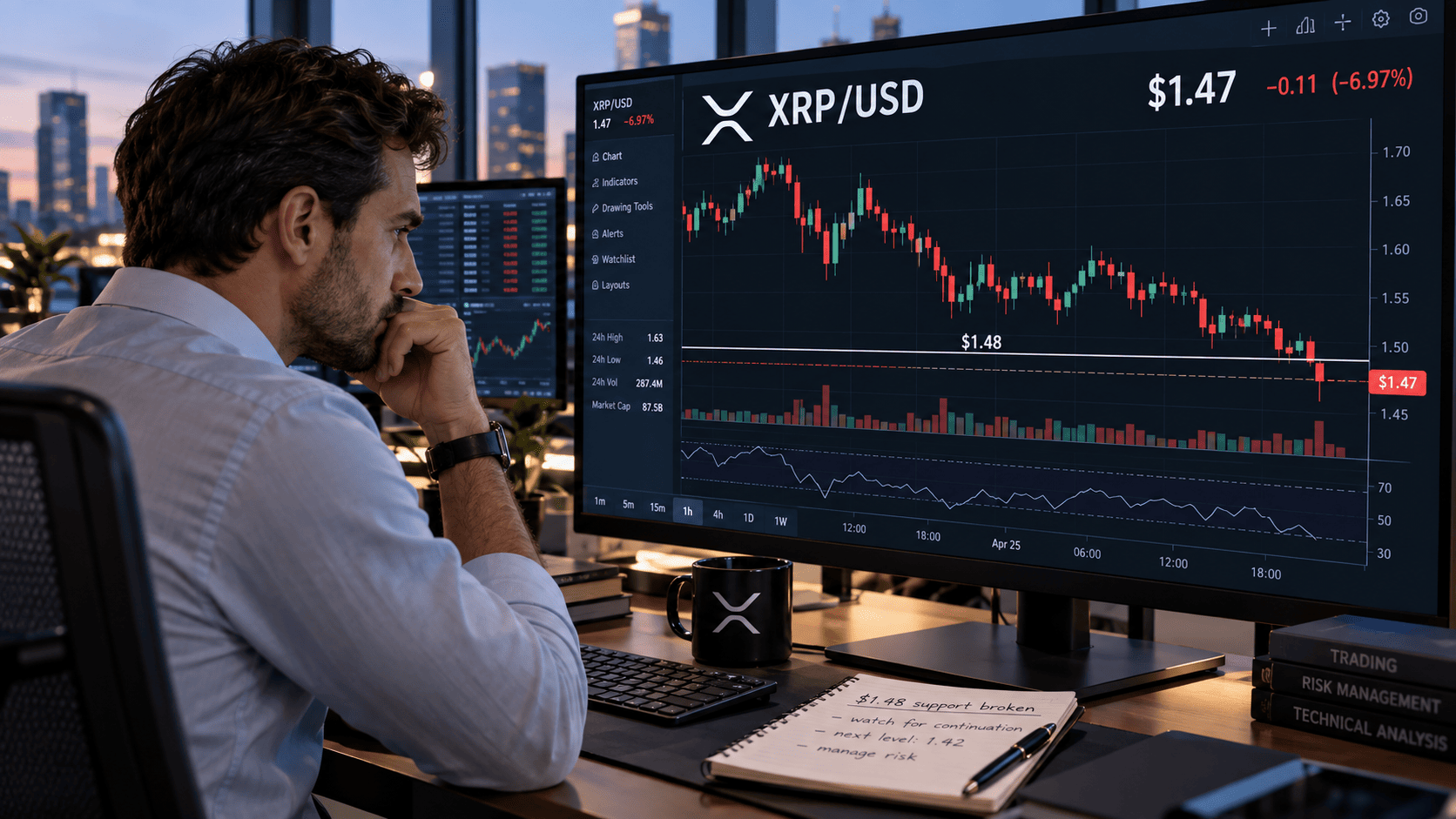
XRP is trading around $1.477 on Tuesday, recovering slightly after three consecutive losing sessions. Despite the recent pullback, derivatives data indicates that traders are still leaning bullish, a stance that may pose risks if the downtrend continues.
According to CoinGlass, the long-to-short ratio for XRP stands at 0.974, indicating a near balance between long and short positions, with shorts marginally ahead. This narrow margin suggests limited conviction among traders. However, funding rates tell a different story: the rate is positive at 0.0062%, meaning long perpetual futures holders are paying shorts. This typically signals demand for long exposure, but it also makes the market vulnerable if prices fall and leveraged longs are forced to close.

On-chain data from CryptoQuant flags overheating conditions in both spot and futures markets, with sell-side dominance in futures. These indicators suggest that trading activity may be stretched, and futures sellers retain influence. This helps explain why positive funding has not yet translated into a sustained recovery. Traders may be willing to hold bullish positions, but the market needs sufficient buying demand to absorb selling and push through nearby resistance.
Long-term holder (LTH) supply typically oscillates between net buying and selling. During the early stages of bull markets, LTH buying often peaks aggressively in intermediate ranges after a significant breakout, before the uptrend continues higher. Currently, LTH behavior does not show the same aggressive accumulation, adding to the mixed signals.
From a technical perspective, XRP remains above its 50-day and 200-day exponential moving averages (EMAs) near $1.365 and $1.369, respectively. The 100-day EMA sits near $1.307, providing additional support below. However, momentum has cooled: the relative strength index (RSI) is near 55, close to neutral, and the MACD has flattened around zero. These readings suggest a market consolidating after its earlier advance rather than one showing a strong immediate breakout.
The first significant support area lies around $1.37, where the 50-day and 200-day EMAs converge. A sustained move below that zone would bring the $1.300 area into view. If the bearish trend persists, the $1.0 psychological level provides a deeper demand zone, although XRP would need to fall substantially before it becomes the immediate focus.
On the upside, $1.574 is the first resistance level. Reclaiming it would strengthen the case for a move toward $1.90, while another rejection would leave XRP exposed to further consolidation or a test of its moving averages.
The combination of bullish positioning and falling prices is a classic setup for a potential squeeze if the market turns. However, the lack of clear directional bias and the presence of sell-side dominance in futures suggest that the path of least resistance may be lower unless buying pressure intensifies.
This article is for informational purposes only and does not constitute financial advice.

