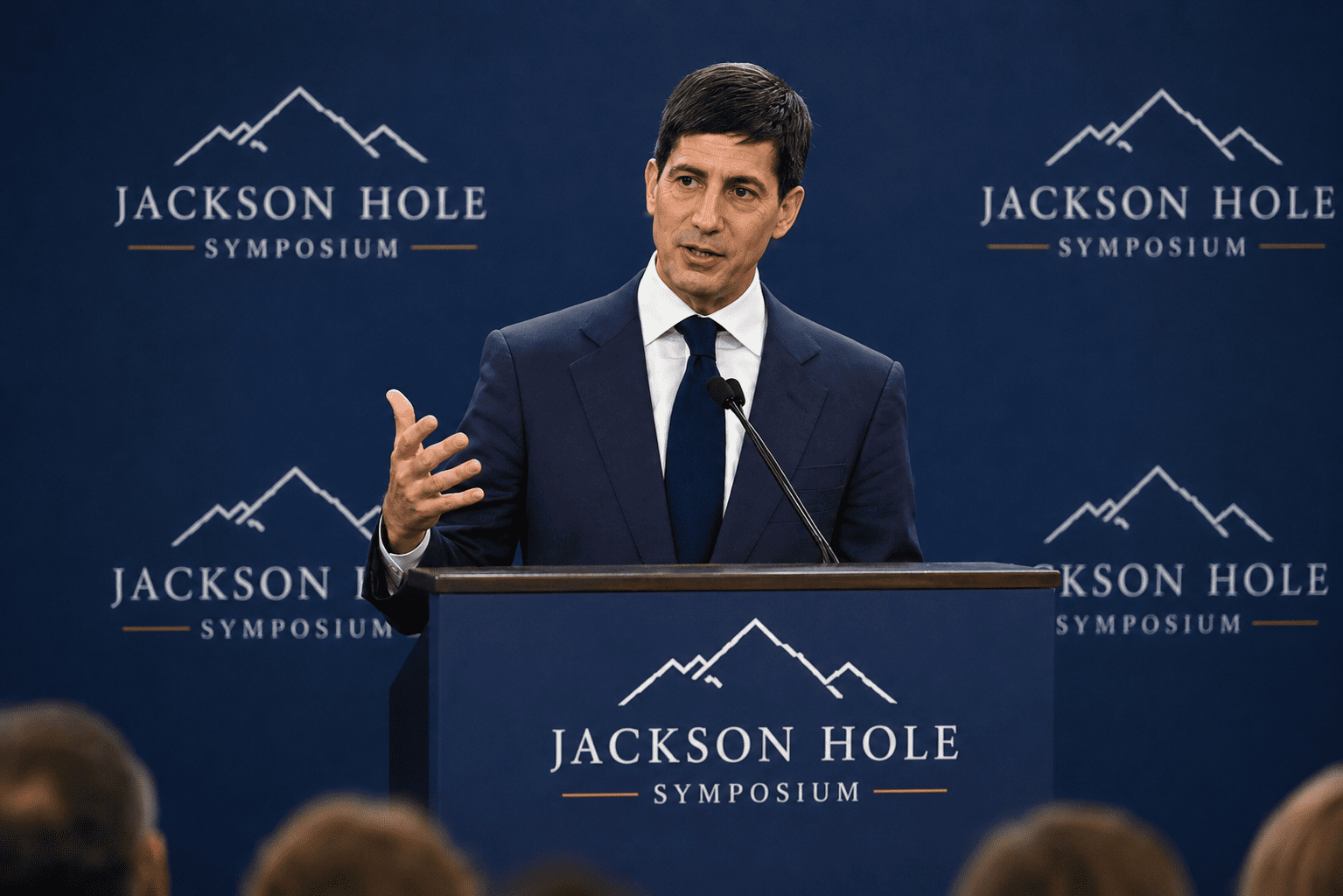
Federal Reserve Chair Kevin Warsh used his first major address to signal that the central bank may need to tighten policy further if inflation fails to show sustained progress toward its 2% target. Speaking at the Kansas City Fed's annual Jackson Hole symposium, Warsh emphasized that recent improvements in price data have not yet provided enough evidence of a durable slowdown.
"We must be confident that underlying inflation is moving toward our 2% objective at a sufficient pace," Warsh said. "Without that confidence, we have work to do." He stopped short of committing to a specific rate decision at the September meeting, instead stressing a data-dependent approach.
Financial conditions not broadly restrictive
Warsh noted that the current federal funds rate range of 3.5%-3.75% does not appear to be placing significant restraint on the broader economy. Credit and loan markets show limited evidence of policy tightening, he said, and while some sectors like housing and agriculture show weakness, he would be "hard pressed to describe broad financial conditions as restrictive."
This assessment could bolster the case for maintaining a restrictive stance or even raising rates if inflation remains sticky. The debate within the Fed has centered on whether elevated price pressures stem from temporary shocks—such as tariffs and geopolitical events—or from demand that continues to outpace supply.
Inflation remains well above target
The Personal Consumption Expenditures (PCE) price index, the Fed's preferred inflation gauge, is currently running at 3.7%, well above the 2% target. Warsh acknowledged that summer inflation readings were better than expected but said they have not demonstrated a meaningful improvement in underlying trends.
He highlighted the breadth of price increases: about half of the items in the Fed's preferred inflation basket are rising at an annual rate above 3%, compared with roughly one-third in the two decades before the pandemic. This broad-based pressure suggests inflation is not just a few volatile components.
Market expectations for a September rate hike have fluctuated. According to CME FedWatch data, 55.7% of participants expect a 25-basis-point hike, while 44.3% expect rates to remain unchanged. Earlier in August, expectations for a hike had fallen below 40% after softer June and July inflation prints.
Labor market takes back seat
Warsh indicated that inflation is currently more concerning for policymakers than the labor market, which he described as broadly robust. This suggests the Fed's dual mandate is currently weighted toward price stability.
The remarks provide the clearest indication yet of Warsh's monetary policy approach since taking over as Fed chair. While he avoided a firm commitment, his emphasis on persistent inflation leaves the door open for further tightening if price pressures do not ease sufficiently.
Investors will be watching upcoming data closely, including the next PCE report and employment figures, for clues on the Fed's next move. As July's PCE inflation ticked up to 3.7%, the path forward remains uncertain. Meanwhile, markets have been reacting to Warsh's speech, with equities showing mixed performance.
For investors, the key takeaway is that the Fed remains vigilant and data-dependent. Core PCE remains sticky at 3.3%, and wholesale prices signal persistent inflation. As gold dips below $4,600, the market is pricing in the possibility of more rate hikes.
This article is for informational purposes only and does not constitute financial advice.