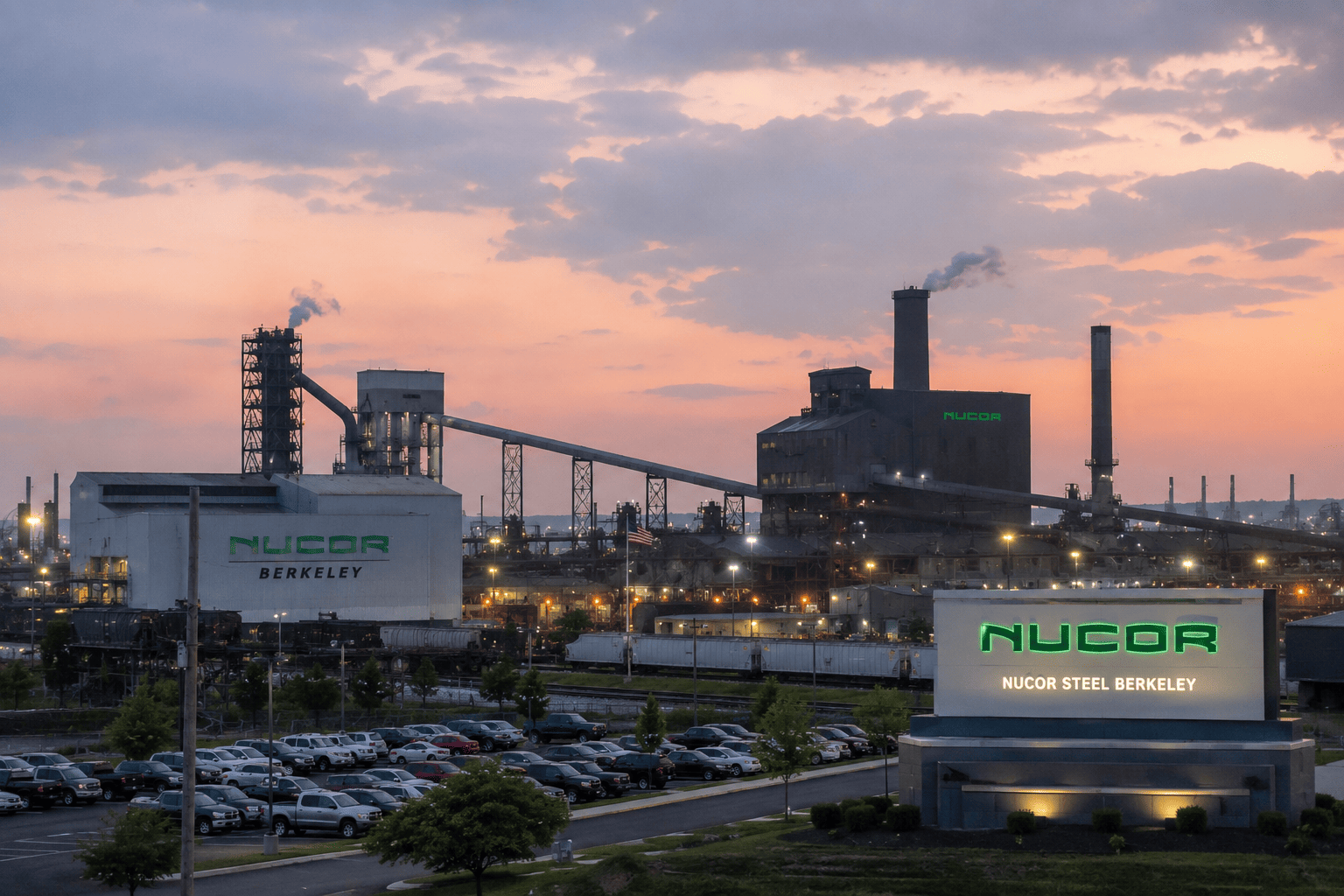
US steel producers saw their shares climb on Monday after the breakdown of US-Canada trade negotiations, which left the existing tariff regime intact and reinforced expectations that domestic steel prices will remain elevated. Nucor (NUE) gained about 4%, Steel Dynamics (STLD) rose roughly 4%, Cleveland-Cliffs advanced around 7%, and Century Aluminum added about 5%.
The rally reversed last week's selloff, which had been driven by hopes that Washington and Ottawa were close to a deal that could have reduced tariffs on Canadian steel and aluminum. A tentative agreement, reported by Bloomberg, had suggested tariffs on some Canadian exports could be lowered to 25%, raising fears of increased competition for US producers.

Those expectations were dashed on Friday when talks collapsed, and the US subsequently imposed 50% tariffs on certain Canadian products starting Saturday. Canada has announced retaliatory tariffs effective September 8. The breakdown means the current tariff structure remains in place, which investors view as a positive for domestic steelmakers.
Tariffs keep US steel prices well above global benchmarks
Tariffs have been a key factor in keeping US hot-rolled band (HRB) steel prices significantly higher than international levels. According to SteelBenchmarker, US HRB prices reached $1,208 per metric ton on June 24, the highest since April 2023, compared with $780 in Western Europe and $490 in the global export market. That leaves US prices 54% above European levels and 146% higher than the global benchmark.
While domestic supply-side factors have been the primary driver of US steel prices, tariffs have shielded producers from foreign competition, reinforcing their pricing power. The collapse of the trade talks removes the near-term threat of tariff relief, providing a tailwind for companies like Nucor and Steel Dynamics.
Nucor's strong fundamentals underpin investor confidence
Despite Monday's rebound, Nucor remains down about 6% over the past five sessions, but the stock is up roughly 50% year-to-date. The recent volatility contrasts with the company's strong second-quarter results, which sent shares up 7.2% in July. Revenue rose 23% year over year to $10.4 billion, while adjusted earnings per share reached $4.84. The Steel Mills segment was particularly robust, with pretax earnings surging 84.5% to $1.6 billion, driven by higher prices, strong volumes, and record shipments.
Analysts expect Nucor's fiscal 2026 earnings per share to jump 132.8% to $17.95. The company has beaten consensus estimates in three of the past four quarters, and Wall Street remains broadly positive, with 13 of 16 analysts rating it a Strong Buy and three rating it Hold.
Steel Dynamics benefits from data-center demand
Steel Dynamics has also delivered strong gains this year, up about 35%, though it is down 8% in the last five sessions. The company reported second-quarter adjusted EPS of $3.69, slightly below the $3.76 consensus, but revenue of $6.1 billion exceeded estimates and rose from the prior year. Net income climbed to $534 million from $299 million a year earlier.
Beyond tariffs, both Nucor and Steel Dynamics are benefiting from robust demand tied to data-center construction, as hyperscale tech companies invest heavily in AI infrastructure. This exposure, combined with reshoring and broader US manufacturing activity, has helped these companies outperform the wider steel sector.
Near-term outlook and risks
The collapse of the US-Canada trade talks provides a near-term catalyst for domestic steelmakers, as higher tariffs on Canadian imports remain in place. However, risks persist, including potential Canadian retaliation that could dampen steel demand or force price concessions. Investors will be watching for further developments in trade policy and any signs of softening in global demand.
For context on the broader market reaction, see our coverage of the trade talks collapse and Monday's broader market rebound.
This article is for informational purposes only and does not constitute financial advice.